


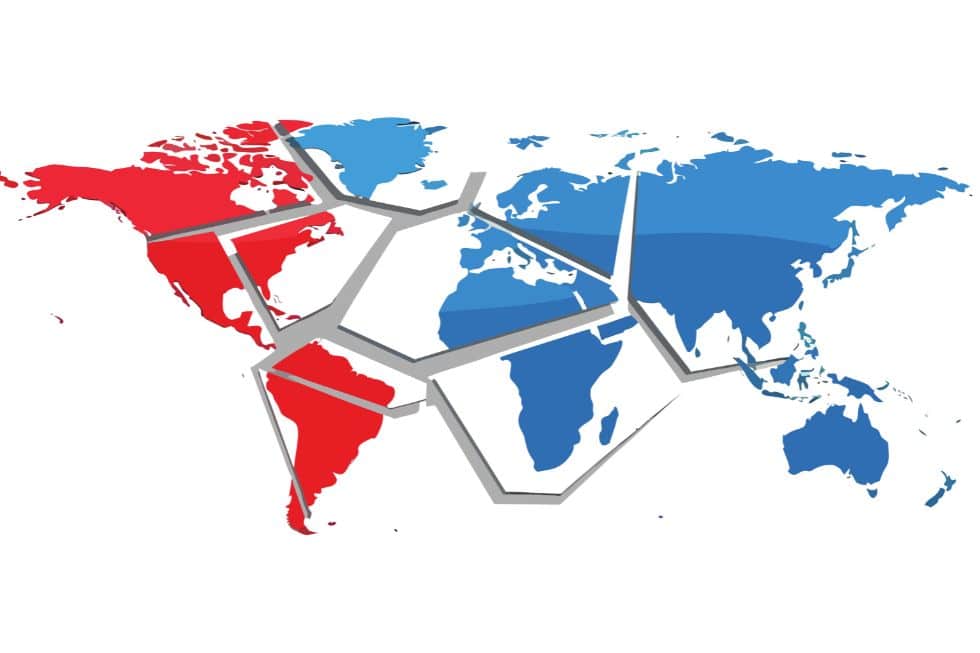



For more than three decades, debates about world order have revolved around two influential — and seemingly opposing — visions of the post-Cold War era. American political scientist, political economist and international relations scholar Francis Fukuyama famously argued that liberal democracy represented the “end of history,” the final stage of ideological evolution. American political scientist and academic Samuel Huntington responded with a darker prediction. He claimed the future would be defined not by ideological convergence, but by a “clash of civilizations.”
Today, the world is best described neither by Fukuyama’s liberal triumph nor by Huntington’s civilizational clashes. Instead, we see a new era emerging — one defined by fragmented interdependence, in which economic and technological ties deepen even as political and cultural divides intensify.
Fukuyama’s insight and Huntington’s correction
Fukuyama was right that liberalism retained global appeal after the Cold War, fueling economic dynamism, institutional capacity, and popular demand for prosperity and participation. Yet he underestimated the persistence of identity, religion, nationalism and history. Conflicts like Russia–Ukraine, intra-Islamic tensions in the Middle East, and US and EU polarization over Western identity exemplify fragmentation within major cultural spheres.
Huntington recognized this earlier, seeing that globalization and modernization failed to erase cultural differences. Societies could modernize economically while remaining politically and culturally distinct.
China modernized without adopting Western liberalism. Russia’s renewed nationalism, persistent political Islam, European nationalist movements and global identity politics all show that liberal democracy did not universally prevail. In this sense, Huntington captured something essential: Modernization does not necessarily mean Westernization.
Huntington’s thesis assumes that civilizations are coherent actors, but many destabilizing conflicts now occur within, rather than between, civilizations. Conflicts like Russia–Ukraine, intra-Islamic tensions in the Middle East, US and European polarization, India’s struggle over identity and China–Taiwan exemplify fragmentation within major cultural spheres.
Fragmentation within civilizations
The problem is not simply conflict between civilizations. It is fragmentation within civilizations. Fukuyama and Huntington both underestimated how globalization would create deep interdependence without political or cultural integration. The world is not unifying under liberalism or splitting into rigid civilizational blocs, but is entering a fragmented interdependence. This condition defines the emerging international system.
Global supply chains and technology connect societies as never before, but shared frameworks for interpreting reality and maintaining trust have eroded. Interdependence has deepened precisely as consensus has weakened.
The US and China are rivals, yet are still economically tied. Europe’s politics struggle amid globalization and nationalism. Digital connectivity intensifies informational fragmentation. Climate change exposes shared vulnerabilities amid national interests. This is not the world Fukuyama anticipated. Nor is it fully Huntington’s world, because civilizations themselves are politically fragmented, socially divided and geopolitically misaligned.
The epistemic crisis of the 21st century
The defining crisis of the 21st century may therefore be neither ideological nor purely civilizational. Instead, it is increasingly epistemic: a crisis rooted in the breakdown of shared ways of knowing, interpreting facts and agreeing on basic truths.
Societies are losing a shared understanding of politics, values and facts. Institutions mediating these divides — universities, media, global organizations, religious bodies — face falling trust and authority. Truth and consensus give way to subjectivity and echo chambers.
This epistemic weakness helps explain why contemporary conflicts increasingly appear permanent and unresolved. Wars no longer produce decisive political outcomes. Military superiority often fails to generate stable settlements. The wars in the Middle East exposed the limits of overwhelming force in the face of complex political realities. Russia’s invasion of Ukraine demonstrated how quickly assumptions about rapid victory can collapse into prolonged attritional conflict. Sudan’s ongoing collapse reveals the consequences of fragile states becoming trapped in cycles of violence without meaningful resolution.
States still rely on Cold War-era strategic assumptions, but modern conflict involves interdependence, asymmetric warfare, technology and shifting alliances. The result is a world increasingly characterized by chronic instability rather than decisive transformation.
The incomplete debate
The Fukuyama-Huntington debate is incomplete. Fukuyama saw liberalism’s appeal, Huntington saw enduring cultural difference — both missed the era’s complexity. Fukuyama and Huntington both misjudged how societies would become more connected yet more fragmented. The 21st century may be seen as “fragmented interdependence”: economic integration with rising political, cultural and epistemic fragmentation. This distinction matters because diagnoses shape strategy.
If policymakers believe the world is fundamentally divided into fixed civilizational blocs, they may embrace hardened spheres of influence and permanent geopolitical confrontation. If they continue to assume that liberal convergence is inevitable, they risk ignoring the depth of current fragmentation and institutional decay.
The more urgent challenge is not defeating rival civilizations or waiting for democratic convergence. It is rebuilding institutions and frameworks capable of managing interdependence in conditions of deep pluralism and declining consensus. The alternative is already increasingly visible: a world where crises spread globally through interconnected systems, but where political leaders and societies in general lack the shared understanding necessary to respond collectively. Neither Fukuyama nor Huntington foresaw this world, yet it has become our reality: deeply interconnected, but fragmented and lacking shared understanding.
[Kaitlyn Diana edited this piece.]
The views expressed in this article are the author’s own and do not necessarily reflect Fair Observer’s editorial policy.
Resilient Liberalism: Reimagining Freedom in an Age of Disruption
The liberal international order faces decline amid authoritarianism, ecological crisis and social fragmentation. Resilient liberalism advocates adaptable continuity, emphasizing individual...


Support Fair Observer
We rely on your support for our independence, diversity and quality.
For more than 10 years, Fair Observer has been free, fair and independent. No billionaire owns us, no advertisers control us. We are a reader-supported nonprofit. Unlike many other publications, we keep our content free for readers regardless of where they live or whether they can afford to pay. We have no paywalls and no ads.
In the post-truth era of fake news, echo chambers and filter bubbles, we publish a plurality of perspectives from around the world. Anyone can publish with us, but everyone goes through a rigorous editorial process. So, you get fact-checked, well-reasoned content instead of noise.
We publish 3,000+ voices from 90+ countries. We also conduct education and training programs
on subjects ranging from digital media and journalism to writing and critical thinking. This
doesn’t come cheap. Servers, editors, trainers and web developers cost
money.
Please consider supporting us on a regular basis as a recurring donor or a
sustaining member.
Will you support FO’s journalism?
We rely on your support for our independence, diversity and quality.





Comment