


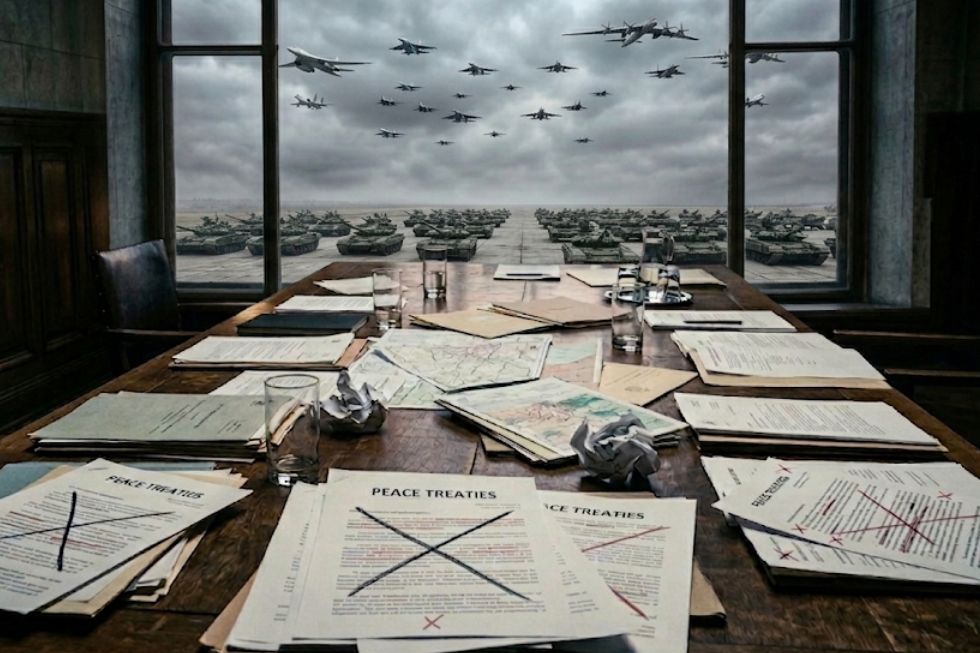



The last round of US-Russia-Ukraine talks in Geneva ended more than two months ago, with no date set for the next round. For Russia, this is not a problem — it is a strategy. Now that the attention of the US is consumed by the operation in Iran, trilateral negotiations to resolve the Ukrainian conflict have been put on pause, through no fault of its direct participants.
For Moscow, this pause is precisely what it wanted. With the world’s attention now fixed primarily on Iran, and oil prices allowing Russian leadership to recover revenues lost in recent years, Russia is counting on this moment as a window of opportunity to strengthen its negotiating position before negotiations resume. The spring thaw has ended, and Moscow sees another chance to improve its position on the battlefield — and thereafter to adjust its negotiating stance depending on success or failure.
The moment Russia has been waiting for
The warring parties were unable to reach an agreement at the last round of talks, as the focus was on merely trying to placate US President Donald Trump by demonstrating a sincere willingness to negotiate. Yet the energy with which the US presidential administration approached these talks left hope for an end to the hot phase of the war between Russia and Ukraine. It gradually narrowed the parties’ room for maneuver in the negotiations, drawing them closer to a final choice: either say “yes” to a deal, or upset Trump and incur his displeasure — something neither Russia nor Ukraine could afford.
Negotiations will have a greater chance of success when one or both sides of the conflict are critically exhausted — economically, militarily and psychologically. That is not currently the case.
The momentum of the negotiations has been lost. Russia now has the opportunity to conduct yet another large-scale summer campaign in 2026 in an attempt to bring the remaining territory of Donetsk Oblast under its control. There are no signs that Russian leadership intends to abandon its claims to full control over 100% of the Donbas, nor any indications that Russia will forgo a summer campaign — its fifth. Moscow will draw its conclusions in the autumn.
Negotiations may resume at some point during this campaign, but they would likely be without any substantive changes in the positions of Moscow and Kyiv since their last meetings mediated by representatives of the Trump administration.
A duplicated strategy
Russia’s negotiating tactics resemble North Vietnam’s approach during the Vietnam War, where talks lasted more than four years before the Paris Agreement was signed in 1973. At those negotiations, North Vietnamese representative Le Duc Tho repeatedly restated his country’s demands and refused to compromise. He sought to wear down the negotiators on the other side and compel them to make concessions while continuing military pressure on South Vietnam in parallel.
Moscow is now doing the same. It is firmly holding to its key demand that Ukraine cede the portion of the Donbas still under its control. Russian leadership is hoping either to achieve that result directly or exhaust the other side’s negotiators and resolve the matter on the battlefield.
Oil prices change the equation
Problems in the Russian economy are the most critical factor capable of influencing Moscow’s negotiating position. Economic sanctions, Ukraine’s strikes on Russian oil infrastructure and the decline in global oil prices in recent years have all weighed negatively on the health of Moscow’s economy and created the primary risk to financing its military industry and armed forces.
According to Russia’s Ministry of Finance, oil and gas revenues in 2025 declined by 23.8% compared to 2024. However, as the Middle East conflict drags on, Brent crude prices have recently stabilized above $95 per barrel. The price of Russian Urals crude oil on tankers at Indian ports reached $98.93 per barrel, while crude oil in Russian ports traded at just over $73 per barrel. On the day before the US-Israeli operation against Iran began, Urals was priced at around $40 per barrel. Russia has thus gained the opportunity to stabilize its economy for at least several months, and this is happening precisely on the eve of a new summer campaign.
NATO under pressure, Europe in a bind
The US exit strategy from the Iran conflict remains unclear, as do its timelines. A prolonged conflict will require ever more resources and attention from Washington. On March 17, Trump explicitly expressed his dissatisfaction with NATO countries’ failure to respond affirmatively to his request for assistance in unblocking shipping through the Strait of Hormuz. He also said the war was a “great test” of the alliance’s relations with the US. Trump, already a major critic of NATO, may now draw conclusions that negatively affect the cohesion and unity of the alliance.
This directly bears on the security and defense of Europe. European countries and the EU as a whole find themselves under unrelenting pressure from the East, as well as from a US administration displeased with European nations’ conduct within NATO. Europe could consider joining US efforts in limited Middle East operations, in exchange for asking Washington to help with the Ukrainian conflict. However, doing so would require Europe to take on a serious risk of being drawn into a prolonged war in the Middle East, which it cannot currently afford. Moreover, there is no guarantee that Trump would be satisfied with the limited participation of other NATO members and might continue his pressure on European allies.
Russia will attempt to exploit the contradictions within NATO, demonstrating to Europe that Moscow has no intention of backing down from its demands and that European states must yield to Russia’s terms. Russia has an interest in drawing the US and European countries into a long escalation in the Middle East, thereby diverting their attention and resources from support for Ukraine. Ukraine may find itself severely worn down as a result of another summer campaign, which could further deplete its human and material resources.
In a situation where the US administration is aggrieved at its NATO allies and has concentrated its attention on Iran, Russia may attempt to restore its relations with Europe. Moscow may offer Brussels and other European capitals a return to peaceful coexistence, but it will seek to do so from a position of strength and demand serious concessions in return. Russia has consistently denied Europe the right to participate in negotiations on Ukraine, but this is merely one more element of pressure on Brussels’ position. Russia wants to talk with Europe only about recognition of Moscow’s spheres of influence in Eastern Europe and the restoration of economic cooperation on terms dictated by Russian leadership.
Two scenarios for the rest of 2026
Now, with the US distracted by Iran, Europe facing pressure from Trump within NATO, global oil prices continuing to rise and the discount on Russian Urals oil narrowing, Moscow has the opportunity to conduct another offensive campaign and adjust its demands afterward. For Russia, this may be the last window of opportunity to improve its position in Ukraine, and Russian leadership will not fail to seize it.
Following the results of the 2026 summer military campaign, Russia’s negotiating position may shift from what it was in 2025. In the event of success on the battlefield and the military conquest of the remaining parts of Donetsk Oblast, or significant advances by Russian forces in other parts of Ukraine, Russia may harden its negotiating stance. It could also demand the transfer of all of Zaporizhzhia and Kherson oblasts, as well as the creation of a neutral zone along the entire border between Russia and Ukraine. This would, in essence, mean the withdrawal of Ukrainian armed forces from the border.
If, on the other hand, Russian forces have not significantly improved their battlefield positions by October–November in the course of the forthcoming offensive, and if the Middle East conflict is resolved and oil prices return to the $60–70 range per barrel, Russian leadership may be more receptive to seeking a compromise and a ceasefire along the current front line. A window of opportunity has now opened for Moscow, which it will attempt to exploit to improve its position in Ukraine through military means. However, when that window closes, Russia’s negotiating position will almost certainly have changed.
[Andrew Litz edited this piece]
The views expressed in this article are the author’s own and do not necessarily reflect Fair Observer’s editorial policy.
FO Live: Wars in Ukraine & Iran — Does Europe Look Weak in 2026?
In this episode of FO Live, Peter Isackson, Jean-Daniel Ruch and Peter Hoskins discuss Europe’s uncertain strategic position as the...
The Agenbite of Diplomacy: Are Negotiations Still a Thing?
Language sometimes betrays us. Politicians routinely betray language. Trump has perfected a trend he didn’t initiate: the discrediting of diplomacy...
FO Talks: The Iran War Exposes Europe’s Vulnerability and NATO’s Strategic Divide
In this episode of FO Talks, Rohan Khattar Singh and Sebastian Schäffer explore how the Iran war and the Strait...
Support Fair Observer
We rely on your support for our independence, diversity and quality.
For more than 10 years, Fair Observer has been free, fair and independent. No billionaire owns us, no advertisers control us. We are a reader-supported nonprofit. Unlike many other publications, we keep our content free for readers regardless of where they live or whether they can afford to pay. We have no paywalls and no ads.
In the post-truth era of fake news, echo chambers and filter bubbles, we publish a plurality of perspectives from around the world. Anyone can publish with us, but everyone goes through a rigorous editorial process. So, you get fact-checked, well-reasoned content instead of noise.
We publish 3,000+ voices from 90+ countries. We also conduct education and training programs
on subjects ranging from digital media and journalism to writing and critical thinking. This
doesn’t come cheap. Servers, editors, trainers and web developers cost
money.
Please consider supporting us on a regular basis as a recurring donor or a
sustaining member.
Will you support FO’s journalism?
We rely on your support for our independence, diversity and quality.





Comment