

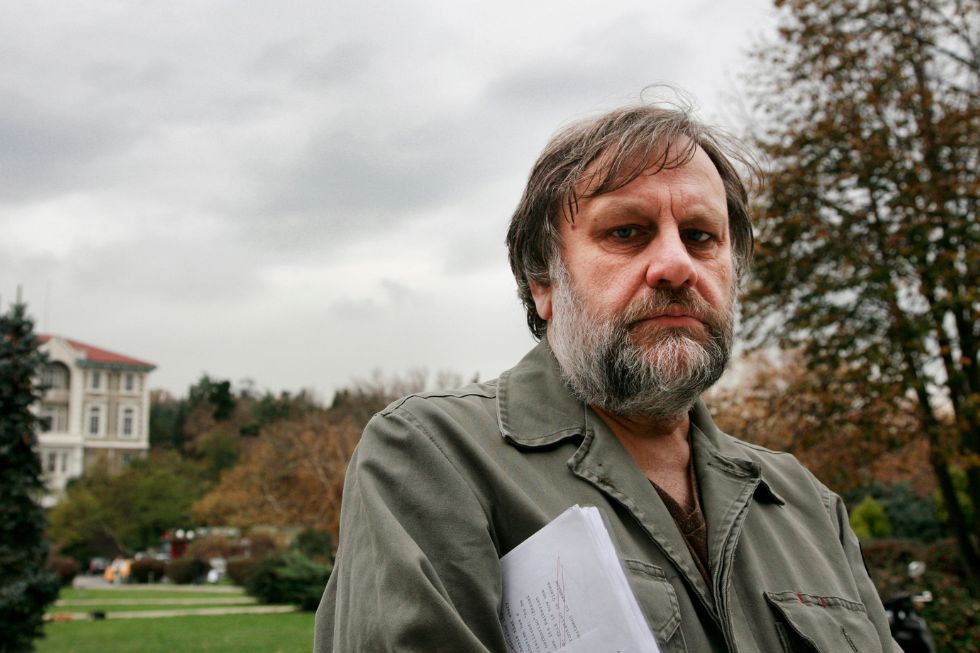



Slovenian neo-Marxist philosopher and cultural theorist Slavoj Žižek has spent 50 years telling us everything is broken. Has anyone considered that the diagnosis might be personal?
He hates parties. He hates small talk. He hates long dinners. He hates teaching. He hates students, whom he has described as mostly stupid and boring. He hates his own face, which he once asked a photographer not to capture because it looked, he said, like something that belonged in a film called Dumb and Dumber. He has told a student who came to him with a personal problem to, in his words, kill yourself. He said this and laughed. The student laughed too. The audience watching the interview laughed.
This is the strange gift of Žižek. He has made despair into a genre.
At 76, the Slovenian philosopher conducted a recent interview by video conference, at his own insistence, because he dislikes traveling and hates crowds. “I hate people,” he told his interviewer, half-laughing, half-grimacing. This was not a slip or a provocation. It was a statement of settled conviction.
What is remarkable is not that a man of Žižek’s temperament exists. Difficult men of difficult temperament are common enough in intellectual history. What is remarkable is what has been built upon: a philosophical system, a political program, a publishing empire and a global following, all resting on a single unexamined emotional fact. The world as experienced by Slavoj Žižek feels fundamentally, irremediably wrong.
The question nobody has seriously asked is whether that feeling is a philosophical position or a symptom.
A pessimistic worldview
Clinical depression has a characteristic cognitive style: a sense that surface pleasures conceal hidden rot, a compulsion to locate the negative within the apparently positive, a catastrophism that feels, from the inside, like clear-eyed realism. Articulate depressives are often experienced by others as unusually perceptive. They mistake their pathology for acuity. So do their admirers.
Run through that checklist against Žižek’s oeuvre. You get a near-perfect match.
He has admitted, on record, that seeing stupid people happy makes him depressed. He offered this not as confession but as cultural commentary, as though happiness in the wrong hands were itself a form of social dysfunction. Behind the joke is a man for whom other people’s contentment registers as an affront. That is a description of anhedonia: the inability to experience or sanction pleasure as legitimate.
His philosophy follows the same circuitry. The central move in almost everything Žižek writes is the puncturing of the apparent good. In The Pervert’s Guide to Ideology, his psychoanalytic tour through popular cinema, he asks what hidden Catholic teachings lurk in Robert Wise’s The Sound of Music (1965), what fascist dimensions underlie Steven Spielberg’s Jaws (1975) and what ideology James Cameron’s Titanic (1997) perpetuates. Every beloved cultural object, examined through his lens, reveals something rotten at its core. Every chocolate box contains a turd. He does not merely analyze ideology in film. He cannot stop doing it. That compulsion, the need to peel back every surface and confirm that darkness lies beneath, is the signature of a particular kind of mind. Not a dialectical one. A depressive one.
Cinema, he once declared, is the ultimate perverted art: It doesn’t give you what you desire, it tells you how to desire. This is a sophisticated observation, and also the observation of someone for whom desire is always, at some level, a trap.
A vicious spiral of dissatisfaction
Jacques Lacan, a French psychoanalyst and psychiatrist, shared similar views through the controversial ideas he propagated. But in his later work, Lacan described the sinthome: the idea that a person can build a workable, even pleasurable relationship with their own compulsions and private sources of satisfaction, what psychoanalysis calls jouissance. Žižek has no interest in this Lacan. He gravitates entirely toward the Lacan of the death drive, of desire as something that can never be satisfied. It is the depressive reading of Lacan. And Žižek has spent his career building a philosophical architecture to confirm what he already knew in his bones.
His political philosophy operates by the same mechanism, only the stakes are higher.
Žižek calls himself a communist. He has done so for decades, through the fall of the Soviet Union and the failures of actually existing socialism everywhere. When pressed on what, exactly, this communism would look like, the honest answer, which he has given in various forms, is that he does not know. He is more interested in the failure of every existing alternative than in constructing one of his own. When pushed for positive content, he retreats to Samuel Beckett’s famous quote from his prose work, Worstward Ho (1983): “Try again. Fail again. Fail better.”
This has been received, in certain quarters, as radical honesty. It is worth considering whether it is something else. The inability to picture a liveable future in concrete terms is a clinically recognizable feature of depression. The depressive knows, with certainty, what is wrong. The good, in any specific form, eludes him. Žižek’s communism is not a program. It is a permanent diagnosis without a prescription. And it has found a massive audience among people who feel the same way, people who have concluded that everything is broken and are not entirely sure they want it fixed.
Contempt as a philosophical method
Žižek’s contempt is promiscuous. He has attacked liberal democracy, capitalism, humanitarian intervention, identity politics, the progressive left, the academic left, the populist right, Greenpeace, mindfulness culture and American linguist and activist Noam Chomsky, his one-time ally, with whom he spent most of 2013 in a very public feud. He hates ecology’s tendency toward what he calls pseudosuperego personalization: guilt-tripping individuals over recycling instead of pushing for systemic change. The word hate appears in his interviews in the way other people use, think or feel. It is his primary register.
This, too, is a clinical feature. The depressed are not indifferent to the world. He is exquisitely sensitive to it, and that sensitivity tends to organize itself around irritability and contempt rather than sorrow. The sadness is there, beneath the surface, but it expresses itself as disdain. Žižek has turned this into a philosophical posture. It reads as rigorous. It is, on closer inspection, pain dressed up in Hegel.
Intimacy, fantasy and failure
His personal life, to the extent he has disclosed it, follows the pattern. He has been married three times. He has described himself as constitutionally unsuited to real intimacy, someone who prefers the fantasy of the other to the actual person. In The Plague of Fantasies, he writes about the fundamental disappointment that structures love: that the beloved is never, in reality, what desire is projected onto them. This is a philosophical observation with a long history. It is also what a man tells himself when closeness keeps going wrong.
He has a standard line for students who bring him their personal problems. He asks them to look at him, observe his tics and mannerisms, and ask themselves why they would seek advice from a madman. He deploys this with considerable charm. But beneath the performance is something worth taking seriously. He is telling his students, his readers and anyone who will listen that he is not well. Nobody quite believes him, because he says it with such evident enjoyment.
The universalization of personal despair
That is the paradox at the center of the Žižek phenomenon. He has turned his dysfunction into entertainment, into theory, into a brand. The compulsive verbal overflow, the physical tics, the shirt-tugging, the way one sentence multiplies into five, these are not stylistic affectations.
They are the behavior of someone managing considerable internal disorder through the only mechanism that has ever reliably worked: thinking out loud, in public, without stopping. He fears being unable to work, he has said, more than death itself. That is not a philosopher’s observation. That is a depressive’s confession. The work is not an expression. The work is containment.
None of this would matter if it stayed personal. But Žižek has done something significant. He has universalized his pathology. He has taken the structure of his inner life and built a philosophical system that presents it as the correct way to see. The depressive’s certainty that happiness is false, that beneath every good thing lies a horror, that the future cannot be pictured, that other people are mostly exhausting, that the only honest response to the world is permanent vigilance against it. All of this repackaged as insight.
And his readers have agreed. In their hundreds of thousands.
The culture that rewards bleakness
There is something to be learned here, not about Žižek but about the milieu that produced and sustains him. Left intellectual culture, at least since the 1980s, has developed a pronounced bias toward the bleak. Optimism is naïve. Hope requires justification. Anyone who believes things might improve has not, we are implicitly told, read enough Lacan. Žižek did not create this culture, but he is its most entertaining product and its most effective salesman. He has given people permission to mistake their despair for sophistication.
The cruelest irony is this. Žižek has devoted his career to the critique of ideology, to showing how apparently neutral positions mask unconscious investments, how what we take to be objective analysis is always shaped by forces we have not examined. He is brilliant at this. He applies it to cinema, to politics, to popular culture, to love, to Coca-Cola.
He has never applied it to himself.
A man who finds happiness in others depressing, who cannot picture what the good would look like, who has structured an entire worldview around the inexhaustibility of what is wrong: His ideology is not communism. It is his nervous system. The revolution he is calling for is not political. It is the one he cannot quite bring himself to have.
[Zahra Zaman edited this piece.]
The views expressed in this article are the author’s own and do not necessarily reflect Fair Observer’s editorial policy.









Join the conversation
Share your perspective
Log in to share your thoughts and take part in the discussion.