


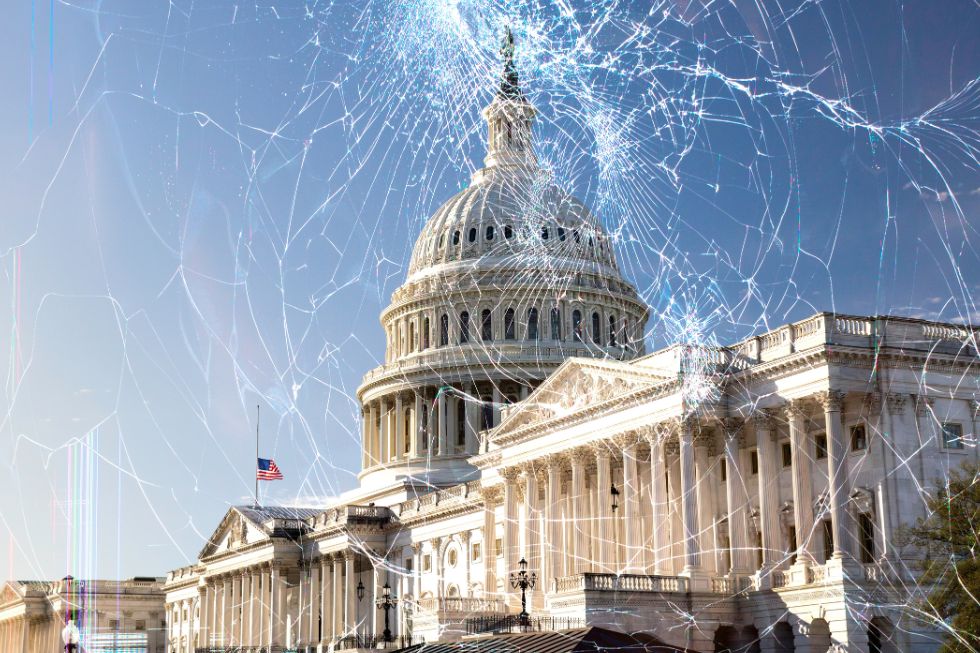



In an age of democratic decline and disinformation, the US cannot hope to persuade others that it still adheres to the values it once promoted while the Trump administration dismantles the very institutions that once claimed to embody them. As democracy weakens, imperial ambitions gain momentum and disinformation spreads, foreign audiences now view the US as a central locus of the problem, a view that is underscored by the country’s aggressive posturing. This view is furthered by the flood of memes designed for shock and algorithmic attention, which now creates the most salient and memorable images of the US in the minds of foreign audiences.
The erosion of public diplomacy and democratic values
Public diplomacy, once a cornerstone of America’s international engagement, has been gutted. In July 2025, the State Department sent layoff notices to more than 1,300 employees, including 246 Foreign Service officers, as part of a department “reorganization” far beyond routine turnover. Politicized hirings and firings and the erasure of institutional memory have left the system hollow. Even with new leadership, rebuilding functional government will take years.
The deprofessionalization and politicization of the government “influencer” machine have also reduced the trust allies once placed in US agencies and officials. Officials now produce partisan content that ridicules opponents and undermines allies. Memes reinforcing US President Donald Trump’s personal power accompanied the US capture of Venezuela’s leader, Nicolás Maduro. Another video, reported by Wired in August 2025, showed footage of handcuffed migrants being loaded onto a deportation plane to the tune of Frank Sinatra’s “Come Fly With Me.” Humor can be effective propaganda, but this was a performance of cruelty for clicks. Abroad, such images circulate beside scenes of mass protests and police violence, making the US appear erratic, authoritarian and unstable.
Washington’s hostility toward its democratic partners is in full view. Memes have promoted US imperial ambitions to annex the Danish sovereign territory of Greenland and have been circulated on official and affiliated channels, framing the territory as in need of American “protection.” As a NATO ally, Denmark has taken the potential use of force seriously, and its foreign minister dismissed a White House aide’s suggestion to pay $10,000 to $100,000 per Danish citizen for the territory.
On March 25, 2025, The New York Times revealed leaked messages from senior officials calling Europe “pathetic.” At the Munich Security Conference the following month, US Vice President JD Vance dismissed European defense efforts as “freeloading on American power” and told delegates they were “too anxious about foreign influence.” Such contempt has consequences.
The US fell from first place in the 2009 Anholt Nation Brands Index to 14th place this year — its lowest standing since the index began. Before the election, Simon Anholt suggested that a new president could “fix America’s brand.” Instead, recent actions and rhetoric have further damaged it. In the UK — one of America’s most reliable partners — trust in the US fell by 25 points between November 2024 and September 2025, according to YouGov polling for Best for Britain.
This distrust is mirrored at the highest levels: On November 11, 2025, CNN reported that the UK suspended intelligence-sharing with Washington over strikes in the Caribbean that British officials said might have broken international law. By April 2025, the remnants of the State Department’s Global Engagement Center (GEC) operations — which once exposed foreign propaganda campaigns — were shutting down after years of political attacks from pro-Trump figures and media. As Wired characterized it, the GEC “became a MAGA [Make America Great Again] boogeyman.”
The limits of soft power in a digital age
Generations of Europeans have long been consumers of American culture, as the US profited from its “soft power.” My parliamentary evidence in the UK’s Disinformation Diplomacy Inquiry (written evidence submitted March 2025) explains that while traditional soft-power tools such as aid and public diplomacy are being cut, dominance endures through technology and cultural exports. But what was once a mutual cultural exchange is now also exploited to seed a far-right shift and rally anti-government protests — such as the September 15, 2025, London rally where businessman and entrepreneur Elon Musk addressed crowds mobilized by activist Tommy Robinson via video link, warning that “violence is coming”. The event ended in clashes after Musk’s platform amplified it to millions.
In 2024, The Guardian reported that Musk had suggested he could provide up to $100 million in funding to Reform UK. With US elites seeking to influence British politics in this way, it is unsurprising that allies have grown wary.
As American professor and scholar Nancy Snow warned in her classic 1998 book Propaganda Inc., “big business and big money rule the American system of democracy.” Today, they don’t just rule it — they have trampled it. Foreign policy is guided by raw power, and the fusion of political power, corporate money and media control has deepened to levels unseen in modern US history. A small circle of right-wing media barons and tech oligarchs now dominates the country’s information space, erasing the boundary between state messaging and commercial propaganda.
This pattern reflects what I describe, with coeditor Vian Bakir, in our 2024 book, the Routledge Handbook of the Influence Industry, as the global maturation of a digital “influence industry,” in which state and commercial actors coordinate to shape ideas and emotions across borders. This monopolization is reinforced by direct pressure on the press, such as new Pentagon rules restricting journalist access, introduced in September 2025.
Rebuilding trust: the role of civil society
Public diplomacy outlets like Voice of America, under the Trump administration, struggle to continue, amid calls for support from staff and press-freedom groups to keep the service alive. But as Voice of America staff resist its transformation into a propaganda tool, the most impactful public diplomacy will for now have to come from outside government. It is journalists, educators, artists and civic networks — and the public — who must carry America’s democratic voice and values forward: telling real stories, connecting across borders and showing the world what they really stand for.
Even if a more democratic administration returns, the damage will persist. The habits and bureaucratic apparatus of authoritarianism do not vanish with an election. Rebuilding credibility abroad will require accountability and reform through sustained investment in education, civil society and independent journalism. The US cannot simply communicate its way out of this crisis. It must demonstrate change through urgent action, not words. Future public diplomacy efforts to support democracy abroad will be possible only if the US can create it at home — not as a brand or an aspiration, but through concrete reforms that rebuild trust with allies.
[The USC Center on Public Diplomacy first published this piece.]
[Kaitlyn Diana edited this piece.]
The views expressed in this article are the author’s own and do not necessarily reflect Fair Observer’s editorial policy.
The Fall of Democracy Is a Markov Process
Greek philosophers built theories of political change to explain the rise and fall of their city-states. A modern analysis uses...
How to Write Disinformation, I Mean, the Truth
Western editors and analysts are facing increasing pressure to tone down their language in discussions of Russian influence and democratic...

Truth, Lies and Tweets: The Truth About Digital Diplomacy
Digital diplomacy, powered by social media and real-time tools, has revolutionized international relations by fostering openness, public participation and direct...
Support Fair Observer
We rely on your support for our independence, diversity and quality.
For more than 10 years, Fair Observer has been free, fair and independent. No billionaire owns us, no advertisers control us. We are a reader-supported nonprofit. Unlike many other publications, we keep our content free for readers regardless of where they live or whether they can afford to pay. We have no paywalls and no ads.
In the post-truth era of fake news, echo chambers and filter bubbles, we publish a plurality of perspectives from around the world. Anyone can publish with us, but everyone goes through a rigorous editorial process. So, you get fact-checked, well-reasoned content instead of noise.
We publish 3,000+ voices from 90+ countries. We also conduct education and training programs
on subjects ranging from digital media and journalism to writing and critical thinking. This
doesn’t come cheap. Servers, editors, trainers and web developers cost
money.
Please consider supporting us on a regular basis as a recurring donor or a
sustaining member.
Will you support FO’s journalism?
We rely on your support for our independence, diversity and quality.





Comment