


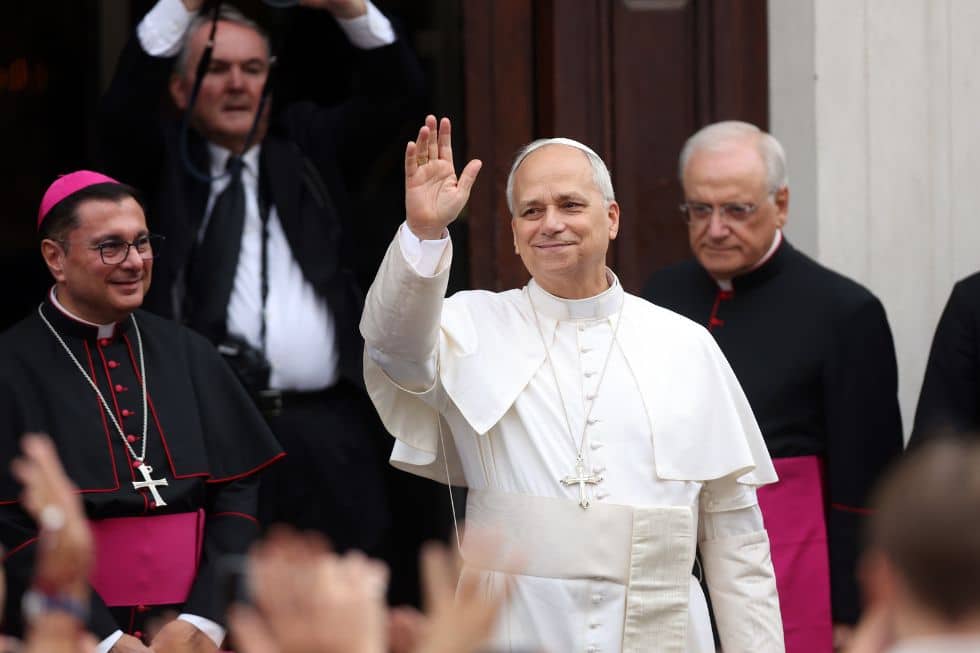



Just over a year ago, on May 2, 2025, Pope Francis breathed his last at the age of 88. His death marked the end of a 12-year papacy defined by concern for the poor, a refusal to treat doctrine as ideology and a deliberate effort to reorient the Church toward a Gospel of peace and mercy. Francis was often misunderstood — treated by his critics as a left-wing agitator, and by some of his admirers as a kind of progressive mascot. In reality, he was neither. In the eyes of the world, however, his legacy had ensured that a neutral succession would be all but impossible.
The Catholic Church is an absolute monarchy, but an elective one. Not even the pope can name his own successor. So, on May 6, the 129 cardinals under the voting age of 80 gathered in Rome. They cast their votes by secret ballot in the Sistine Chapel, underneath the stern gaze of Michelangelo’s Universal Judgment. After just two days and four ballots, the cardinals elected Robert Francis Prevost. On that day, a year ago today, he took the name of Leo XIV.
Born in Chicago and ordained as an Augustinian priest, Prevost earned advanced degrees in canon law in Rome before returning to the United States. In 1988, he was sent to Peru, where he remained for most of the next two decades. He worked as a missionary and pastor before being appointed bishop of Chiclayo in 2015. In 2023, Francis named him prefect of the Dicastery for Bishops — one of the most consequential positions in the Vatican bureaucracy. There, he served as a close collaborator of Francis and played a central role in shaping the global episcopate, especially in Latin America.
The purpose of this piece is simple: to see whether Leo has begun doing what he signaled he would do on the night of his election. A year later, the answer appears to be yes. The circumstances of his rise still reveal something important about the Church that chose him. His first year has confirmed that the cardinals were looking for continuity with Francis rather than a sharp change of direction. His background in Peru helps explain why Latin America remains central to the Church’s present and future. And the name he chose — Leo — points to the deeper intellectual tradition he may yet bring to bear on the work Francis set in motion.
The surprise of Leo
Prevost is the first native English speaker to be elected pope in 870 years — the last being Nicholas Breakspear, an Englishman who became Adrian IV in 1154. To say that his accession came as nothing less than a shock would still be an understatement.
For us Americans, the moment registered as surreal. For nearly the entire existence of the United States as a civilization, the papacy has been an Italian (or at least European) and distant institution. The election of Francis, an Italo-Argentinean, was the first chink in that armor. But no one expected the next pope to be “some guy” from Chicago. He speaks Italian with an American accent. In the days that followed the election, everyone’s mother, aunt or neighbor seemed to have a photo with him from some parish event to share. He was one of us.
Immediately, the memes started pouring out about whether the newly minted pontiff was a Chicago Cubs or a White Sox fan. That was funny enough. What really blew our minds, however, was that he had an answer. Cries of jubilation rang out in Chicago’s South Side, and indeed, the beaming mug of “Father Bob” now adorns Rate Field.
Yet when he strode out onto the balcony of St. Peter’s Basilica, the man we saw — perfectly human and visibly moved — was not Robert but Leo, the Vicar of Christ and pastor of the whole world, complete with the distinctive red mozzetta that his predecessor had notably foregone.
At a time like that, one naturally wondered what the coming of a new pope could mean for the Church and the world. After a pontificate as unconventional as Francis’s, many justifiably assumed the next papacy would be unpredictable. Yet from the beginning, Leo had already signaled the direction he intended to take.
Continuity with Francis, not rupture
Pope Francis, for all his virtues, was sometimes confusing. In many ways, this was deliberate. He didn’t always answer questions. He shook things up rather than settling them down, often preferring to create space for action rather than to solidify definitions.
So when he died, many — perhaps most — expected the next pope to change directions in one way or another. Some hoped for a traditionalist rollback, a correction or even rebuke of Francis that would recall the perceived conservatism of Benedict XVI, or earlier popes, depending on the commentator’s theological preference. Others wanted bold doctrinal change, a progressive pope who would make official what they believed Francis had suggested. Either way, they assumed the moment called for resolution.
Leo has been and will be neither of these things. Scant hours after the election, a good section of the dissident traditionalist crowd was already upset with the cardinals’ choice. Meanwhile, PinkNews took just minutes to decry the new pontiff for his opposition to the “homosexual lifestyle.” (I’m not sure what they had expected.)
As a cardinal, Leo was, by all accounts, a close ally of Francis. That doesn’t mean he will be a carbon copy of his predecessor, but it does mean his papacy will begin from the world Francis helped shape, not the one he left behind.
Nowhere is that continuity clearer than in his concern for the poor. For Francis, this wasn’t a policy preference — it was theological bedrock. And for Leo, too, it has long been at the heart of his pastoral life.
Nowhere has Pope Leo made this more clear than in his October 2025 apostolic exhortation, Dilexi te (“I have loved you”):
Love for the Lord, then, is one with love for the poor. The same Jesus who tells us, “The poor you will always have with you” (Mt 26:11), also promises the disciples: “I am with you always” (Mt 28:20). We likewise think of his saying: “Just as you did it to one of the least of these brothers and sisters of mine, you did it to me” (Mt 25:40). This is not a matter of mere human kindness but a revelation: contact with those who are lowly and powerless is a fundamental way of encountering the Lord of history. In the poor, he continues to speak to us. [Boldface added.]
Concern for the poor was the backbone of Francis’s papacy, and the same is now true of Leo’s. As a young Augustinian priest, he spent years living among the poor, offering pastoral care in a country fractured by violence, inequality and corruption. Long before he had a title, Prevost was the kind of bishop Francis later praised: close to the people, grounded in daily life, unwilling to treat poverty as a social issue separate from the Gospel. When Francis made him bishop of Chiclayo, Prevost brought the same pastoral instincts with him.
That same instinct followed him to Rome, where, as prefect of the Dicastery for Bishops, he prioritized episcopal candidates who shared Francis’s pastoral sensibilities. His rise was quiet, but not accidental. He was chosen precisely because he embodied the vision that Francis had tried to implant.
In his inaugural address as pope, Leo reiterated this vision, stating, “We want to be a synodal Church, a Church that walks, a Church that always seeks peace, that always seeks charity, that always seeks to be close especially to those who suffer.”
That kind of continuity shouldn’t be surprising, but to some it still is. And it speaks to a larger misunderstanding. In short: It’s always a little distorting to speak of left and right in the College of Cardinals. These are not parties, and this is not a parliament. Every man in that room is appointed by a pope, not elected by a base.
Still, there’s a kernel of truth in the shorthand. Most commentators describe Leo as a centrist. This is true to the extent, not that he splits the difference between factions, but that he holds together things that are often pulled apart.
Like his predecessor, Leo will combine fidelity to the truth with compassion — and that means compassion both for those who struggle to live up to the Gospel and for those who suffer in a world that runs hard against it.
The Church’s focus on Latin America continues
With Francis and Leo, we have had two bishops with extensive service records in South America elected pope back-to-back. That’s no accident.
For centuries, Latin America has been the stronghold of global Catholicism. After the Reformation divided Europe and the Enlightenment displaced religion from public life, it was Latin America that sustained the Church’s demographic and cultural vitality. Today, nearly 40% of the world’s Catholics live between the Rio Grande and Tierra del Fuego. This region is not the Church’s frontier, but its center.
Yet the Church is acutely aware that it is losing support across Latin America. In the region’s most populous nation, Brazil, the Catholic population has fallen from over 90% to just above 50% in the space of a few decades. Across the continent, evangelical churches continue to expand — fast, well-funded and pop-culture savvy. Their growth is not marginal; it is structural. In many places, bishops and parishes no longer shape religious life. The energy has moved elsewhere.
This didn’t happen on its own, to be sure. The rise of evangelicalism in Latin America is the result of decades of American religious influence — deliberate, organized and long in the making. Since the mid-twentieth century, missionaries, media networks and theological schools have advanced a model of Christianity imported from the north. This alternative philosophy has since bypassed local clergy, displaced longstanding forms of Catholic life and redefined religious authority in ways that were foreign to the region’s spiritual and cultural memory.
Leo understands this. He is American, but his vocation was forged in Peru. He spent decades working not to supplant the native Church, but to strengthen it. He trained local clergy, supported diocesan leadership and reinforced institutions under pressure. He saw what it looked like when religion was treated as an export, and so he knows what has been eroded, and how it can still be rebuilt.
Evangelicalism in Latin America offered something the Church had ceased to provide: immediacy. Not just theological clarity, but emotional urgency, personal attention, spiritual spectacle. Catholicism, by contrast, had grown distant, perhaps more visible in chancelleries than in neighborhoods.
We often view the Latin American Church as a passive victim of outside forces. That image is both inaccurate and infantilizing. As in Europe during the Reformation, the Church was caught off guard not by superior theology, but by its own institutional inertia. For too long, it assumed people would remain Catholic out of habit. Yet the Church is not helpless; it is made up of living, thinking people, and it possesses the resources to recognize and respond to its present circumstances.
The charismatic renewal has restored a great deal of expressive prayer and spiritual intensity to Catholic life, deepening participation in the sacraments. Eucharistic devotion is returning with real force, reclaiming a sense of presence that is both personal and public. What Pentecostalism tries to manufacture in a moment, the Church can offer measure upon measure in a deeper, enduring sacramental experience. The affective life Latin Americans, and people everywhere, have sought doesn’t require leaving Catholicism; it invites rediscovering it.
The Church is learning to move again through a return to what is most fully its own. Charismatic renewal and Eucharistic devotion are signs of a living faith reasserting itself from the ground up, led by laypeople, sustained in parishes and rooted in tradition.
Now, the Vatican is paying attention. Under Leo XIV, the focus is both pastoral and structural. He understands that renewal in Latin America depends on the attention and support of the Church’s central organs. He bridges the distance between Rome and the continent that now defines the Church’s present and its future. And he does so by drawing upon the deep resources of the past.
The fourteenth Leo is in good company
The most recent previous Leo was Leo XIII (1878–1903), in many ways the first modern pope, someone who set the tone for all popes after him. By picking “Leo,” Leo XIV avoided overt signaling of partisanship for Francis (like choosing “Francis II” or, as Francis himself had once joked, “John XXIV”). He also avoided signaling an oppositional course correction, the kind of gesture “Pius XIII,” “Benedict XVII” or “John Paul III” might have implied.
The choice was a masterstroke. It suggested continuity without factionalism. It hearkened back to a pope who was modern and yet far enough from the present day that no party can “claim” him — the founder of both the neo-Scholastic revival and of modern Catholic social teaching. And more than that, it pointed toward the intellectual tradition of the Church.
Francis, like St. Francis, led with pastoral instincts rather than academic ones, and he often de-emphasized rigorous formulations. Leo, on the other hand, is an intellectual. His formation was in canon law — a discipline that demands not only legal precision but deep theological grounding. Church law is not a closed system; it is an expression of doctrine, rooted in sacrament and ecclesiology, shaped by the conviction that the Church is not merely a community but a structure with form and order, authority and continuity.
Perhaps Leo will play for Francis the role that St. Bonaventure played for St. Francis. As master general of the Franciscan order, Bonaventure grounded spiritual insight in intellectual rigor, while gently reining in the more “enthusiastic” of his followers who sought a kind of change not in accordance with the organic and episcopal structure of the Church. Bonaventure did not stifle the Franciscan movement; he preserved it. That act of protection may be Leo’s task now.
That would place Leo XIV squarely in the tradition of the Church’s intellectual popes — those who understood that reform without form collapses, and that the life of the Church depends as much on clarity of thought as on purity of intention. The name “Leo” evokes that lineage.
St. Leo I (440–461), the first to bear the name, gave the Church its clearest articulation of Christ’s nature at the Council of Chalcedon — one person, two natures, undivided and unconfused. That definition has remained the cornerstone of Catholic Christology ever since. It was not merely a theological solution; it was an act of preservation — of unity, of clarity, of continuity. In choosing Leo, the new pope aligns himself with that kind of intellectual responsibility: the work of stating clearly what the Church is, especially when the world around it is shifting.
Leo X (1513–1521) is perhaps best known for excommunicating Martin Luther — an act often framed as censorship, but in reality is a recognition that moral reform without doctrinal coherence fractures the Church. That Leo’s intervention came at a time of real ecclesial failure makes the point sharper: doctrine cannot be improvised in crisis. The Church’s capacity to respond — even to legitimate critique — depends on the stability of what it already knows. Intellectual coherence was not the enemy of reform, but its precondition.
Leo XIII (1878–1903) brought the Church into modernity not by conceding to it, but by confronting it on its own terms. He revived Thomism, articulated the first modern Catholic response to industrial capitalism with the encyclical Rerum Novarum, and reshaped the Church’s intellectual infrastructure. These were not tactical maneuvers. They were intellectual foundations laid with purpose and depth. He also restored the Pontifical Lateran University as a center of serious formation — the same institution where Robert Prevost earned his doctorate in canon law. Leo XIII was not just a writer of encyclicals; he was a teacher of popes. Pius X, Benedict XV, and Pius XI were all formed under his shadow. His legacy is not just in what he taught, but in the kind of minds he left behind.
The Leos of history have emerged in times of pressure — defending doctrine with intelligence and restoring the Church’s self-understanding when it risked forgetting itself. Leo I brought Christological clarity to a fractured Church. Leo X showed that lasting reform must be grounded in theology. Leo XIII engaged modernity with a depth and discipline beyond the expectations of his age. By choosing the name “Leo”, Leo XIV places himself in that lineage — a tradition of definition and renewal through understanding.
The first year of Leo’s papacy has shown that he is neither reversing nor simply repeating Francis’s work, but is giving it shape. What Francis began in gesture, Leo is now rendering in grammar. The poor, the critique of an inhuman capitalism, the concern for the Latin world, the maintenance of doctrinal tradition — none of this is a rupture or a compromise, but an inheritance. Leo is the first American pope, but his task is Catholic in the deepest sense: to hold together what history has tried to pull apart.
[Nick St. Sauveur edited this piece.]
The views expressed in this article are the author’s own and do not necessarily reflect Fair Observer’s editorial policy.
Does the US Really Want to Annex the Vatican?
How long the College of Cardinals will convene before announcing the identity of the new pope no one can predict....
Benedict XVI’s Death Ends Rare Era: Pope Francis Now In-Charge
Pope Francis and Pope Emeritus Benedict XVI shared the stage for one final time. The Argentine pope bowed his head...
The Education of Priests and the Future of the Catholic Church in Ireland
I was asked to speak at a seminar in St Patrick’s Pontifical University in Maynooth County Kildare. The seminar considered...
Support Fair Observer
We rely on your support for our independence, diversity and quality.
For more than 10 years, Fair Observer has been free, fair and independent. No billionaire owns us, no advertisers control us. We are a reader-supported nonprofit. Unlike many other publications, we keep our content free for readers regardless of where they live or whether they can afford to pay. We have no paywalls and no ads.
In the post-truth era of fake news, echo chambers and filter bubbles, we publish a plurality of perspectives from around the world. Anyone can publish with us, but everyone goes through a rigorous editorial process. So, you get fact-checked, well-reasoned content instead of noise.
We publish 3,000+ voices from 90+ countries. We also conduct education and training programs
on subjects ranging from digital media and journalism to writing and critical thinking. This
doesn’t come cheap. Servers, editors, trainers and web developers cost
money.
Please consider supporting us on a regular basis as a recurring donor or a
sustaining member.
Will you support FO’s journalism?
We rely on your support for our independence, diversity and quality.





Comment