


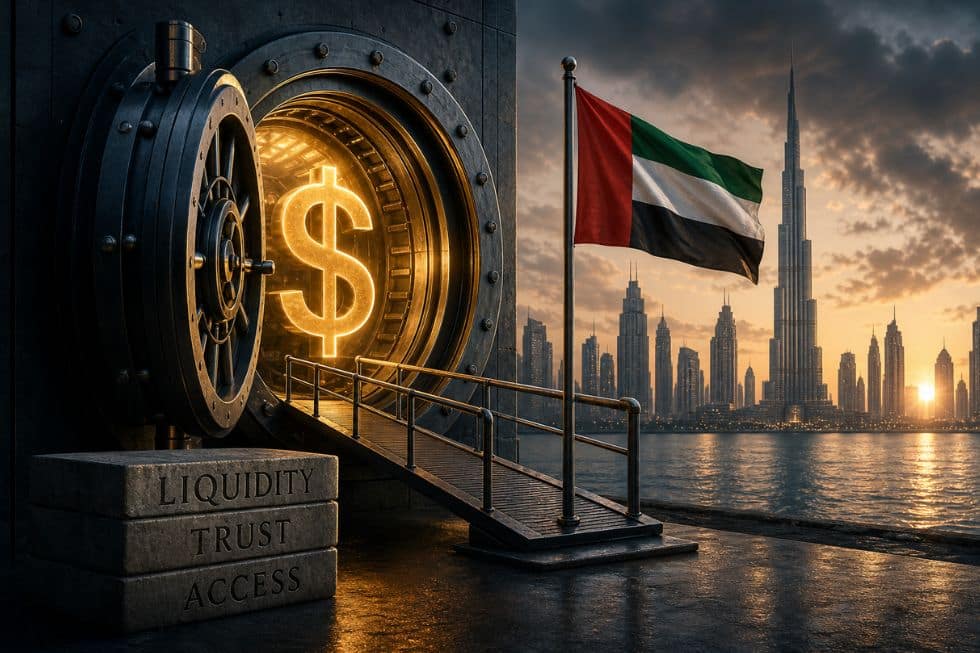



The current debate over dollar liquidity is often framed as a technical question — who gets access to swap lines, under what conditions and through which institutional channel. That framing understates what is changing. Access to dollar funding is becoming a strategic variable, shaping how countries position themselves within an increasingly layered global system. The renewed focus on the United Arab Emirates (UAE) is not incidental; it is diagnostic of a broader shift from reactive crisis management toward selective, forward-looking allocation of liquidity.
To see the shift clearly, it helps to map the evolution in three stages.
Stage one was improvisational. In earlier crises, liquidity support resembled an emergency response — fast, flexible and episodic. Authorities intervened where stress was most acute, often with ad hoc tools and limited predictability. This model stabilized moments, not systems.
Stage two took shape after the 2008 global financial crisis. The Federal Reserve formalized standing swap lines with a small circle of advanced-economy central banks — the European Central Bank, Bank of Japan (BoJ) and Bank of England (BoE), among them. Liquidity provision became predictable. The point was not just to supply dollars during stress but to anchor expectations before stress emerged. Markets internalized the presence of a credible backstop, dampening the very dynamics that would otherwise trigger panic.
Stage three is now emerging. Liquidity is no longer only about stabilizing markets; it is about structuring relationships. Access is increasingly selective, and that selectivity carries strategic meaning. The boundary between monetary cooperation and geopolitical alignment is thinning.
The UAE at the solvency–liquidity boundary
The UAE sits squarely at this boundary. By conventional metrics, it is a strong candidate for self-insurance. Global Sovereign Wealth Fund (SWF), Abu Dhabi Inc. estimates Abu Dhabi-based sovereign wealth funds at $1.7 trillion and notes that its external balance is supported — albeit cyclically — by hydrocarbon revenues. Yet liquidity stress is not a function of net worth; it is a function of timing. When global financial conditions tighten — higher US rates, stronger dollar, volatile oil receipts — short-term dollar funding can become scarce even for asset-rich states. Liquidating long-duration holdings in stressed markets is costly and procyclical. The distinction between solvency and liquidity becomes operational, not academic.
A dollar swap line solves precisely that problem. It converts a potential scramble for funding into a pre-arranged channel, accessed without stigma and without fire sales. This is why swap lines matter even when they are barely used. Their value is embedded in expectations. The credible availability of dollars compresses funding premia, reduces rollover risk and stabilizes behavior across banks, corporates and sovereign-linked entities.
But the UAE case is not just about efficiency; it is about positioning. The country occupies a junction of financial corridors: deep ties to US markets and security arrangements, expanding trade and financial links with Asia, and a growing role as a regional hub for capital intermediation. Granting it direct, privileged access to dollar liquidity would not be a neutral extension of a technical facility. It would be a statement about where the center of gravity lies.
This is where comparisons with China clarify the landscape. The People’s Bank of China has built an extensive network — by early 2025, currency swap agreements with roughly 40 countries. The breadth is real. The function, however, differs. These arrangements are used primarily to facilitate renminbi settlement and to deepen bilateral ties. They are not widely deployed as high-volume, crisis-time liquidity backstops. The constraint is not diplomatic; it is structural. A swap line only stabilizes if the currency it provides is supported by deep, liquid and trusted asset markets.
Here, the dollar system retains a decisive advantage. US Treasury securities offer scale, price transparency and a near-universal acceptance as collateral. This ecosystem allows liquidity to be absorbed and redistributed without severe dislocation. It is why, despite persistent narratives of “de-dollarization,” the dollar continues to anchor global finance — roughly 58–60% of reserves, close to 90% of foreign exchange (FX) transactions, and a dominant share of cross-border funding. Network effects reinforce this position: The more the system is used, the more valuable its liquidity becomes.
The UAE in the global dollar network
Against this backdrop, expanding swap line access to a country like the UAE would deepen, not dilute, the dollar’s role. It would extend the perimeter of the system’s most credible promise: that dollars will be available when they are most needed. Crucially, that promise is not universal. It is granted.
That selectivity introduces a new dimension of leverage. Traditional instruments of financial statecraft — sanctions, export controls — operate by restriction. Swap lines operate by provision. They do not directly compel behavior; they shape incentives by lowering the cost of alignment and raising the cost of exclusion. The power lies in the asymmetry: Access to stability is discretionary.
For the UAE, the calculus is pragmatic. A swap line offers immediate benefits — lower funding risk, reduced volatility in domestic money markets and insulation from global dollar squeezes. But it also embeds a relationship. Even in the absence of explicit conditionality, the existence of a standing facility creates expectations on both sides. In periods of stress, the presumption of support becomes part of the policy landscape. Over time, this can influence portfolio allocation, regulatory choices and even diplomatic posture at the margin.
Institutional shift and strategic liquidity
The institutional pathway matters as well. To date, the most credible and least politicized channel for dollar liquidity has been central bank cooperation. If, however, the locus of action shifts toward fiscal authorities — particularly mechanisms associated with the US Treasury — the strategic dimension becomes more explicit. Tools like the Exchange Stabilization Fund (ESF) allow targeted interventions with greater discretion. They also carry a clearer imprint of national policy priorities. A migration in this direction would not replace central bank swap lines, but it would complement them with instruments that can be calibrated more directly to geopolitical objectives.
The UAE is a plausible candidate for such calibration. Its role as a financial hub, its intermediary position between major blocs, and its capacity to absorb and redirect capital flows make it systemically relevant beyond its size. In an environment of elevated uncertainty — fragmented supply chains, regional tensions, more volatile commodity cycles — the value of reliable liquidity channels increases. So does the premium on being inside the network that provides them.
Exclusivity and tiered system
There is a counterargument worth taking seriously. Expanding access could be seen as diluting the exclusivity that underpins the signaling power of swap lines. If too many countries are admitted, the facility risks becoming routine, losing its edge as a marker of trust. This is a real constraint. The effectiveness of selective provision depends on maintaining a credible boundary.
The likely outcome is not universalization but gradation. We should expect a tiered system: a core of standing lines among advanced economies; a secondary layer of contingent or temporary arrangements with strategically significant partners; and a broader set of ad hoc tools that can be activated under stress. The UAE would fit naturally into the second tier — important enough to warrant structured access, but outside the original core.
Such a configuration would mirror the broader evolution of the global financial system. Rather than a clean bifurcation into competing blocs, we are seeing a layering of networks with different purposes. The dollar system remains central, providing liquidity and collateral of last resort. Parallel networks — most notably China’s — facilitate trade, settlement and bilateral engagement. Countries navigate both, optimizing across them.
Signals, risk and market implications
The risk in this environment is not fragmentation per se, but misalignment of expectations. If access to liquidity is assumed where it is not guaranteed, stress can propagate quickly. Conversely, where access is credible, volatility is dampened even before any facility is drawn. This is why the announcement effect of a swap line can matter more than its utilization.
For policymakers, the implications are straightforward but demanding. First, clarity of intent matters. If liquidity provision is to serve a strategic function, the criteria for access — however informal — must be internally coherent. Second, institutional design matters. The balance between central bank independence and fiscal discretion will shape both credibility and flexibility. Third, calibration matters. Overuse risks normalizing the tool; underuse risks leaving gaps that parallel systems can exploit.
For market participants, the signal is equally clear. Country risk is increasingly tied not only to fundamentals — reserves, fiscal balances, growth — but to network position: who has access to reliable dollar liquidity, and under what conditions. In periods of stress, that distinction will be priced.
System transition and strategic perimeter
All of this points to a system in transition. The move from improvisational support to institutionalized backstops, and now toward selective, strategic allocation, marks a qualitative change. The mechanism remains the same — a swap of currencies with an agreement to reverse. The meaning has shifted.
A single image captures the evolution: The system is less like a set of emergency hoses rolled out during fires, and more like a gated water network, where pressure and flow are assured inside the perimeter and conditional at its edges. Who is connected — and how securely — now matters as much as how much water exists.
The UAE case shows how that perimeter may expand. Not indiscriminately, and not without consequence, but in ways that reflect the priorities of a system still anchored in the dollar. In a world where uncertainty is persistent and shocks are frequent, the value of assured liquidity rises. So does the importance of being among those to whom it is assured.
[Kaitlyn Diana edited this piece.]
The views expressed in this article are the author’s own and do not necessarily reflect Fair Observer’s editorial policy.
Dollar Milkshake Theory Is Still Useful
Despite rising debt and excessive money printing, US Treasuries remain the ultimate safe haven for investors worldwide. No other alternatives...

The Long-Term Dangers of China’s Expanding Swap Line Strategy: Financial Dependence and Geopolitical Influence
China’s currency swap strategy expands its financial influence by creating economic dependencies. While these agreements provide liquidity to struggling economies,...

Central Bank Independence Is Unbelievably Valuable for the World Economy
To ensure sound monetary policy and economic stability, central banks like the US Federal Reserve need their independence (CBI). Opposing...

Support Fair Observer
We rely on your support for our independence, diversity and quality.
For more than 10 years, Fair Observer has been free, fair and independent. No billionaire owns us, no advertisers control us. We are a reader-supported nonprofit. Unlike many other publications, we keep our content free for readers regardless of where they live or whether they can afford to pay. We have no paywalls and no ads.
In the post-truth era of fake news, echo chambers and filter bubbles, we publish a plurality of perspectives from around the world. Anyone can publish with us, but everyone goes through a rigorous editorial process. So, you get fact-checked, well-reasoned content instead of noise.
We publish 3,000+ voices from 90+ countries. We also conduct education and training programs
on subjects ranging from digital media and journalism to writing and critical thinking. This
doesn’t come cheap. Servers, editors, trainers and web developers cost
money.
Please consider supporting us on a regular basis as a recurring donor or a
sustaining member.
Will you support FO’s journalism?
We rely on your support for our independence, diversity and quality.





Comment