

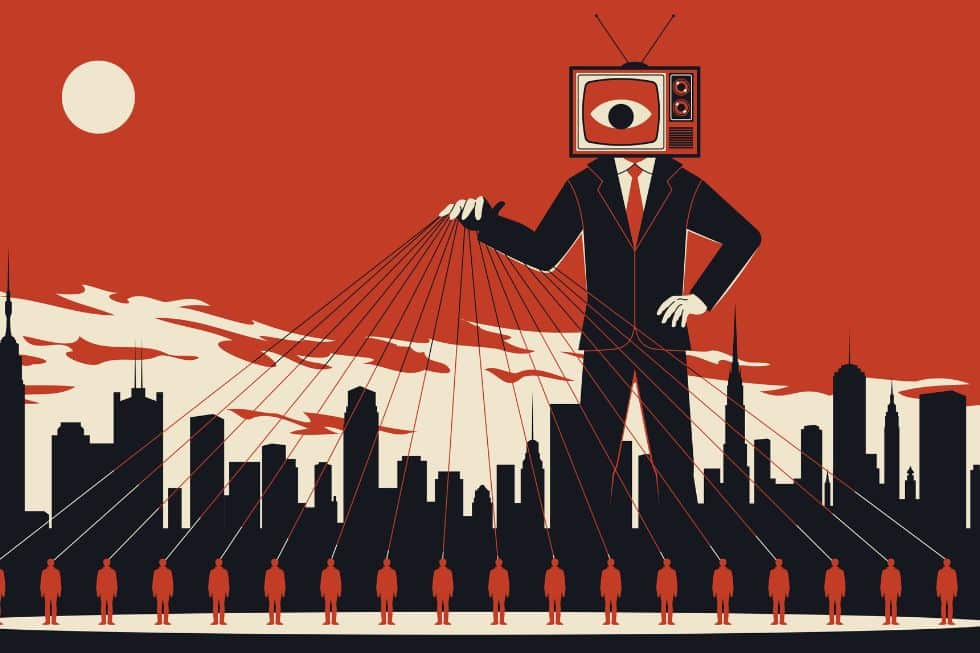



Imagine a world where movies, music, art exhibitions, plays and TV shows are produced under government instructions to shape your everyday preferences and habits. Well, that has already been imagined, from English author George Orwell’s 1984 (1949) to Canadian author Margaret Atwood’s The Handmaid’s Tale (1985). But instead of people being aware or forced to consume disguised official propaganda, what if no one knows that political leaders are behind what you watch, applaud, recommend to your kids and teach in classrooms?
This dystopian world is not so far away. In the 21st century, governments of all kinds — democratic elected, autocracies and dictatorships — are realizing that their political ambitions can be reached faster and cheaper with the help of cultural soft power, the ability to shape the preferences of the world by art and entertainment products, resulting not only in an increase of tourism and economic growth but also in political stability and longevity in power. The only tricky thing is that citizens cannot feel that cultural soft power is being controlled by government officials; otherwise, it may not work. Discretion or denial is a key part of the strategy, and it’s already happening.
Government influence in media and entertainment
In the US, after the 2025 acquisition by Skydance Media, led by David Ellison, Paramount has taken several steps to align with the Trump administration, including shifting the editorial direction of CBS News. This year, President Donald Trump influenced the Paramount-Warner Bros. Discovery merger by favoring the Ellisons, who promised to reshape CNN, and by leveraging his son-in-law Jared Kushner’s firm and the financial bonds he held in the company, which helped secure regulatory approval. With the new owners aligned with the current administration, not only journalism, but also entertainment may be shaped by their preferences (Make America Great Again [MAGA] ideologies) in the near future.
In Turkey, the government of President Recep Tayyip Erdogan has direct influence on Turkish soap operas — known as dizis — using them as tools of cultural soft power by promoting a conservative Islamic ideology through state-run media, regulatory pressure and active encouragement of specific historical narratives, such as promoting the “neo-Ottoman” historical dramas, such as in Diriliş: Ertuğrul (“Resurrection: Ertuğrul”), which aligns with the Adalet ve Kalkınma Partisi’s (the Justice and Development Party [AKP]) narrative of national pride and Islamic identity.
The Radio and Television Supreme Council (RTÜK), Turkey’s media watchdog dominated by AKP members, issues fines, broadcast bans or sanctions against shows that violate conservative, moral or political standards. This often leads to self-censorship, where producers avoid depicting taboo topics like alcohol, smoking, sex or specific political issues.
In Hungary, the now-defeated Prime Minister Viktor Orbán and his Fidesz party have systematically restructured the arts, media and culture sectors since 2010 to advance a nationalist narrative. Through legislative changes, centralized funding and the creation of large pro-government media conglomerates, the administration has diminished plurality in the arts, restricted independent expression and fostered an environment where self-censorship was increasingly common. The Orbán government has implemented “culture laws” that give it greater control over institutions such as theaters and arts education.
Fidesz has created a sprawling right-wing media conglomerate (KESMA), which controls around 80% of Hungary’s media market, including newspapers and cultural publications. This allows for the dissemination of a singular nationalist, socially conservative narrative. While the government supports a boom in Hungarian film production, funding is largely channeled through the National Film Institute (NFI), which prioritizes content that aligns with nationalist historical perspectives.
In Poland, the Ministry of Culture and National Heritage shapes cultural soft power by prioritizing projects that align with its conservative, patriotic and ideological agenda, sometimes resulting in the marginalization of critical or progressive artistic voices. State-controlled companies, such as oil giant Orlen, have purchased local media chains, like Polska Press, bringing local media under indirect government control. The Polish History Museum runs grant agendas, such as “Patriotism of Tomorrow” (Patriotyzm Jutra), aimed at encouraging historical narratives that bolster national identity.
The evolution of government cultural control
How is this different from what the Soviet Union used to do with its greatest cultural soft power, ballet? Well, there’s actually a huge difference. Back during the Cold War, the USSR explicitly used ballet as a propaganda and educational tool, fully controlling companies like the Bolshoi and the Kirov and imposing clear censorship on choreographers and dancers. But today, governments are not explicit in their direct hand on cultural production. Instead, political leaders combine wealthy allies in media conglomerates with legislative control to operate behind the scenes and reshape cultural production, always denying any censorship or state-controlled ideology.
The “narcotizing dysfunction” — the overwhelming flood of information that leads to apathy or inaction towards problems — became even greater with social media, where influencers and fake news flood the population, clouding the real agents and their intentions by reshaping cultural soft power. US greatest cultural soft powers — Hollywood movies, TV shows and pop music — influenced the consumer habits of the planet mostly under democratic values and freedom of speech, even with some occasional alliances with government interests — such as Disney’s cartoons during the Second World War. But what if freedom of speech and democratic values are no longer necessary to create great manifestations of cultural soft power?
“Chinawood” and state-guided cultural soft power
In China, the local government of Dongyang, Zhejiang province, has supported Hengdian World Studios’ infrastructure development, granted tax exemptions to companies and, as of 2017, planned to build government-funded studios within the complex to enhance competitiveness. While privatized, the studio operates under strict state content controls and, in 2004, was recognized by authorities as an experimental zone for the national film and television industry.
Until 2025, “Chinawood” was far from seducing the world’s audiences with its high-budget films. But in 2026, the $80 million budget animation Ne Zha 2 became the first animated film in history to exceed $2 billion at the global box office. Okay, “only” $50 million was made outside China. It’s not much — analysts say international distribution is not a priority, since domestic consumption is huge. But the greatest conquest may be far from these numbers. There’s no explicit “government hands” over the animation, but the characters and story are perfectly aligned with Beijing. That may be the case for future Warner Bros. films and TV shows.
From left to right, governments are proving that liberty, democracy and freedom of speech are not essential ingredients to make films, TV shows, music and art cultural soft power tools. The dystopian world where you applaud art and entertainment, with the secret blessing of your government, is already happening.
[Kaitlyn Diana edited this piece.]
The views expressed in this article are the author’s own and do not necessarily reflect Fair Observer’s editorial policy.






Join the conversation
Share your perspective
Log in to share your thoughts and take part in the discussion.