


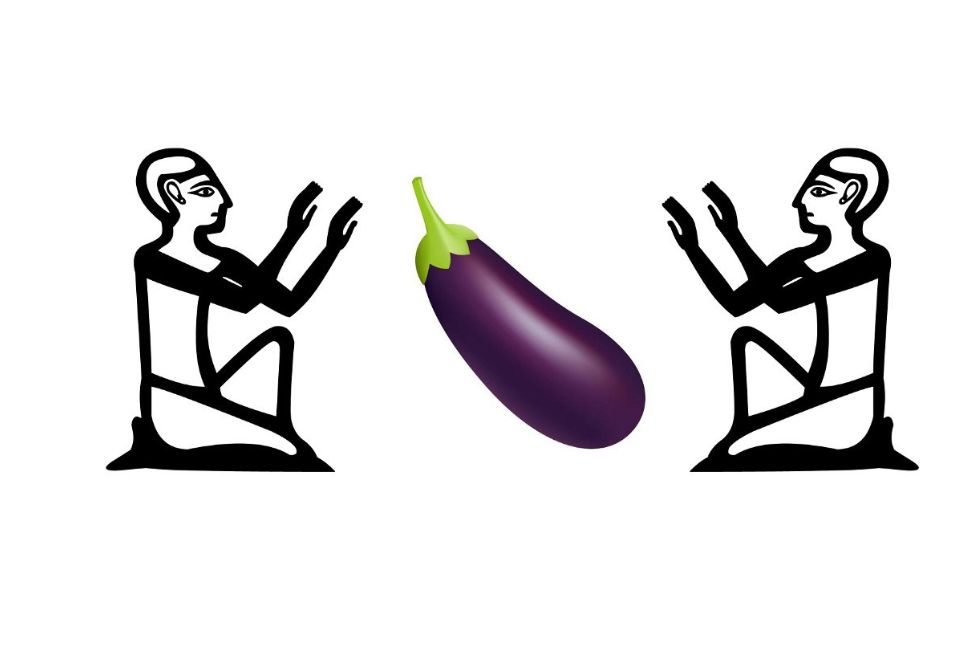



I’m pretty certain that most people think Ancient Egyptian hieroglyphs are pictograms. As in, if I want to write “dog” in hieroglyphs, I would draw a picture of a dog. This isn’t really correct.
Actually, the Egyptian writing system is a fascinating combination of both pictographic and alphabetic writing systems. It is also far easier to read than most people imagine. To really appreciate Ancient Egyptian, we have to understand how the Ancient Egyptians wrote their language. To do that, let’s look at some dirty chain texts first.
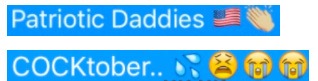
A friend of mine recently sent me an emoji-filled holiday chain letter. This is an entire genre of spam texts. In case you haven’t been exposed to these wonderful messages, here are some examples:
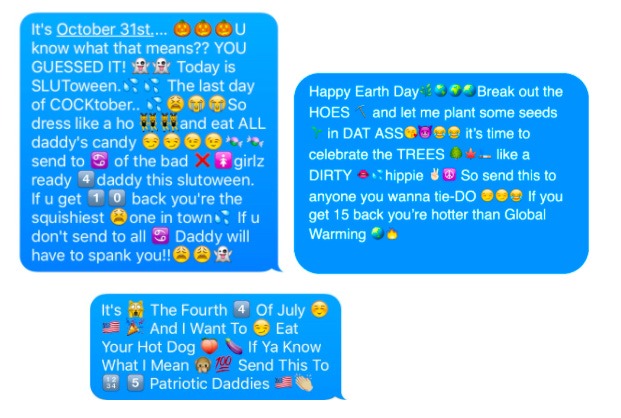
Generally, these emoji-filled exhortations are text messages, usually wishing you a happy holiday, promising you sex if you forward it to another person and cursing you with a lack of sex if it isn’t forwarded. These messages are usually littered with ham-fisted sex puns.
Emoji chain texts also happen to be the most perfect modern analogy for the writing system of Ancient Egypt that I’ve ever encountered.
The Rebus Principle: a literary equation
Let’s consider an example. From the first chain text:

Consider the function of the “4” emoji. This is nominally a pictorial representation of the number “four,” using the Arabic numeral system. However, in American English, the pronunciation of “four” coincides with the pronunciation of the preposition “for.” Hence, the pictogram “4” can be used to mean “for.” This is an example of the rebus principle, in which words are represented by pictograms that sound the same. Here’s another example of the rebus principle, from the Egypt Exploration Society’s webpage:
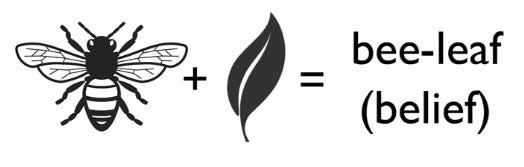
A picture of a bee followed by a picture of a leaf would be pronounced “bee-leaf,” a homophone of the word “belief.” Thus, the bee and the leaf symbols, together, represent the totally unrelated concept “belief.”
The Ancient Egyptian writing system is based on the rebus principle. Originally, the “mouth” hieroglyph represented the concept of “mouth,” and was pronounced something like r.
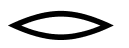
Not long after the invention of Egyptian writing, the mouth glyph was assigned the phonetic value of r. A set of these signs was standardized, creating the hieroglyphic alphabet. Here’s the (Middle) Egyptian alphabet:
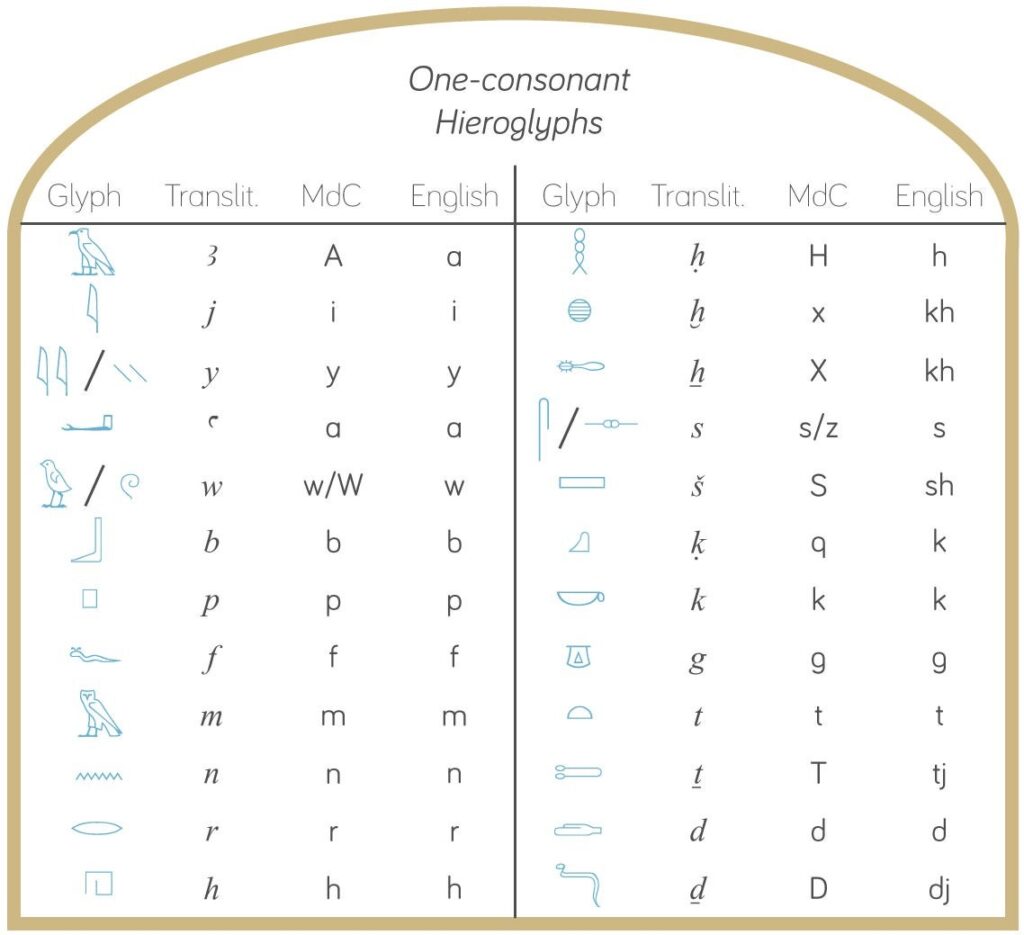
These signs are used to spell out the sounds of Egyptian in the same way that the Roman alphabet is used to spell the sounds of English. Mostly. In Egyptian, like a lot of Semitic languages (Hebrew, Arabic, etc.), vowels tend not to be explicitly written out. Only the consonants were written down, along with pseudo-vowels like i, sometimes called a “weak consonant.” This lack of vowels in writing leads to a lot of homophones in Egyptian, words that sound (or at least are written) the same but have different meanings.
Semantic determinatives as seen through Earth emojis
Let’s now consider a second example, from the second chain text:

Here, consider how the emojis following the word augment its meaning. It begins with “Happy Earth Day,” followed by an emoji of a plant and three of the Earth. The compound noun “Earth Day” is composed of two words written in the Roman alphabet. The individual characters (a, p, y, etc.) tell the reader how the words are pronounced. This is the hallmark of an alphabetic system; an individual character d represents the sound of a single consonant, and multiple characters representing distinct sounds, like d a y, are placed in sequence to form a word with lexical meaning, “day.” The characters tell you how the word is pronounced, and collectively form a written representation of both the concept “day” and the sound “day.”
The sound-signs forming the word “Earth Day” are followed by a picture of a plant and three pictures of the planet Earth, indicating that “Earth Day” is a concept associated with living, growing things and the planet Earth. In other words, the pictograms following the alphabetic characters add shades of meaning to the phrase “Earth Day,” clarifying the category of concept to which this word belongs.
This is precisely how Egyptian words are formed. Paraphrasing from James Hoch’s Middle Egyptian Grammar, Egyptian words are commonly spelled out alphabetically, but also followed by an additional sense-sign, called a determinative, that adds context and meaning to the sound-signs.
For example, the word ra is written as:
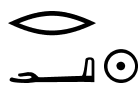
It consists of two alphabetic signs, the mouth hieroglyph, pronounced r, and the arm hieroglyph a, pronounced something like the Arabic ayin. The word ra is followed by this circular determinative, which indicates the meaning of the word ra.

Can you guess what ra means from the determinative sign? You probably can: ra means “sun,” and the determinative is a picture of the sun. The image of the sun clarifies the meaning of the sound-glyphs r and a.
Disambiguation by means of eggplants and seated gods
Let’s consider a third illustrative example. From the third chain text:

The emojis clarify the meaning of “Hot Dog.” The compound noun “Hot Dog” is followed by a peach and eggplant emoji, commonly used to mean “butt” and “penis” respectively. Here, the eggplant and peach emojis serve an important semantic function — they clarify the ambiguity in the sentence “I Want To Eat Your Hot Dog” by explicitly informing the reader, using the eggplant determinative, that “Hot Dog” is a euphemism for “penis.” Thus, instead of the sentence indicating a desire to eat a delicious, all-beef frankfurter, it indicates a desire to perform oral sex.
Ancient Egyptian uses determinatives in exactly the same way as the chain text uses the peach and the eggplant. Returning to our example of ra, consider these two examples of Egyptian words, both spelled ra:
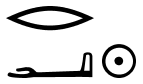
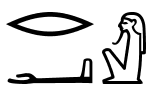
The first word is followed by the “sun” determinative, and thus refers to the concept of the sun, i.e., the ball of fire in the sky. The second is followed by the seated god determinative, and instead of referring to the sun itself, it refers to the sun god Ra. The determinative serves to clarify which concept, both spelled ra, is being referred to in the text.
The determinative is extremely important to understanding written Egyptian, due to the number of homophones in the written language.
Lesson 4: Illustrative Examples
We also notice that in these emoji chain texts, the short, common words without really concrete meanings (like “is” or “to”) are not followed by emoji determinatives, whereas nouns like “Patriotic Daddies” and “COCKtober” are followed by one or two determinatives indicating their meaning or associations in the context of the sentence.
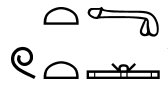
Egyptian follows the same pattern. Short, common words, like m, meaning “in” or “with,” are composed of alphabetic signs alone, without determinatives.

However, nouns and verbs usually consist of a series of alphabetic signs that indicate the pronunciation of the word, followed by a semantic determinative that indicates its sense, category, or associations.
Let’s consider the example of the Egyptian verb “beget,” meaning “to bring into existence”:
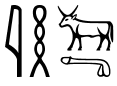
This word consists of five signs: three sound-signs and two determinatives. The first three signs are the coiled rope, pronounced w, followed by two loaf-of-bread signs, pronounced t. Thus, the word is transliterated as wtt and pronounced something like “wetet.”
The next two signs are determinatives and give the sense of the word. The first determinative is a hieroglyph that’s easily recognizable in any era.

It’s a penis, in case you didn’t notice. The penis glyph’s function in indicating the semantic meaning of “beget” is obvious. This sign is actually used in many Egyptian words, such as:
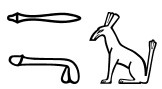
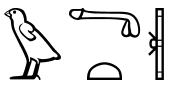
Yes, the penis hieroglyph can mean “thick” in Ancient Egyptian. I guess the priests who came up with this writing system wanted everyone to know a little something about their assets.
Now, back to “beget.” The second determinative in “beget” is the rolled scroll.

The scroll is often used for abstract concepts. This is because abstract concepts are often not easily represented by pictograms, but can be written down on, for example, a scroll.
Putting it all together, the combination of glyphs rope, bread, bread, penis, scroll produces a verb pronounced something like “wetet,” and meaning “to beget.”

Convergent evolution: Hieroglyphs are still used today
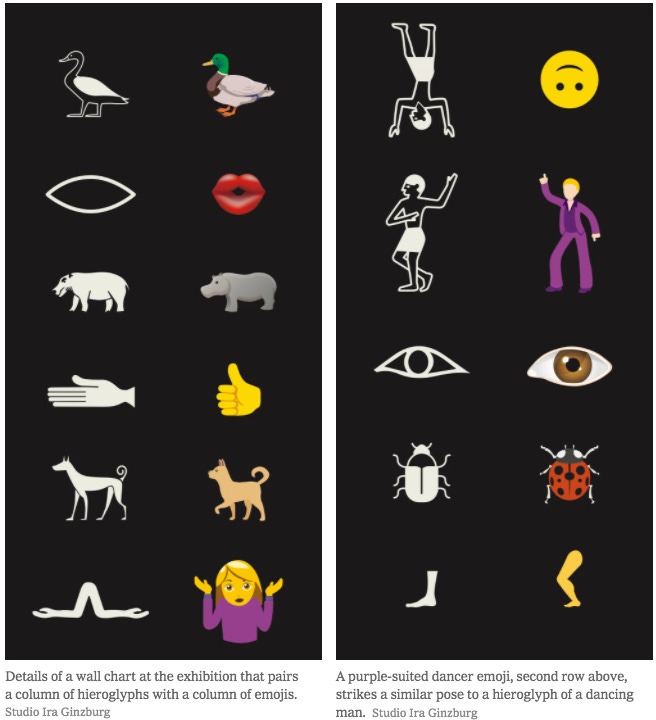
Here’s another fun fact about hieroglyphs. By pure chance, many modern emojis look nearly identical to their ancient counterparts. This article has some wonderful examples of convergent glyph evolution, reproduced here for convenience.
And so, the next time one of your friends sends you a message like this:

I hope that you can appreciate it (syntactically, if nothing else) as a modern reinvention of an ancient form of writing.
[Cheyenne Torres edited this article.]
The views expressed in this article are the author’s own and do not necessarily reflect Fair Observer’s editorial policy.
The Path of Meaning
The contradictions within human nature provide ample room for creativity. Contemporary studies of language reveal its limitations in describing reality....

“Which way, American man?”: The Utility of Memes for the Trump Administration
The second Trump administration has revolutionized government communication on social media. By frequently posting memes and engaging in viral internet...

The Anatomy of a Viral Trend
Aesthetic trends driven by influencers seamlessly embed advertising into daily life, so the marketing seems less transactional. Viral successes depend...

Support Fair Observer
We rely on your support for our independence, diversity and quality.
For more than 10 years, Fair Observer has been free, fair and independent. No billionaire owns us, no advertisers control us. We are a reader-supported nonprofit. Unlike many other publications, we keep our content free for readers regardless of where they live or whether they can afford to pay. We have no paywalls and no ads.
In the post-truth era of fake news, echo chambers and filter bubbles, we publish a plurality of perspectives from around the world. Anyone can publish with us, but everyone goes through a rigorous editorial process. So, you get fact-checked, well-reasoned content instead of noise.
We publish 3,000+ voices from 90+ countries. We also conduct education and training programs
on subjects ranging from digital media and journalism to writing and critical thinking. This
doesn’t come cheap. Servers, editors, trainers and web developers cost
money.
Please consider supporting us on a regular basis as a recurring donor or a
sustaining member.
Will you support FO’s journalism?
We rely on your support for our independence, diversity and quality.





Comment