





Indonesia is often described as the world’s largest archipelagic state. With more than 17,000 islands and vast marine waters, the country lies at the center of global marine ecosystems and international fishery trade routes. Its waters serve as important habitats and migration corridors for many commercially valuable fish species.
Despite this enormous potential, Indonesia faces a persistent threat that continues to undermine its economic strength and maritime sovereignty. One of the most serious challenges is the practice of Illegal, Unreported and Unregulated (IUU) Fishing. This activity has become a major concern for marine governance and fishery sustainability in the region.
For many people, IUU Fishing is often understood simply as the theft of fish by foreign vessels. Such a perception, however, oversimplifies the problem. In reality, IUU Fishing represents a multidimensional issue that involves economic losses, environmental degradation, violations of maritime sovereignty and connections to transnational organized crime.
Massive economic losses
From an economic perspective, the impact of IUU Fishing on Indonesia is extremely significant. National losses are estimated to range from 30 trillion ($1.7 billion) to 101 trillion Indonesian rupiah ($5.9 billion) annually. Earlier estimates from Indonesia’s Supreme Audit Agency suggested that the potential losses could reach as high as 300 trillion Indonesian rupiah ($17 billion) per year.
These figures demonstrate that IUU Fishing is far more than an ordinary illegal activity. It represents the extraction of natural resources without contributing any economic benefit to the state. Fish caught through illegal operations are not recorded in official fishery statistics and are not subject to taxes or landing fees.
In many cases, the catch is transported directly overseas without passing through Indonesian fishing ports. This situation deprives the country of potential non-tax state revenue and eliminates opportunities for domestic value-added activities in fish ports. Practices such as illegal transshipment at sea prevent catches from entering national supply chains, thereby reducing economic opportunities for local fish processing industries.
The economic consequences are also felt directly by small-scale fishers. Large industrial vessels that operate illegally create an uneven competition with traditional fishing communities. In several cases, such conditions have triggered conflicts and intimidation against local fishers.
Threats to marine resource sustainability
Beyond economic losses, IUU Fishing also poses a serious threat to the sustainability of marine resources. Unregulated fishing pressure accelerates overfishing and leads to significant declines in fish stocks. Such pressures can disrupt marine ecosystems and weaken the resilience of fishery resources.
Illegal fishing and unreported catches are estimated to result in substantial losses of marine resources each year, with some estimates suggesting figures of up to 1.6 million tons annually. Losses of this magnitude not only harm the fisheries sector but also disturb the ecological balance of marine environments.
The situation is further aggravated by the use of destructive fishing methods such as blast fishing, cyanide poisoning and trawl fishing. These practices have caused extensive damage to marine habitats. Reports indicate that around 33.82% of Indonesia’s coral reefs have experienced degradation due to environmentally destructive fishing activities.
Fish is also one of the main sources of protein for many Indonesian communities. Declining fish stocks, therefore, have direct implications for national food security. Reduced fish availability may increase the risk of nutritional deficiencies in coastal and island communities.
In a broader global context, the degradation of Indonesia’s marine resources carries international implications. Indonesian waters form part of important migration routes and habitats for globally traded fish species. Declining productivity in these waters may therefore influence seafood supply stability in international markets.
Violations of maritime sovereignty
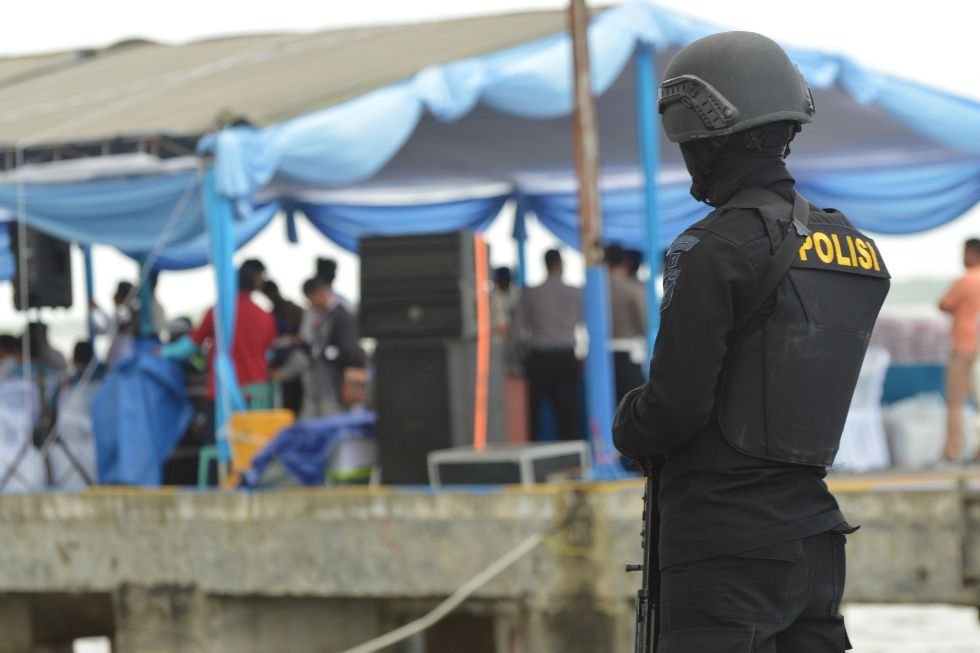
IUU Fishing also represents a direct violation of Indonesia’s maritime sovereignty. Many foreign vessels illegally enter Indonesia’s Exclusive Economic Zone and conduct fishing operations without permits. Such activities undermine the authority of the state over its own maritime territory.
To evade detection, these vessels often disable their Vessel Monitoring System or manipulate ship documentation. Some vessels also engage in double flagging by changing vessel identity and registration. These strategies make enforcement more complicated and reduce the effectiveness of monitoring systems.
Law enforcement at sea also faces institutional challenges. In Indonesia, at least seven agencies share authority over maritime law enforcement. These include the Indonesian Navy, the National Police, the Ministry of Marine Affairs and Fisheries and the Indonesian Maritime Security Agency.
The overlapping responsibilities of these institutions often create coordination challenges in the field. Such institutional fragmentation may open opportunities for illegal operators to exploit gaps in enforcement. As a result, IUU Fishing continues to persist despite regulatory efforts.
Links to transnational organized crime
Over time, IUU Fishing has evolved beyond a simple violation. The practice increasingly operates as part of transnational organized crime networks that threaten economic stability and maritime security. These networks frequently operate across national borders and utilize complex logistical structures.
Criminal involvement in illegal fishing operations often includes labor exploitation and human trafficking. Such practices further increase humanitarian vulnerabilities in maritime regions.
In addition, illegal fishing operators often rely on document manipulation and vessel identity changes to conceal ownership and evade monitoring systems. These methods complicate law enforcement efforts to identify the corporate ownership structures behind illegal fishing operations.
Illegal transshipment at sea is another key mechanism used in these networks. This activity allows vessels to transfer catches offshore in order to avoid customs inspections and sanitary regulations. As a result, illegally caught fish can be disguised and mixed with legally caught products in global seafood markets.
Investigations into IUU Fishing operations have also revealed connections to other crimes such as modern slavery and drug trafficking. These activities often rely on the same distribution networks operating across international waters. Empirical studies indicate that this form of transversal criminality involves thousands of violations globally and includes hundreds of industrial fishing vessels linked to corporate entities across multiple jurisdictions.
Legal challenges further complicate efforts to prosecute the masterminds behind these networks. Fishery regulations frequently impose penalties only on vessel crews rather than targeting the corporate actors responsible for organizing illegal operations. Jurisdictional ambiguity in the high seas also allows offenders to obscure the origin of catches before landing them in port.
This situation not only threatens marine ecosystems but also worsens the vulnerability of coastal communities that depend heavily on fishery resources. The continued exploitation of marine resources through illegal activities is weakening food security and undermining sustainable fishery governance.
Strengthening ocean governance
In response to these challenges, Indonesia has implemented policies based on three main pillars: sovereignty, sustainability and welfare. One of the most widely known policies is the sinking of illegal fishing vessels. This measure was designed to create a deterrent effect against illegal fishing operators.
The policy has contributed to a temporary reduction in certain types of violations. However, combating IUU Fishing requires more than symbolic enforcement actions. Strengthening monitoring systems through monitoring, control and surveillance technology remains essential.
Improved coordination among maritime enforcement institutions is also necessary. Institutional integration would help close enforcement gaps that illegal fishing operators frequently exploit. Effective governance requires collaboration across agencies responsible for maritime security.
International cooperation is equally important. Because IUU Fishing networks operate across borders, regional collaboration in maritime surveillance and fishery governance is essential. Data sharing, coordinated patrols and supply chain transparency can significantly strengthen enforcement efforts.
IUU fishing and the challenge of achieving the SDGs
Ultimately, IUU Fishing is not merely a fishery management problem. It is an issue that intersects with economic development, environmental protection, maritime security and human rights. In the context of global sustainability, the persistence of IUU Fishing also directly undermines the achievement of several Sustainable Development Goals (SDGs).
Unchecked illegal fishing threatens SDG 14 (Life Below Water) by accelerating the depletion of marine resources and damaging critical ocean ecosystems. At the same time, declining fish stocks and the loss of fishery income weaken coastal livelihoods and undermine SDG 1 (No Poverty) and SDG 2 (Zero Hunger), particularly for communities that rely heavily on fisheries as a primary source of food and income.
The human rights dimension of IUU Fishing further highlights its relevance to SDG 8 (Decent Work and Economic Growth) and SDG 16 (Peace, Justice and Strong Institutions). Illegal fishing operations are frequently linked to labor exploitation, human trafficking and weak maritime governance, which undermine fair labor conditions and effective law enforcement in maritime sectors.
Addressing IUU Fishing should therefore go beyond enforcement alone. It requires strengthening governance systems, improving transparency in fish supply chains and reinforcing state authority in maritime territories. In this context, combating IUU Fishing is also part of safeguarding national sovereignty and institutional integrity.
At a time when global marine resources are under increasing pressure, Indonesia’s ability to tackle IUU Fishing will play an important role in advancing the global sustainability agenda. Effective action against IUU Fishing can contribute not only to ocean conservation but also to food security, equitable economic development and stronger institutions across the Indo–Pacific region.
[Casey Herrmann edited this piece]
The views expressed in this article are the author’s own and do not necessarily reflect Fair Observer’s editorial policy.
The Green Transition Needs a Blue Transition, Too
The response to the climate crisis is itself in crisis. As political goals shift and mineral extraction intensifies, the role...
Between Neutrality & Security, Indonesia Treads a Tight Rope
Indonesia has long considered strategic neutrality as the basis for its foreign policy. However, the ambiguity of these policies threatens...

Sushi Wars: Maritime Food Security, Criminal Networks and Geopolitical Risk
Global fisheries, particularly the sushi supply chain, are entangled with rising geopolitical tensions, climate change and transnational crime. China’s use...
Support Fair Observer
We rely on your support for our independence, diversity and quality.
For more than 10 years, Fair Observer has been free, fair and independent. No billionaire owns us, no advertisers control us. We are a reader-supported nonprofit. Unlike many other publications, we keep our content free for readers regardless of where they live or whether they can afford to pay. We have no paywalls and no ads.
In the post-truth era of fake news, echo chambers and filter bubbles, we publish a plurality of perspectives from around the world. Anyone can publish with us, but everyone goes through a rigorous editorial process. So, you get fact-checked, well-reasoned content instead of noise.
We publish 3,000+ voices from 90+ countries. We also conduct education and training programs
on subjects ranging from digital media and journalism to writing and critical thinking. This
doesn’t come cheap. Servers, editors, trainers and web developers cost
money.
Please consider supporting us on a regular basis as a recurring donor or a
sustaining member.
Will you support FO’s journalism?
We rely on your support for our independence, diversity and quality.





Comment