






The war against Iran has already taken several forms, and it is a month old. The war was announced via Truth Social, without a public address to Congress, and was initially justified as a response to an imminent threat. That framing gave way to a broader invocation of nuclear danger, which gave way in turn to Secretary of State Marco Rubio’s more candid account: The US had entered the war partly because Israel was committed to striking Iran regardless, which would have provoked Iranian retaliation against American assets, making preemptive US action the rational course. However, Washington could simply have restrained Israel, but chose not to (perhaps, for political reasons). Saying that this was a preemptive strike to avert an imminent response from a known surprise attack is a completely circular argument.
The instability of the justification is not merely a communications problem. It reflects the absence of a coherent legal premise, and that absence has consequences that outlast any single administration’s war.
Public debate has already moved on to a different question: not whether the operation was legal, but whether its consequences will justify it. For some, the answer is already yes. An Iran without the Islamic Republic, a Middle East freed from the reach of Tehran’s proxy networks, an America that finally treated decades of hybrid warfare as the warfare it was — these outcomes, if they materialize, strike many observers as worth the legal ambiguity. Some even argue that modern international law has become the preferred camouflage for regimes that treat procedural restraint not as a principle but as a tactical resource. Iran exploited every available ambiguity, from plausible deniability to the rituals of multilateral consultation and the manufactured distance between the regime and its proxies.
Meanwhile, Western governments remained distracted and split over how to handle an increasingly aggressive and unpredictable America. Observing the situation in disbelief and helplessness, many people around the world are increasingly frustrated by the rules-based international order’s inability to matter when it most counts.
International law on the use of force provides some of the clearest and most unequivocal rules, especially within the post-World War II world order, but it also faces a serious enforcement problem. The gap between what the UN Charter prohibits and what powerful states actually do has always been managed through creative interpretation and the selective will to enforce. Invoking legal prohibition as though it were self-executing is a form of bad faith that serves no one.
But a more fundamental difficulty is that self-defense arguments, followed to their conclusion, license far more than the dry law suggests. If law is camouflage for the weak and power reorganizes systems when institutions fail, that logic is available to every state with sufficient force and a grievance. The potential proliferation of certain types of weapons has been repeatedly cited as necessitating a preventive act of self-defense. Russia has deployed versions of it regarding NATO expansion and Ukraine. The door is increasingly being pushed open for others to deploy it regarding their own adversaries, their own thresholds of existential risk, their own calculations about when deliberation has run out.
Was it legal?
The short answer, on the publicly available evidence, is almost certainly not — though the legal analysis is more complicated than the volume of condemnation might suggest, and the complications matter for what follows.
The laws governing the use of force are grounded in Article 2(4) of the UN Charter, which prohibits force against the territorial integrity of any state, and in Article 51, which preserves the right of self-defense in the event of an armed attack. Iran had not launched an armed attack on either the US or Israel before the strikes began. The retaliatory Iranian missile and drone strikes came afterward and cannot be used to retroactively justify what preceded them.
Anticipatory self-defense — acting before an attack lands — has a narrow, contested but not implausible basis in customary international law, rooted in the 19th-century Caroline affair. The standard requires that necessity be instant, overwhelming, leaving no choice of means and no moment for deliberation. What US and Israeli officials actually described, however, was something considerably broader: a preventive campaign aimed at long-term capabilities, regional restructuring and the permanent foreclosure of Iranian nuclear ambitions.
The legal distinction between anticipatory and preventive force is not a technicality. Anticipatory self-defense responds to a threat that is genuinely about to materialize. Preventive war responds to a threat that might materialize at some future point. The latter has no serious basis in existing law, and the operation as described maps far more closely onto preventive logic than onto the narrow anticipatory model.
The timing compounds the difficulty. Oman had reported progress in nuclear negotiations. Technical discussions at the International Atomic Energy Agency (IAEA) were reportedly days away. The UN Secretary-General said a diplomatic window had been squandered. The Caroline standard requires no moment for deliberation. The available chronology suggests there were moments and that they were deliberately closed. As Marko Milanovic, professor of international law at the University of Reading, put it: Using force would require a basis in self-defense, and there are many ways to respond to a threat that fall short of launching a war. Senator Mark Warner was more direct still: There was no imminent threat to the US from Iran. There was a threat to Israel. Whether a threat to Israel constitutes an imminent threat to the US, he noted, is genuinely uncharted legal territory.
The structural problem with imminence
At this point, the legal argument becomes structurally interesting rather than merely factually contested, and it connects directly back to the argument from the other side of the debate.
The defenders of the operation do not simply claim the facts support imminence. They claim imminence itself requires reconceiving. Mobile missile launchers, cyber capabilities, decentralized proxy networks, nuclear latency — all of these compress available warning time to the point where traditional temporal markers no longer apply. By the time a threat looks genuinely imminent in the older sense, the window for effective action may have closed.
This is not a frivolous position. It has been the subject of serious legal scholarship since the 2002 Bush National Security Strategy reopened the question after September 11, 2001. The problem is that accepting it transforms imminence from a temporal constraint into a capability assessment. Once the relevant question becomes not whether an attack is about to happen but whether a state possesses capabilities that could eventually be used against us, the constraint effectively dissolves. Any sufficiently powerful state can point to adversary capabilities and construct a legal rationale for force. The argument does not produce a principled limit. It produces a vocabulary.
This elasticity is not an accident of bad faith. It is a feature of the architecture. Legal scholars have long observed a dynamic they call lawyerization — the embedding of legal advisers within military planning cycles, where their institutional position leads them to read ambiguous terms such as military necessity and definite military advantage in ways that preserve operational flexibility rather than constrain it. The framework appears to regulate force while structurally accommodating it.
The Security Council session after the strikes illustrated this with uncomfortable clarity. Every actor reached for legal language. The US ambassador invoked lawful preemptive self-defense. Iran’s ambassador called the strikes a crime against humanity. Russia invoked the precedent of Iraq in 2003. China called the timing shocking. The Arab League noted Israel’s own refusal to submit its nuclear facilities to international inspection. All of them cited international law. None of them agreed on what it said. This is not a failure of the framework. It is the framework operating as designed.
Why invoking the law may not be enough
The critical response to Epic Fury has understandably focused on its illegality. The legal critique is largely correct. But there is a prior question worth sitting with: What kind of order does international law on the use of force actually reproduce?
The framework was created by states, for states. It reflects a world order built by the most powerful actors in the post-1945 international system to manage interstate relations in ways broadly favorable to their interests. That order is preferable to its absence, and its erosion carries real costs. But it has never been neutral. It institutionalizes assumptions about sovereignty, force and legitimate violence that systematically favor technologically advanced states capable of fighting what are sometimes called clean wars — wars conducted with lawyers present, precision weapons deployed and proportionality assessments documented in advance.
The just war tradition, which provides the intellectual foundations of the contemporary self-defense framework, has always served this dual function. It constrains violence at the margins while legitimizing it at the core. Michael Walzer, one of just war theory’s most prominent defenders, warned that the triumph of just war thinking would normalize a world in which war is always, potentially, justifiable, provided the relevant criteria are satisfied. The shifting justifications for Epic Fury are a case study in meeting criteria after the fact, or attempting to.
When critics invoke international law to condemn the strikes, they implicitly accept this framework. The argument that the operation failed the legal tests — imminence not established, proportionality strained, necessity undermined by ongoing diplomacy — is probably correct in each of its particulars. But it concedes the premise that force is permissible when the tests are genuinely met. It leaves intact a structure in which powerful states can, with sufficient legal preparation and institutional support, always find a way to meet the tests, or to redraft them as the post-September 11 period demonstrated was possible.
There is a structural parallel here to the political dynamics that have followed right-wing populist challenges to democratic institutions in several countries. The progressive response has been to defend the institutions — to insist on norms, procedures and legal constraints. That defense is understandable and not without value. But it can also function as a restoration of an order that itself generated the conditions for the challenge: an order that worked well enough for a certain managed consensus but accumulated, over time, a substantial deficit of legitimacy among those it claimed to serve.
International law on the use of force is in an analogous position. Defending it against its most cynical exploiters is necessary. But defending it without asking what it was built to do and whose interests it has consistently served is insufficient.
Maybe the war is legal, and that is the problem
The uncomfortable conclusion toward which this analysis points is that Operation Epic Fury may, in fact, be legal under international law as it is actually practiced — not as it is ideally formulated, but as it functions in the real world of great power competition and doctrinal elasticity.
Not because the facts clearly satisfy the Caroline criteria, they probably do not, but because international law on the use of force has always been indeterminate at its core. State practice is inconsistent. The Security Council is structurally incapable of enforcing the prohibition on force against its permanent members. The doctrinal debate about imminence has no clean resolution. In these conditions, legality functions less as a constraint than as a resource — available, in practice, to whichever actor can most effectively perform compliance with its terms.
The commentator who argued that law is camouflage for the weak is, in a narrow sense, describing this accurately. Where the argument fails is in treating that description as a justification rather than a diagnosis. The observation that powerful states exploit legal ambiguity is not an argument for abandoning legal constraint. It is an argument for understanding why the existing framework fails so consistently and in whose favor those failures tend to run.
The mimetic dimension of this failure is both real and urgent. When the US stretches self-defense doctrine to license what is, by any careful reading, a preventive war, that stretch does not remain local. Other states observe it, cite it and adapt it. The legal order that consolidates around such precedents is not one in which force is better regulated. It is one in which force is more widely licensed, and the licensing vocabulary is borrowed from the most powerful actors in the system.
The question that follows from Epic Fury is therefore not primarily whether this operation was lawful. It is what kind of order the legal tests, as they actually function, reproduce — who benefits from them, who is systematically disadvantaged by them and what alternatives exist beyond the horizon of a framework that has always, ultimately, found room for the wars that powerful states decide to fight.
International law will not save us from the next Epic Fury. It was not designed to. It was designed to regulate the world as it is, a world of unequal sovereign states in which the most powerful retain, in practice, the greatest latitude. Recognizing that is not counsel for despair. It is the beginning of a more honest conversation about what legal constraint on force would actually require.
[Patrick Bodovitz edited this piece]
The views expressed in this article are the author’s own and do not necessarily reflect Fair Observer’s editorial policy.
Imperial Decline in the Strait of Hormuz: The Iran War as America’s Very Own Suez Crisis
Empires rise and fall — one major example being the British Empire following the 1956 Suez Crisis. The US–Israel war...
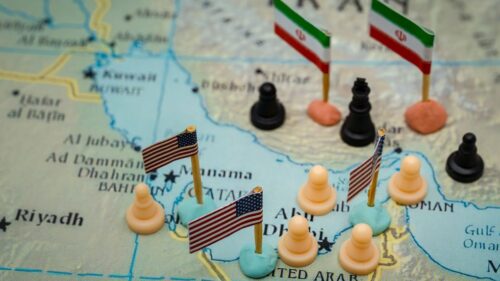
Has the US Invented the Pyrrhic War? Part 1
This debate with Claude explores the idea that US military strategy is now designed to engineer lasting disorder rather than...
Why a Fragmented Iran is Israel’s Greatest Security Threat
The dissolution of the Iranian state into smaller ethnic or sectarian entities is a catastrophic miscalculation in 2026. Rather than...
Support Fair Observer
We rely on your support for our independence, diversity and quality.
For more than 10 years, Fair Observer has been free, fair and independent. No billionaire owns us, no advertisers control us. We are a reader-supported nonprofit. Unlike many other publications, we keep our content free for readers regardless of where they live or whether they can afford to pay. We have no paywalls and no ads.
In the post-truth era of fake news, echo chambers and filter bubbles, we publish a plurality of perspectives from around the world. Anyone can publish with us, but everyone goes through a rigorous editorial process. So, you get fact-checked, well-reasoned content instead of noise.
We publish 3,000+ voices from 90+ countries. We also conduct education and training programs
on subjects ranging from digital media and journalism to writing and critical thinking. This
doesn’t come cheap. Servers, editors, trainers and web developers cost
money.
Please consider supporting us on a regular basis as a recurring donor or a
sustaining member.
Will you support FO’s journalism?
We rely on your support for our independence, diversity and quality.





Comment