


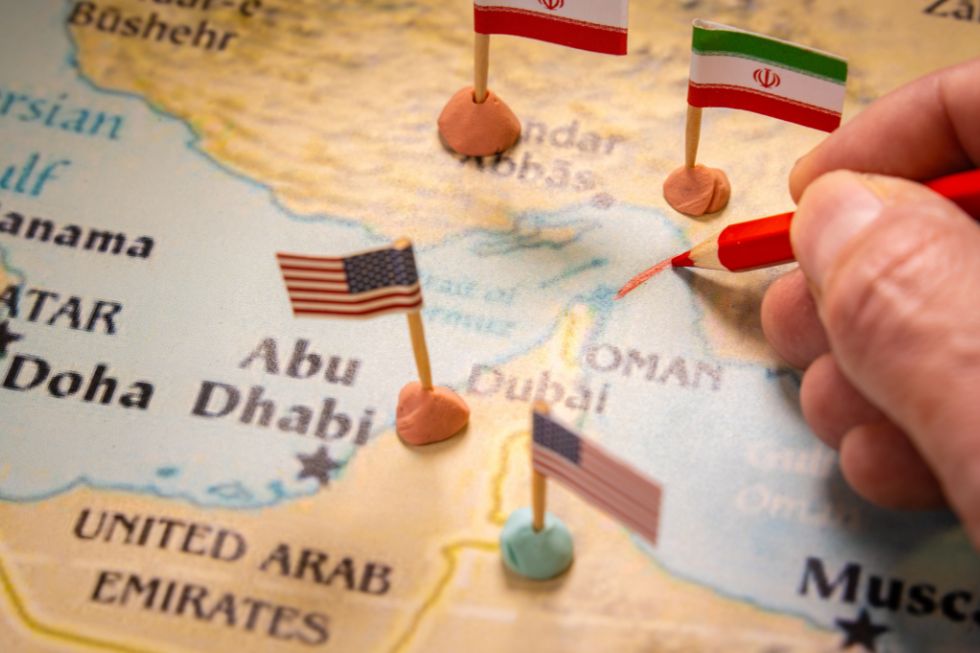



Having pummeled Iran with devastating effect for nearly four weeks, the administration of US President Donald Trump finds itself in a tight spot over the Strait of Hormuz. The Iranian government, despite its navy and air force having been nearly entirely destroyed by American and Israeli forces, has effectively closed the critical shipping channel by threatening ship traffic with missile and drone attacks. Ship owners and insurance companies have halted their services into and out of the Persian Gulf.
Such a closure should have been anticipated by US planners and administration officials well before launching the first wave of attacks on February 28. The security of the Persian Gulf and safe passage through the Strait of Hormuz have been a fundamental principle of US policy in the Middle East since at least the administration of Jimmy Carter in 1979.
But the administration either did not heed or discounted warnings from those who would have known. Trump’s Chairman of the Joint Chiefs of Staff, General Dan Caine, specifically advised Trump that a closure attempt was a real possibility. The president erroneously reasoned that once the Americans and Israelis took out the Iranian Supreme Leader, Ali Khamenei, the Iranians would capitulate. As the administration has come to realize, this was a major failure in judgment.
For decades, Iran has threatened to close the Strait if attacked. During the so-called Tanker War phase of the Iran-Iraq War (1980–1988), the Iranians tried to close the Strait but ultimately failed. Additional attempts and/or threats were made in 2011–12 and 2018–19. During the June 2025 Israel-Iran War, the Iranian parliament voted to close the Strait, but Tehran eventually backed off. Professional American diplomats, intelligence officers and military planners of the State and Defense (now War) Departments and the Central Intelligence Agency (CIA) would most certainly have known this and communicated the information up the chain.
The US administration and its Israeli allies now face a conundrum. Even if Trump decides to declare victory and end the US attacks, Iran appears determined to maintain closure of the Strait until certain commitments are made, including a pledge not to renew attacks in the future, closure of US bases in the Middle East and payment of war reparations. There is zero chance of the US or Israel accepting such terms, and even if accepted, they would be meaningless. Tehran is certainly aware of that but seeks to save face and use such commitments as “proof of victory” to their public in a war in which they’ve suffered devastating and humiliating losses.
An avoidable problem but still hope
Trump appealed to NATO allies to commit vessels to secure safe passage in the Persian Gulf and the Strait of Hormuz. Unsurprisingly, NATO countries with the means to do so rejected the request. Having been left out of the planning for the attacks, NATO members were understandably reluctant to commit their forces to an operation to secure the Gulf and Strait without prior planning for such an undertaking.
A more farsighted US administration would have reached out to NATO members well before the attack launch to propose that they support freedom of navigation operations in the area in the event the Iranians attempted closure. That would have allowed for planning and mobilization in advance. It is also the way NATO has operated throughout most of its nearly 77-year history.
Of course, it has not helped that, dating back to his first administration (2017–2021), Trump and others in his administration have used nearly every opportunity to insult, denigrate, disparage, demean and humiliate NATO members and the NATO organization. His contempt for America’s most important and oldest alliance is hardly a secret. It is also a stain on America’s image as a reliable global superpower.
There may still be hope yet for persuading some NATO allies to lend support. After all, Europe needs the Strait to be open to normal tanker and shipping traffic at least as much as the US does, and probably more. Moreover, the Gulf Arab countries also do. The administration should consider ending its rhetoric and discreetly consult NATO and Gulf countries about securely opening the Gulf and Strait. Others with similar interests, in Asia, for example, might also be persuaded. But it will require respectful, urgent and serious diplomacy.
Such help would be most welcome as the war taxes the US military and its diminishing stocks of munitions and other critical supplies. The president has ordered US ground forces to the region, including US Marines, and may be considering adding the elements of the US Army’s 82nd Airborne Division. While the exact purpose isn’t known, speculation suggests the US may be planning to seize Iran’s principal oil terminal and port, Kharg Island, responsible for 90% of the regime’s oil exports, or to capture or neutralize the estimated 400–440 kilograms of 60% enriched uranium stored in underground bunkers in Isfahan, but also perhaps Natanz and Fordow. These operations are fraught with challenges and risks and would be highly complex and costly for the US in terms of lives and expense, irrespective of the outcome.
Declare victory and end the war?
In addition to failing to anticipate the closure of the Strait of Hormuz, the US administration and its Israeli partners failed to fully consider the commitment, fervor and resolve of Iran’s regime. It is one deeply immersed in the righteousness of their political-religious mission. To capitulate and deny that mission would be to deny their identity and betray the fundamental principles of the Islamic revolution. Married to Iran’s dominant Shi’a religious faith, which glorifies martyrdom for the faith, this revolutionary resolve takes on a dimension and depth not fully appreciated in the West. It gives the leadership and its followers, especially among the Islamic Revolutionary Guard Corps (IRGC), an almost mystical or spiritual determination to defend the regime, whatever the costs and in spite of overwhelming losses and the unpopularity of the regime.
This reality leaves the US administration with few options. It may continue to wage this war and inflict ever more destruction on the country’s defenses and perhaps even economic infrastructure. The regime and the Iranian people will suffer, but the leadership will not capitulate short of annihilation.
The US could also negotiate. But it should not expect more than short-term, tactical concessions made after extended negotiations spent haggling over microscopic details. The regime won’t negotiate itself out of existence. Its threat against the Strait is one way to demonstrate its remaining capability in the face of incalculable military and political losses. They have found the Americans’ Achilles heel: oil and the global economy. They won’t give up the Hormuz card without concessions from the US and Israel.
President Trump can also declare victory and end the US role in the war. Israel might go along. But the Iranians have a say, too, and might choose to continue threatening shipping traffic in the Gulf and Strait. It might also decide to begin enriching its remaining 400 kilograms of enriched uranium (provided it still possesses the requisite number and type of centrifuges, which is unknown). Therefore, the war does not end, though this “first phase,” if it may be called that, may. At that point, the US must decide when and how to re-engage with Iran to end Iran’s effective siege of the Gulf and Strait of Hormuz. It becomes the very “forever war” against which Trump so vigorously campaigned in running for office.
There is one final alternative. But it’s one Trump and the formidable war machines of the US and Israel have little control over. It’s the Iranian people and their abiding resentment of the regime.
The war is a disaster for the regime
However the Hormuz predicament is resolved, it should not distract anyone from the country’s current state. Iran has been irreparably weakened. The Hormuz closure is a ploy intended to show that the regime still has leverage. It does indeed, but it can’t sustain a regime that’s lost its navy and air force, seen its regional proxies reduced to gun-toting tunnel dwellers and suffered significant losses in its ballistic missile capabilities.
Its economy was already on the brink of collapse before the war started. Its currency is worthless; punishing economic sanctions will continue. It has no allies willing to come to its aid. Soon, it won’t be able to feed its people, pay public employees or conduct the most basic public services. A greater number of Iran’s middle class will slip below the poverty line. It will lack energy to cool homes and offices in Iran’s fast-approaching searing summer heat. Water shortages, which have plagued the nation for years, will worsen. The regime was helpless to resolve any of these problems before the war. It will end the war in a much worse state.
Iran’s security forces have been weakened but remain largely intact. Morale has reportedly suffered as rank-and-file IRGC forces and their paramilitary militia, the Basij, and regular armed forces, the Artesh, have helplessly watched the nation’s defense and security infrastructure systematically destroyed. Some troops aren’t getting paid, and desertions have been reported. Potentially worse, tensions have begun to appear between the better-funded and more politically powerful IRGC and the larger but less supported Artesh.
Worst of all for the regime, the Iranian people will know all of this, having witnessed much of it firsthand. They and the regime know the regime is at its weakest point in its 47-year history. Oppression will increase, and the system necessary to maintain it will be more costly. There may not yet be outward signs of another uprising of the sort we saw in January. But perhaps when the war dust settles and Iranians feel safer from the war itself, they will emerge to challenge the regime again with renewed vigor, hope and rage.
When they do, it is likely to be ugly. Updated estimates of the number killed by regime security forces in January now reach more than 36,000. The next round will be worse as the regime struggles for survival against its own citizens. Should the people prevail, regime elites know their fate. Rank-and-file troops of the Artesh and police may feel hard-pressed to defend a regime they know is on life support and cannot provide for the most basic needs of government and the people. Will they be motivated to attack their own people?
If and when that happens, the world will know the Islamic Republic has reached its well- deserved end. That may be Mr. Trump’s best hope, but it’s out of his hands.
[Kaitlyn Diana edited this piece.]
The views expressed in this article are the author’s own and do not necessarily reflect Fair Observer’s editorial policy.
Imperial Decline in the Strait of Hormuz: The Iran War as America’s Very Own Suez Crisis
Empires rise and fall — one major example being the British Empire following the 1956 Suez Crisis. The US–Israel war...
How the Iranian Regime Has Arrived at the Verge of Collapse
Iran’s anti-Western policies and support for nonstate actors led to international isolation and economic collapse. Its focus on nuclear and...
FO Exclusive: A New Iran–US Conflict Looms Large
In this section of the February 2026 episode of FO Exclusive, Atul Singh and Glenn Carle examine the rising risk...
Support Fair Observer
We rely on your support for our independence, diversity and quality.
For more than 10 years, Fair Observer has been free, fair and independent. No billionaire owns us, no advertisers control us. We are a reader-supported nonprofit. Unlike many other publications, we keep our content free for readers regardless of where they live or whether they can afford to pay. We have no paywalls and no ads.
In the post-truth era of fake news, echo chambers and filter bubbles, we publish a plurality of perspectives from around the world. Anyone can publish with us, but everyone goes through a rigorous editorial process. So, you get fact-checked, well-reasoned content instead of noise.
We publish 3,000+ voices from 90+ countries. We also conduct education and training programs
on subjects ranging from digital media and journalism to writing and critical thinking. This
doesn’t come cheap. Servers, editors, trainers and web developers cost
money.
Please consider supporting us on a regular basis as a recurring donor or a
sustaining member.
Will you support FO’s journalism?
We rely on your support for our independence, diversity and quality.





Comment