


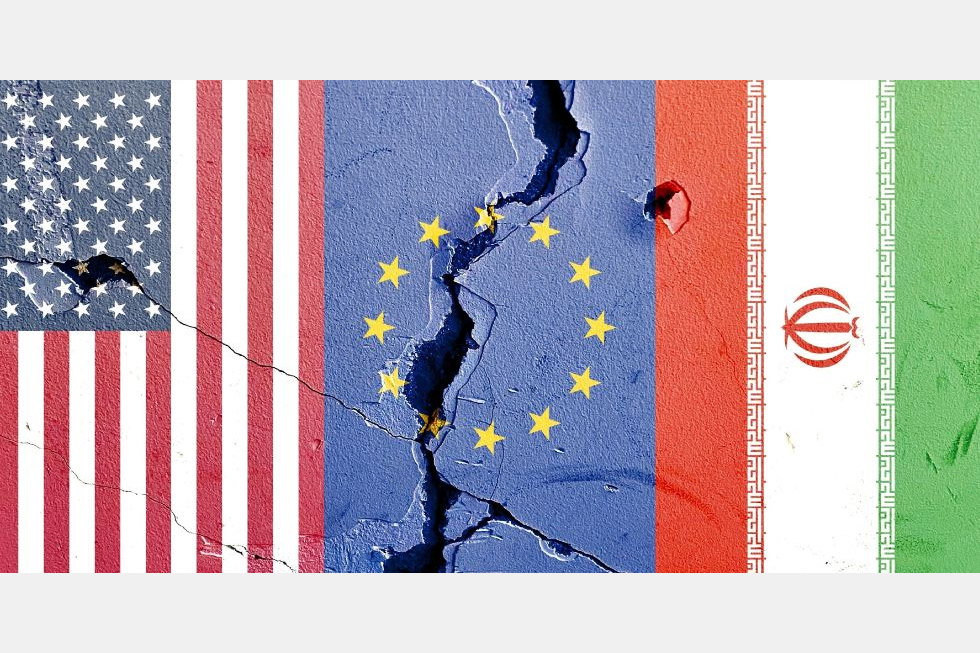



There aren’t many foreign policy issues where the EU once played a central, constructive role. Iran used to be one of the rare exceptions. The Joint Comprehensive Plan of Action (JCPOA), agreed to in 2015, began in 2003 as a diplomatic initiative led by the EU and the “EU3” of France, Germany and the UK. For a time, this was held up in Brussels as the flagship proof that slow, patient, law-bound European diplomacy could meaningfully shape global security.
That world is largely gone. Since the US withdrew from the JCPOA in 2018 and, together with Israel, turned increasingly to unilateral kinetic action against Iran, Europe’s most tangible diplomatic success has become the stage on which its influence is steadily eroding. The massive US–Israeli attack on Iran launched on February 28, 2026, and the subsequent killing of Supreme Leader Ayatollah Ali Khamenei on March 1, marked not only the decapitation of the Islamic Republic’s leadership but also laid bare Europe’s strategic paralysis and its profound doubts about the way American power is now being applied.
The case for confronting Iran — and Europe’s unease about how it is being done
There is a serious, substantive case for confronting the Iranian regime, up to and including efforts to bring about its end. Effectively, the US and Iran have been in a shadow war since 1979. Tehran’s network of proxies has killed more than 600 American servicemen in Iraq alone and has repeatedly attacked US and allied bases across the Middle East.
The Islamic Revolutionary Guard Corps (IRGC), now officially listed as a terrorist organization by the EU, has orchestrated or supported operations targeting civilians and infrastructure from the Levant to the Gulf. This is a regime whose leaders routinely chant “Death to America” and “Death to Israel” and have backed those slogans with missiles, militias and terrorism. Ending the rule of a government that openly calls for the destruction of US and European partners and acts to that end is, in principle, a perfectly defensible strategic and moral objective.
Not only that, but Iran has developed biological weapons and can launch cyber-attacks. Hezbollah also has sleeper terror cells in Latin America and could try to infiltrate Europe and the US, if it hasn’t already.
Many European policymakers, especially in Central and Eastern Europe, quietly, and sometimes openly, recognize the danger. For them, an Iranian regime willing and able to blockade the Strait of Hormuz, attack EU-flagged vessels, destabilize Gulf monarchies and edge toward nuclear weapons is not an abstraction but a direct threat to European security and prosperity. But if the case for confronting Iran is strong, the way the US has chosen to wage this war, and the reasons President Donald Trump appears to have for doing so, are far more troubling to European eyes.
A personalized American war
In previous eras, American presidents who embarked on wars of this magnitude, however flawed their decisions, at least made an effort to answer two basic questions: Is this in the American national interest? And what is the political endgame? Trump’s approach is different. Because his administration is so thoroughly personalized, the key question appears to be: How is this in my interest? How will this shape my image as an actor on the world stage? Trump has always possessed a predator’s instinct for exploiting his opponents’ weaknesses. He is now deploying that instinct globally, probing for vulnerabilities he can exploit to glorify his own legacy. He has already pointed to the successful external pressure that helped topple President Nicolás Maduro in Venezuela as a model he can replicate in Iran, overlooking the fact that the Middle East is an entirely different strategic and political landscape.
For Europeans, this is the heart of their discomfort. The war in Iran may be justifiable as a confrontation with a bloodthirsty state that has harassed Western interests for decades. But it is being conducted by a Washington that increasingly seems to substitute presidential ego for strategy, and media cycles for end-state planning.
Europe’s fractured response
European foreign policy toward Iran has undergone a dramatic transformation since the first missiles fell. For years, Brussels clung to the JCPOA as the embodiment of its preference for negotiated solutions. Even after the Trump administration reimposed sanctions in 2018, the EU3 tried to keep the deal alive.
That posture collapsed in late 2025. With Iran expanding enrichment and stonewalling inspectors, the EU3 triggered the snapback of UN sanctions, effectively ending what remained of the JCPOA. By early 2026, European diplomacy had already shifted from salvage operation to damage control.
The outbreak of a US–Israeli war in 2026 accelerated this transformation. In a striking break with past caution, European Commission President Ursula von der Leyen has publicly called for a “credible transition” in Iran that reflects the democratic aspirations of its people. EU foreign policy chief Kaja Kallas described Khamenei’s death as “an open path to a different Iran.” These are not the words of a bloc neutral on regime change; they are the vocabulary of a Europe that has, at least rhetorically, moved closer to endorsing it. Yet this new language masks deep internal fractures.
Member states are sharply split on how far to go in supporting the war and an implied regime-change agenda. Germany, under Chancellor Friedrich Merz, has largely avoided criticizing US strikes and stresses solidarity with Washington. Merz has gone so far as to argue that international law is becoming a thing of the past and that Israel and US tactics should not be criticized if Europe shares US objectives on Iran’s nuclear and missile programs. Berlin’s view reflects both long-standing Atlanticism and a sober recognition that a nuclear-armed Iran would be catastrophic for European security.
The UK, led by Prime Minister Keir Starmer, has aligned closely with Washington militarily and diplomatically. London has always allowed the US to use its bases in Cyprus for strikes on Iranian missile sites and frames its role as “defensive,” aimed at protecting shipping lanes and allied forces. The UK government initially declined to grant the US permission to use the Diego Garcia base for potential strikes against Iran, citing legal concerns. However, this stance was reversed, and permission was later granted for limited, defensive and specifically targeted operations. Post-Brexit, the UK sees unwavering support for the US not just as a strategic choice but as a core element of its identity as a global actor.
France, while also a close US ally, has taken a more ambivalent stance. Paris has bolstered its regional military presence after its base in the United Arab Emirates (UAE) was hit by Iranian missiles, but it has been more outspoken than Berlin or London in insisting on respect for international law and a clear post-war political roadmap. French policymakers are acutely aware that France has economic stakes in the region and that there is a significant domestic debate over another Middle East war.
Spain and several Southern European countries have condemned the war outright as a violation of international law. For them, the US–Israeli campaign against Iran looks alarmingly like previous interventions — Iraq, Libya, Syria — where Europeans paid heavily in terms of migration, terrorism and economic disruption without having a meaningful say in the original decision to use force.
Strategic risks: escalation, sea lanes and economic shock
This patchwork of responses has left Brussels struggling to speak with a coherent voice. On paper, EU institutions call for de-escalation, respect for international humanitarian law and a renewed diplomatic track. In practice, some member states are facilitating military operations while others denounce them, and the Commission’s own rhetoric edges toward support for transition in Tehran.
To Tehran and to many observers in the Global South, the current situation looks like another European double standard, as member states loudly preach international law in Ukraine, but quietly accept its creative reinterpretation in Iran.
Trump has presented the war as a low-cost, high-impact campaign in which air and cyber power can force political change in Tehran. Europeans with operational experience in the region are more skeptical. In the modern era, there are few, if any, examples where air power alone has toppled a regime and produced a stable successor. Even Libya is not a true precedent, since in that case Libyan forces were on the ground advancing against Muammar Qaddafi. In Iran, by contrast, the regime’s security forces remain cohesive, and nationalist sentiment has been inflamed by the perception of an existential foreign threat.
Khomeini, for all his radicalism, always pulled back from directly provoking a full-scale US attempt to destroy the regime. He knew that the US had the capacity to do it. Today’s leadership in Tehran, decapitated but not defeated, has every reason to believe that it is already under such an existential assault. That removes any remaining incentive for restraint. The logical response, from their perspective, is to escalate as far as possible and to fight to the death.
Europe’s fear is that Washington has not fully grasped what that means. A regime that believes it has nothing left to lose can drag the entire region, and by extension Europe, into an escalating conflagration. If Trump is not prepared for that, Europeans argue, he owes his own citizens and his allies a frank explanation of the rationale, the risks and the endgame. So far, that explanation has not been forthcoming.
Europe on the front line of the consequences
The war has immediate operational consequences for Europe, particularly at sea. As Iran and its proxies intensify attacks on maritime traffic in retaliation for US–Israeli strikes, the EU is debating an expansion of its Red Sea naval mission, Operation Aspides. An expanded mission could secure critical trade routes, especially for energy and container traffic transiting between Asia and Europe. Signaling European resolve might protect its own interests, rather than merely free-riding on US naval power. But the enlarged role could also deepen military entanglement, turning European ships into direct targets of Iranian missiles, drones and proxies.
Europe can’t easily proclaim a neutral, law-centric position while its vessels help contain Iran’s retaliatory capabilities. For some in Brussels, reinforcing Aspides is necessary to preserve Europe’s economic lifelines and credibility. For others, it is precisely the sort of incremental step that could transform the EU from wary observer into active belligerent in a war whose strategy it does not control.
European economic interests in Iran have already shrunk dramatically since the US withdrawal from the JCPOA, but they have not disappeared. Before sanctions snapped back, European energy giants and industrial firms — French, Italian, German and others — saw Iran’s vast gas reserves and large consumer market as major long-term opportunities. Even under sanctions, European companies and banks have remained attentive to potential future access, while member states like Italy, Greece and Spain track Iranian energy flows as part of their broader diversification strategies.
The war has revived Europe’s greatest nightmare: an energy crisis triggered by instability in the Gulf. Iran’s blockade of the Strait of Hormuz and its strikes on Gulf energy infrastructure have sent gas prices soaring, doubling in a matter of days. For heavily import-dependent economies such as Germany or Italy, this is not an abstraction but a direct hit to households and industry.
Beyond energy, EU agencies warn of potential refugee waves of “unprecedented magnitude” if Iran’s population of 90 million is further destabilized. Europe still bears the political scars of the 2015 migration crisis; another influx triggered by a war it did not initiate but is seen as condoning could be politically explosive, strengthening far-right forces and deepening divisions inside the Union. In short, even as formal trade and investment with Iran have withered, Europe’s economic and societal exposure to instability in Iran and its neighborhood remains immense.
Europe’s strategic dilemma
This war crystallizes a broader shift in Europe’s perception of the US. On one level, the old dependency remains. The EU still relies heavily on American hard power to deter Russia, protect sea lanes and provide strategic enablers, from intelligence to logistics, that Europe lacks at scale. Many Central and Eastern European governments, in particular, view US power as indispensable.
On another level, however, the way Washington is using that power in Iran reinforces every European anxiety about an increasingly personalized, unpredictable America. The US appears less bound by multilateral procedures and legal constraints than by the impulses of its president and his political calendar. European interests are consulted late, if at all, and often treated as secondary to domestic political needs in Washington.
To some in Europe, the US now looks less like a guardian of order and more like a great power ready to launch regime-change wars whose costs will largely fall on others. The result is a dual sentiment in European capitals, a reluctant recognition that there is a strong case for confronting Iran and that only US military power can credibly do it, coupled with an equally strong fear that this power is being wielded without a coherent strategy and with little regard for European vulnerabilities.
The most frustrating aspect, from a European perspective, is that this conflict should have been precisely where the EU could make a constructive difference. With Tehran weakened but not destroyed, Arab Gulf states desperate for security and the US searching for a viable endgame, there is a real need for a diplomatic framework that can rein in Iran’s nuclear and missile programs, address regional security and provide off-ramps to de-escalation. In the past, Europe’s ability to convene, mediate and design such frameworks was one of its few distinctive strengths.
Instead, by passively condoning the decapitation strike against Khamenei while refusing to engage openly with the regime-change implications of the war, Brussels has undercut its credibility. It now risks being seen as a moralizing actor that invokes international law when convenient, looks away when its allies violate the same norms and offers only vague calls for “dialogue” when hard choices are required. If the war ends with an unstable, embittered Iran and a shattered JCPOA framework, Europe will have lost not only influence in the Middle East, but also one of the last proofs that its model of power — legalistic, diplomatic, multilateral — can shape events.
The stakes for Europe’s strategic future
Uncertain wars rarely yield stable outcomes. Air strikes can decapitate regimes; they cannot, on their own, build legitimate successors. Iran’s leadership has every incentive to fight to the bitter end. The regime’s fall, if it comes, could unleash a wave of chaos, refugees and nuclear insecurity whose front line will be Europe, not the US. Iran itself could fragment. Forty percent of Iran is made up of minorities, many of whom resent the Persian majority. There has long been an active and violent low-level insurgency by armed Kurdish groups (many based in Iraq) fighting for autonomy or secession.
For that very reason, diplomacy should not be dismissed. But neither should the reality that the diplomatic track is now intertwined with a war prosecuted by a Washington whose motives are, in European eyes, uncomfortably personal. Europe needs to reconcile three truths. First, there exists a powerful case for confronting an Iranian regime that has waged war by proxy against the West for decades. Second, the way the US is currently applying its power in Iran is dangerously personalized and opaque. Finally, the EU cannot afford either moralistic passivity or automatic alignment, but rather must define and defend its own interests, even when that means resisting both Tehran and Washington.
Whether Europe rises to that challenge, or resigns itself to being a sidelined commentator on a war that will shape its own security for years to come, will be one of the defining tests of its strategic maturity. If Europe is serious about once again playing a serious strategic role in international affairs, this is the moment to put up or shut up.
[Kaitlyn Diana edited this piece.]
The views expressed in this article are the author’s own and do not necessarily reflect Fair Observer’s editorial policy.
The Great Decoupling: Why the EU and Iran Have Reached the Point of No Return
The longstanding EU–Iran engagement strategy has collapsed amid escalating violence and regime repression, marked by the EU’s 2026 designation of...
A War to End All (Middle East) Wars?
The US and Israel’s strike on February 28 eliminated Iran’s Supreme Leader Ali Khamenei and other top leaders, revealing deep...
Is the US-Iran Nuclear Deal Worth the Hassle?
A renewed US-Iran nuclear deal is on the cards. Yet the changing regional dynamics, perpetually diverging positions as well as...
Support Fair Observer
We rely on your support for our independence, diversity and quality.
For more than 10 years, Fair Observer has been free, fair and independent. No billionaire owns us, no advertisers control us. We are a reader-supported nonprofit. Unlike many other publications, we keep our content free for readers regardless of where they live or whether they can afford to pay. We have no paywalls and no ads.
In the post-truth era of fake news, echo chambers and filter bubbles, we publish a plurality of perspectives from around the world. Anyone can publish with us, but everyone goes through a rigorous editorial process. So, you get fact-checked, well-reasoned content instead of noise.
We publish 3,000+ voices from 90+ countries. We also conduct education and training programs
on subjects ranging from digital media and journalism to writing and critical thinking. This
doesn’t come cheap. Servers, editors, trainers and web developers cost
money.
Please consider supporting us on a regular basis as a recurring donor or a
sustaining member.
Will you support FO’s journalism?
We rely on your support for our independence, diversity and quality.





Comment