



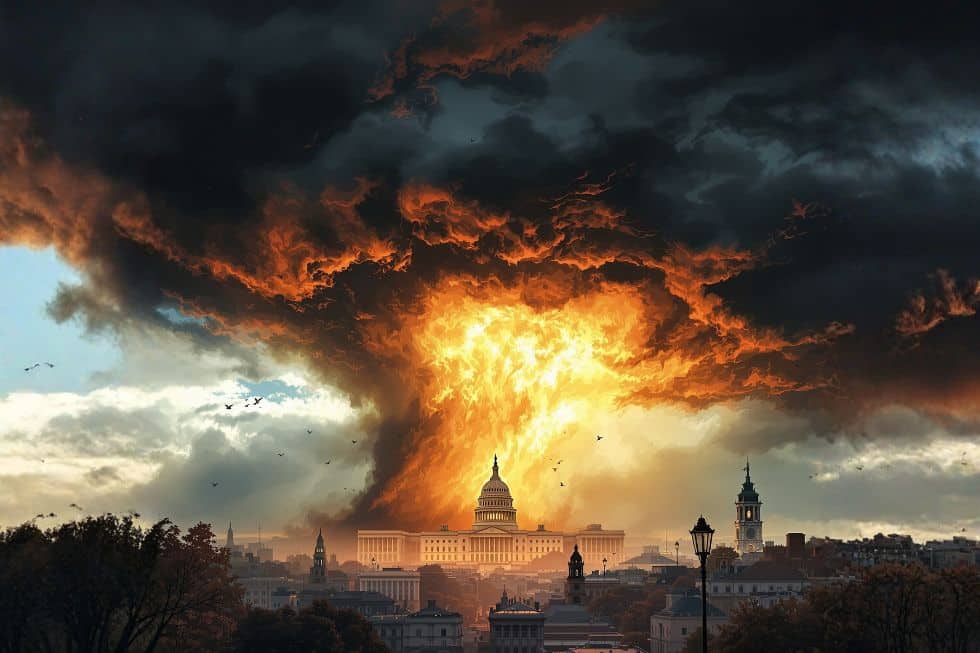



In William Shakespeare’s canon, the most obviously diabolical presences are those of the three witches in what actors superstitiously call, “The Scottish Play.” Legend has it that at its initial performance in 1606, one of the lead actors died on stage. Since then, actors who may well be delighted with the opportunity to play a role in one of the greatest dramas of all time, have studiously refrained from saying aloud the play’s actual title: Macbeth.
Some would make the case that Iago in Othello was the closest equivalent among Shakespeare’s dramatis personæ to an incarnation of the devil. In the very first scene, Iago shares with his accomplice, Roderigo, this confidence: that “I am not what I am.”
If he is not, as advertised in the playbill, the man called Iago, the loyal ensign (ancient) in the service of a Venetian General named Othello, who could he be other than the devil himself? Iago isn’t just duplicitous. In the final act, when his evil acts produce their effects for everyone to see, a Venetian noble calls him a “Spartan dog, / More fell than anguish, hunger or the sea,” as well as a “hellish villain” who will be judged and tortured, but apparently not executed. You can’t, after all, kill an immortal being.
There’s one essential thing the witches and Iago have in common: their mastery of the art of “equivocation.” You could say that equivocation simply means lying, but it’s much more subtle than simple prevarication. The three witches never technically “lie” to Macbeth. Instead, they poison his mind with double-edged prophecies. On the surface, everything they say is incontestably true. And it sounds straightforward.
Bewitched and “rapt withal”
Following a successful battle with treasonous forces, Macbeth encounters the witches who surprise him with an unexpected greeting, first calling him Thane of Cawdor, a title he doesn’t hold. They follow this with, “All hail, Macbeth, that shalt be King hereafter.” How could that be possible, Macbeth wonders, since he isn’t in a line of succession nor is he close to King Duncan? The witches, however, know what they are doing. They also know that if they have any credibility with Macbeth, he will begin to believe that he is destined (or even predestined, in a Scottish Calvinist sense) to one day wear the crown. Shortly after that, however, when King Duncan names his son Malcolm heir to the throne, Macbeth, coaxed by his nervous and nervy wife, begins the process that could be described as assisting predestination to take its course.
In other words, the witches tell Macbeth what he wants to hear while hiding what they know the endgame will look like in reality. Believing the prophecy, the tragic hero becomes not the beneficiary of it but the agent of its realization. He works up the courage (again with the help of his wife) to murder the king who has just rewarded him with a new title of nobility as a recompense for his heroism in battle.
As the play progresses, wracked by guilt and fearful of being found out after securing the crown, Macbeth becomes an authentically paranoid despot, suspecting not only that his enemies will seek revenge but that his allies will betray him. At that point, the witches seek to reassure the anxious king, now suffering regularly from sleepless nights. They announce that two improbable conditions would be required should anyone try to unseat him. First, Birnam Wood must come to Dunsinane, a clear geographical impossibility. And just as unlikely, “None of woman born shall harm Macbeth.” He might be killed by a lion or a bear, but since all humans are “from women born,” he understood there was no chance a human enemy might harm him. Thank you, predestination!
In the final act, believing himself secure, Macbeth confidently confronts his enemy Macduff in battle. Before delivering the fatal blow that ends Macbeth’s life and reign, the combative nobleman whose wife and children Macbeth had recently murdered “in one fell swoop” takes the trouble to explain that he was not “born,” but was “from his mother’s womb untimely ripped.”
As for Birnam Wood, well, as they maneuvered to attack Macbeth’s position at Dunsinane, Malcolm’s troops cut off branches of the trees in Birnam Wood. It would serve as camouflage to disguise their advance towards Dunsinane. Literally the wood of Birnam was in their hands. In both cases, Macbeth belatedly learned, the witches had not lied.
Macbeth in West Asia
Why dwell on Shakespeare’s clever diableries today, in a world so radically different from the medieval Scotland that provided a setting for Shakespeare’s play? We now inhabit a post-Enlightenment world from which witches and devils have been banished by science.
That legitimate question has two answers. The first is that Shakespeare had a pretty good handle on human psychology, especially when it manifested itself in acts of war and wanton murder. And we are living through a period of war and murder. The second is that there have been reports in the news that for some of its key proponents, our week-old war in Iran launched collaboratively by the United States and Israel may stand as a modern case of people believing that prophecies that define predestined outcomes are now playing out, and it’s our role to fulfill them.
The Guardian reports that “US military commanders have been invoking extremist Christian rhetoric about biblical ‘end times’ to justify involvement in the Iran war to troops, according to complaints made to a watchdog group.” It cites one commander who “urged us to tell our troops that this was ‘all part of God’s divine plan’ and he specifically referenced numerous citations out of the Book of Revelation referring to Armageddon and the imminent return of Jesus Christ.” Getting even more specific, we learn that “President Trump has been anointed by Jesus to light the signal fire in Iran to cause Armageddon and mark his return to Earth.”
Is US President Donald Trump aware of this? And might he himself believe it? Thanks to independent journalist Tucker Carlson, who recently interviewed the US ambassador to Israel, Mike Huckabee, we know that key people in Trump’s administration believe that the plan Israeli Prime Minister Benjamin Netanyahu has been pushing for an expanded Eretz Israel (Greater Israel) is justified by texts in the Bible. They also believe that the extent of Greater Israel encompasses the territory of numerous neighboring countries.
It’s quite possible that Trump, as always, is focused on two ideas: securing other nations’ resources and feeling that he is in control to the point of dictating solutions to other nations. Anyone even vaguely attempting to understand Trump’s unique psychological profile and rhetorical style, will have noticed that The Donald practices his own brand of equivocation, thanks to which, just as for Shakespeare’s witches, “Fair is foul and foul is fair.” For all we know, Trump, not known to be an avid churchgoer, may deem the apocalyptic fundamentalism adhered to by multiple members of his team to be nothing more than superstitious nonsense entertained by gullible (but useful) people. But, at the same time, his profound narcissism may convince him that it might just be true.
Despite being a Christian king, Macbeth was not a religious man. He made that clear in his famous soliloquy in which he informs us that…
“Life’s but a walking shadow, a poor player,
That struts and frets his hour upon the stage,
And then is heard no more. It is a tale
Told by an idiot, full of sound and fury,
Signifying nothing.”
Macbeth trusted the words of the witches because they described a reality he could see and touch. His problem with equivocation was that the words he processed not only didn’t perfectly match the reality they referred to, the witches designed them to create an unjustified belief.
The question we must ask today it this: Are our governments and media playing the witches’ game? And if so, why? Witches were supposedly handmaids to the Devil and didn’t need to exert their own reasoning powers. One sometimes gets the impression today that the media are in the same relationship with our complex power structures, of which governments are only one supposedly efficient component.
At the beginning of the play, Macbeth is a patriotic Scotsman willing to risk his life for king and country. The witches take him by surprise and capture his attention. At several points characters describe Macbeth as “rapt,” which Shakespeare scholar Emrys Jones once pointed out to me was a pun on “wrapped.” (Pay attention to the clothing imagery in the play was his message). “Rapt” shares its etymology with “raped.”
When in the early scenes Macbeth and his fellow friend Banquo learn from the king that the witches’ first prophesy had already come to pass — that Macbeth would now bear the title Thane of Cawdor — Banquo exclaims: “What! Can the Devil speak true?” For Banquo considers this an open question. In contrast, Macbeth quickly comments, “The greatest is behind,” a phrase that translates as, “Mission half accomplished.” Where Banquo articulates suspicion of the witches’ intentions, Macbeth indulges in wish fulfillment, imagining his glorious future. Later in the play, of course, Macbeth has Banquo killed.
Would it be abusive to see this as a parable for the modern world? Macbeth, the brave and honest Scot, buys into the manipulative discourse of the witches (the media) and, with the assistance of his frustrated wife (a woman who has “given suck” but apparently has no living children!), convinces himself that he was predestined to carry out a plot he himself had to invent.
It’s difficult to deny a hard historical observation, though there are plenty of people who will deny it. It is that within the largely secular competitive capitalist culture of the US, where people claim to believe meritocracy is the key to a successful economy, the idea of predestination — and particularly Biblical predestination — is still rife. This is not the case in Europe, but, though far from universal, it appears to be firmly anchored in the US psyche.
Americans have a penchant for identifying themselves with missions that appear to be ordained by either divine or transcendent historical logic. We can now see that the ironclad partnership with Israel, initially designed around a different kind of pragmatic historical logic, has yoked together American fundamentalist Christians and the aggressive political class of Israel, both of whom rely on their interpretation of divinely inspired text to draw conclusions about how to treat their neighbors (badly, it seems).
Birnam Wood never did come to Dunsinane, but Birnam wood did make the voyage. Biblical texts about Amalek, the “great nation” of Genesis 12, the drama Armageddon, may convey a message the faithful need to be aware of, but what they mean is not necessarily what the media, an Israeli prime minister or a US ambassador want you to think they mean.
Talk about “poor players” spouting “sound and fury, signifying nothing.” Even after realizing that he had been had by the witches and that his predestined fate as King of Scotland was in shambles, Macbeth comforted himself to the end with the idea that no man “of woman born” might harm him.
Are today’s practitioners of predestined missions working under the same illusions? There’s good reason to think so. Kings or their equivalent will be murdered and children slaughtered as a consequence. Economic chaos is becoming the norm. We’re watching it happen… just as other people are certain a modern version of Birnam Wood will never arrive in Dunsinane.
*[The Devil’s Advocate pursues the tradition Fair Observer began in 2017 with the launch of our “Devil’s Dictionary.” It does so with a slight change of focus, moving from language itself — political and journalistic rhetoric — to the substantial issues in the news. Read more of the Fair Observer Devil’s Dictionary. The news we consume deserves to be seen from an outsider’s point of view. And who could be more outside official discourse than Old Nick himself?]
[Lee Thompson-Kolar edited this piece.]
The views expressed in this article are the author’s own and do not necessarily reflect Fair Observer’s editorial policy.
For Historians, Was This a Pearl Harbor or a Suez Moment? Part 4
Given the gravity of events, are we permitted to laugh at the absurdity of US President Donald Trump’s rhetoric in...
Force Without Legitimacy: Bombing Iran Will Not Produce Regime Change
The US-Israeli strike campaign against Iran aims to topple the regime but overlooks the resilience of Iran’s authoritarian power structure,...
A War to End All (Middle East) Wars?
The US and Israel’s strike on February 28 eliminated Iran’s Supreme Leader Ali Khamenei and other top leaders, revealing deep...

FO° Talks: The Culture of Culture, Part 1 — The Classical Music Concert
Peter Isackson and opera and theater director Emily Hehl discuss the evolving role of classical concerts, traces their origins and...

Iran and Israel: In Conclusion, There’s No Conclusion
When all wars are planned to be endless, nothing can be concluded, either by negotiation or by recognition of an...
Support Fair Observer
We rely on your support for our independence, diversity and quality.
For more than 10 years, Fair Observer has been free, fair and independent. No billionaire owns us, no advertisers control us. We are a reader-supported nonprofit. Unlike many other publications, we keep our content free for readers regardless of where they live or whether they can afford to pay. We have no paywalls and no ads.
In the post-truth era of fake news, echo chambers and filter bubbles, we publish a plurality of perspectives from around the world. Anyone can publish with us, but everyone goes through a rigorous editorial process. So, you get fact-checked, well-reasoned content instead of noise.
We publish 3,000+ voices from 90+ countries. We also conduct education and training programs
on subjects ranging from digital media and journalism to writing and critical thinking. This
doesn’t come cheap. Servers, editors, trainers and web developers cost
money.
Please consider supporting us on a regular basis as a recurring donor or a
sustaining member.
Will you support FO’s journalism?
We rely on your support for our independence, diversity and quality.





Comment