




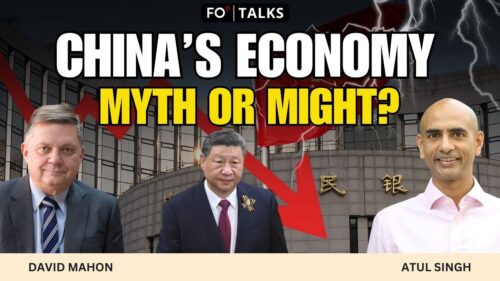
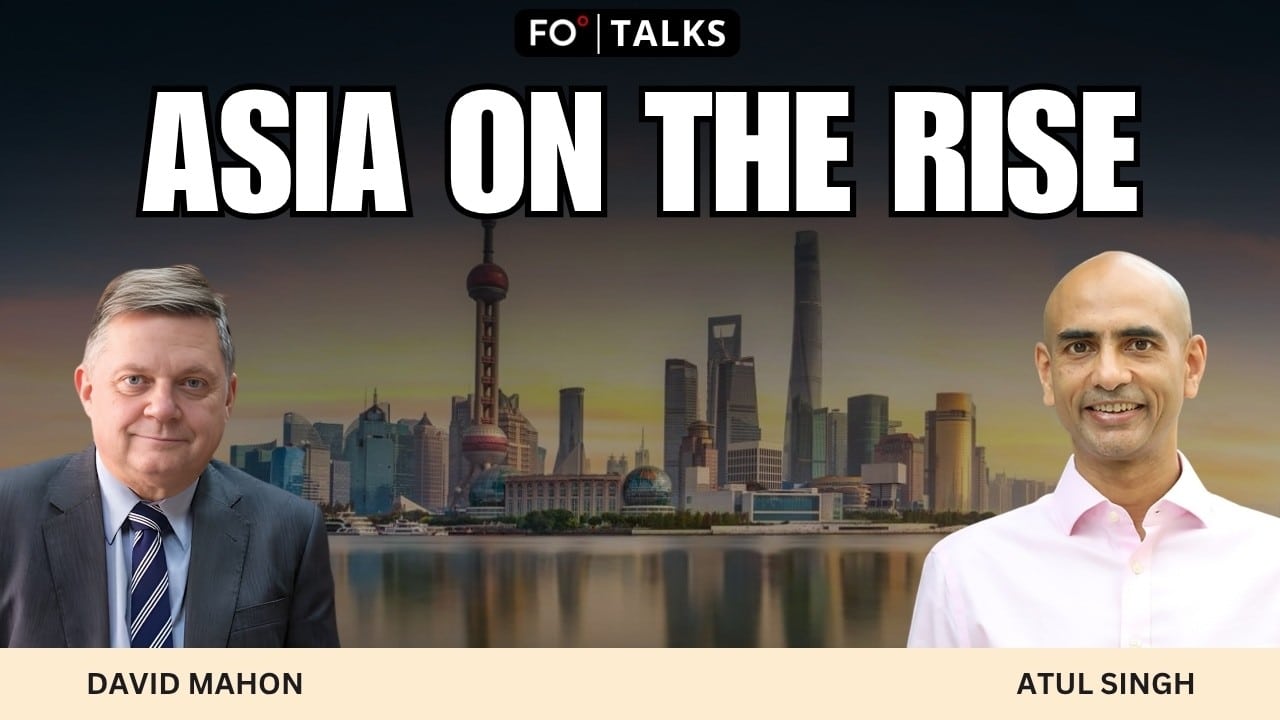
Editor-in-Chief Atul Singh and Beijing-based Kiwi investor David Mahon discuss the increasingly unavoidable relationship between India and China. Despite border tensions, distrust and competing regional ambitions, neither country can afford a clean decoupling in a fragmenting multipolar world. Singh presses on security fears and India’s policy constraints, while Mahon argues that interests, not grievances, will ultimately shape the relationship.
Border tensions, “dehyphenation” and the logic of restraint
Singh opens with the core question: Can trade and economic ties be separated from the border dispute and wider strategic rivalry? Mahon says yes, pointing to periodic high-level pragmatism and long stretches of restraint along disputed lines. He argues that escalation offers little strategic gain for either side, noting, “To have any military conflict there at this point for either side is actually pointless.”
Singh counters with India’s security anxieties: Beijing’s ties with Pakistan, the China–Pakistan Economic Corridor and the broader “string of pearls” concern over Chinese influence in South Asia. Mahon acknowledges these fears but suggests Delhi often overestimates Beijing’s political control in neighboring states. He cites Nepal as an example, arguing that domestic grievances, not Chinese orchestration, better explain recent unrest. Reduced engagement breeds suspicion, while dialogue, even without trust, limits miscalculation.
The trade imbalance and India’s supply-chain dependence
Turning to economics, Singh highlights India’s roughly $100 billion trade deficit with China and its continued reliance on Chinese-manufactured inputs, despite post-2020 restrictions. Mahon frames the imbalance as a structural feature of China’s role as the world’s manufacturing hub rather than a uniquely Indian failure. He agrees that the dependency is real, however.
Singh lists the pressure points: industrial machinery, electronics, solar cells and active pharmaceutical ingredients that underpin India’s drug exports. Even where India’s exports are rising, such as Apple smartphone assembly for the US market, key components still originate in China. Diversification is occurring at the margins, but core industrial linkages remain Chinese.
China as a catalyst: Mahon’s Zhu Rongji argument
Mahon proposes that India treat China less as a threat to exclude and more as a competitor-investor to harness. He invokes former Chinese Premier Zhu Rongji, who used China’s entry into the World Trade Organization to force domestic reform. External competition compels regulators to simplify rules, courts to enforce contracts and firms to raise productivity.
Applied to India, this means selective openness. Mahon proposes allowing Chinese investment in sectors such as electric vehicles under clear conditions that require technology transfer and skill development. The aim is not speed but discipline: gradual engagement that strengthens India’s manufacturing base rather than overwhelming it.
Singh reinforces the institutional critique, arguing that India’s administrative and judicial systems impose severe friction on investment. Together, they suggest that without regulatory reform, India’s ambitions to rebuild manufacturing — from roughly 13% of GDP today — will remain constrained.
China’s slowdown, US pressure and a multipolar reality
Singh challenges the idea that China’s economic slowdown will turn India into a dumping ground for excess production. Mahon rejects the narrative of collapse, calling the idea that trade drives China’s growth “an IMF myth.” He stresses that “5% in an economy of the size and scale and complexity of China is absolutely huge.”
On investment, Mahon broadens the lens, arguing that India’s weak foreign direct investment reflects a global slowdown and uncertainty generated by US policy under US President Donald Trump. Singh maintains that domestic policy choices have amplified the damage.
Both agree that India cannot ignore the United States, given its trade surplus and deep cultural ties. Mahon’s answer is structured hedging: deepen selective economic engagement with China while attracting other investment so no single relationship dominates. He even suggests concentrating early reforms in one or two Indian states, echoing China’s early special economic zones.
Pragmatism, nationalism and execution risk
Mahon outlines three broad outcomes. The best case is a “beneficially transactional” relationship in which business proceeds despite political friction. The worst-case scenario is a nationalism-driven shock or a poorly managed opening that triggers scandal or industrial accidents and poisons public opinion. Singh adds leadership risk: Both Chinese President Xi Jinping and Indian Prime Minister Narendra Modi are aging leaders, and succession periods can encourage opportunistic nationalism.
India and China may distrust each other, but supply chains, investment needs and a weakening Western-led order make engagement more likely than separation. For Mahon, the strategic opportunity is to turn that engagement into a catalyst for Indian reform rather than a story of permanent dependence.
[Lee Thompson-Kolar edited this piece.]
The views expressed in this article/video are the author’s own and do not necessarily reflect Fair Observer’s editorial policy.

































Comment