

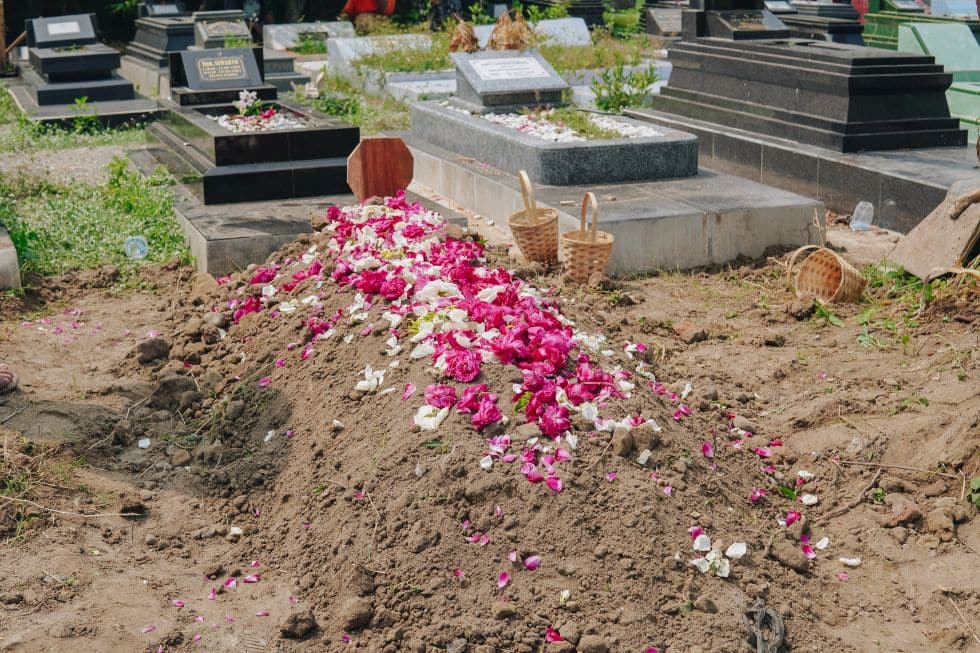


The rising movement for green burial isn’t just a niche environmental trend — it’s a profound cultural counternarrative to the American funeral industry. This practice, also known as natural burial, is a direct challenge to the social, economic and political foundations of a system that sells us an expensive, polluting farewell. Offering a path toward ecological restoration and greater meaning in grief.
The current American way of death is built on an avoidable lie. We’re conditioned to believe that a respectful farewell requires a sealed metal casket, a concrete vault and a body injected with harsh, carcinogenic chemicals. But this “toxic funeral” model is neither ancient, globally common nor legally required. It is a largely 19th-century American invention — a post-Civil War marketing success story that has morphed into a destructive industrial standard.
The environmental and economic toll of a toxic tradition
The environmental consequences of this approach are staggering. Annually, the traditional US burial system commits approximately 4.3 million gallons of formaldehyde-based fluid (a chemical preservative and potential carcinogen), 20 million board feet of hardwoods and 1.6 million tons of concrete to the earth.
Our cemeteries have become ecological dead zones, meticulously manicured lawns maintained with fertilizer and gasoline, turning sacred ground into resource-intensive, land-guzzling monuments to vanity.
The financial cost is equally obscene. With the median cost of a conventional funeral easily approaching $10,000, the industry has successfully corporatized grief, turning a moment of spiritual significance into a high-pressure sales transaction.
Crucially, the centerpiece of this system — embalming — is not legally required in the vast majority of the US. Green burial simply adheres to existing law while rejecting these costly, optional industrial standards.
Reclamation: grieving with integrity
Choosing a natural burial is, for many, an act of spiritual integrity and social defiance against the funeral-industrial complex. It allows the final disposition to reflect a life lived with environmental consciousness, bringing us back to the traditions practiced by most of the world and much of human history.
For faiths like Judaism and Islam, some elements of green burial align well with their mandates: immediate burial, nonembalming and simple shrouds to facilitate the swift return of the body to the earth. Beyond formal religion, natural burial has profound therapeutic value.
The process shifts the ritual from a sterile viewing in a distant funeral home to a family-led event, offering a deeply therapeutic experience that allows for an active, meaningful “continuing bond” with the deceased. It is a return to an affordable, dignified and democratic way to say goodbye.
The global context and rising adoption
The philosophy behind green burial is not revolutionary; it is a global norm. Many cultures, particularly in Africa and Asia, practice natural burial out of necessity, religious obligation or deep tradition. In Western nations such as the UK, Canada, Australia and New Zealand, the natural burial movement is well established, with hundreds of certified sites.
Germany has seen significant growth in “sanctuary forests” or Friedwälder, where ashes are interred at the base of trees, providing a space-efficient and beautifully sustainable alternative. In the US, all states technically permit green burial, as embalming is generally optional. However, states are now creating specific, supportive regulatory frameworks for dedicated sites.
The movement’s footprint is expanding rapidly, with states like California, Washington, Texas and New York seeing a significant increase in the establishment of hybrid and dedicated natural burial cemeteries. This reflects the reality that the primary hurdle is no longer the law itself, but overcoming regulatory inertia and the deep-seated resistance of the conventional funeral industry.
The power of perpetual protection (conservation burial)
The most impactful form of this movement is the Conservation Burial Ground (CBG). This model moves far beyond simply reducing harm; it actively protects and restores land in perpetuity.
In a CBG, one’s final resting place becomes a living memorial. Burial fees are directly channeled into the long-term stewardship of the land. Legal agreements, often in the form of a conservation easement held by a land trust, permanently restrict future development.
The burial funds native habitat restoration, enhances biodiversity and sequesters carbon. The intentional shallow depth of burial maximizes aerobic decomposition and nutrient cycling, directly benefiting the surrounding ecosystem. It is a final act that is regenerative rather than extractive.
Addressing concerns and moving forward
As with any shift in cultural practice, concerns have been raised, primarily focusing on public health and land use. Critics often express fears that unembalmed bodies could contaminate groundwater or be exhumed by animals.
However, scientific studies and the experience of centuries of natural burial globally demonstrate that when basic, common-sense regulations are followed — such as proper burial depth and mandated setbacks from water sources, which many states already have — the risks are negligible.
Furthermore, the concern over land use is easily dismissed by the Conservation Burial model, which turns the land from an ecologically inert lawn into a perpetually protected, biodiverse preserve. Momentum is building for the greening of burial practices.
The National Funeral Directors Association (NFDA) reports that over 60% of consumers are interested in exploring green funeral options. However, there are still many obstacles to overcome, such as:
- Awareness and Accessibility: The primary hurdle remains a lack of public knowledge and the slow adoption by the established funeral industry. Many consumers and funeral directors remain largely unaware of green burial as a legal, accessible option, leading to a gap between consumer interest and provider availability.
- Regulatory Inertia and Zoning: Zoning laws and municipal ordinances were written for the conventional, lawn-park model. Adapting these regulations to accommodate the “wilder,” natural look of a CBG requires political advocacy and legal innovation.
- The Future of Deathcare: The industry’s response includes the rise of hybrid cemeteries that dedicate specific sections to natural burial, and the development of new alternatives, such as human composting (natural organic reduction), which are gaining legal acceptance in several states.
The only real concerns are navigating the lack of a uniform definition — leading to “greenwashing” by some conventional providers — and the challenge of zoning laws, which were simply not written to accommodate the “wilder,” natural look of a conservation site.
The green burial movement is poised to reshape the funeral industry. It proves that the final disposition of the human body can be a regenerative act. The choice is clear: We can continue to bury our loved ones in an expensive, polluting box, or we can choose to return them to the earth to enrich the living land they walked upon, leaving behind a legacy of conservation instead of consumption.
[Zania Morgan edited this piece.]
The views expressed in this article are the author’s own and do not necessarily reflect Fair Observer’s editorial policy.







Join the conversation
Share your perspective
Log in to share your thoughts and take part in the discussion.