


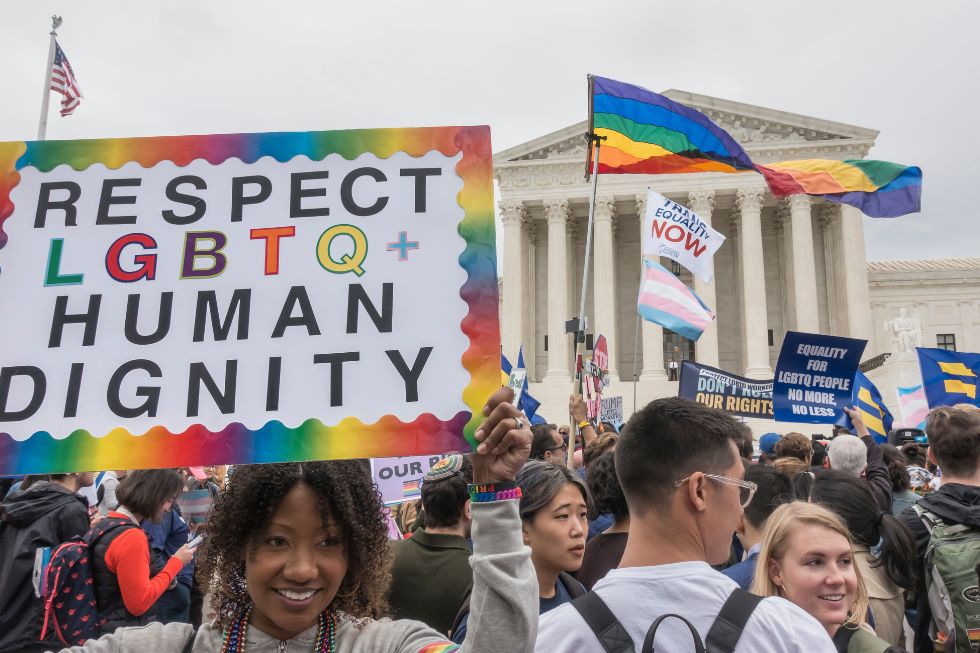



In January 2026, the Supreme Court of the United States concluded oral arguments in two closely watched cases — West Virginia v. B.P.J. and Hecox v. Little — with judgments expected in the coming months. At issue in both cases was whether state laws that barred transgender athletes from participating on girls’ and women’s sports teams violated the Equal Protection Clause of the 14th Amendment and Title IX of the Education Amendments of 1972. Together, these cases are poised to have far-reaching consequences for the future of girls’ and women’s sports in the United States.
Both these cases also come in the heels of a more recent Supreme Court decision that upheld a Tennessee law that banned puberty blockers and hormone therapy for transgender minors. In that case (United States v. Skrmetti, 2025), the Court held that the law did not violate the Equal Protection Clause and followed a now-familiar pattern: the verdict was delivered along a six–three ideological split, with all three Democratic appointees in dissent and the Court’s six Republican appointees forming the majority.
The Court’s ideological divide
Much has already been said about the Supreme Court’s ideological divide — a divide that long predates the present moment. What is particularly worrying, however, is that over the past decade, the Court’s Republican appointees have voted almost uniformly against the expansion of LGBTQ+ rights in nearly every major case before them.
This trajectory stands in stark contrast to the Court’s landmark decision in Obergefell v. Hodges (2015), which legalized same-sex marriage nationwide and marked the culmination of a period of steady expansion of LGBTQ+ constitutional protections, shaped by earlier, LGBTQ+-affirming Supreme Court decisions.
Despite that, Obergefell itself was decided by a narrow five–four margin. Four Republican appointees — Justices Clarence Thomas, Samuel Alito, Antonin Scalia and Chief Justice John Roberts — dissented, and the four Democratic appointees — Justices Elena Kagan, Ruth Bader Ginsburg, Stephen Breyer, and Sonia Sotomayor — formed the majority, joined by Justice Anthony Kennedy. Although Kennedy was a Republican appointee, he was known for his unpredictable swing votes on controversial issues, and in Obergefell, he provided the majority with its crucial fifth vote and even wrote the majority opinion.
The Court’s rightward turn
Since Obergefell, however, both the Court’s composition and its jurisprudential approach to LGBTQ+ rights have changed dramatically. Between 2015 and 2026, the United States experienced three presidential administrations: first, a Republican (Donald Trump [2017–2021]), then a Democrat (Joe Biden [2021–2025]), and thereafter a Republican again (Trump [2025-present]). During his first term alone, Trump successfully appointed three Supreme Court justices: Neil Gorsuch to replace Justice Antonin Scalia; Brett Kavanaugh to replace the more moderate Justice Anthony Kennedy; and Amy Coney Barrett to replace Justice Ruth Bader Ginsburg following her death in office.
These appointments moved the Court from being precariously balanced to being firmly aligned with the right. Moreover, President Biden’s sole appointment — Justice Ketanji Brown Jackson (who replaced Justice Stephen Breyer) — did not alter the ideological balance at all. If, during his second term, Trump were to replace either Justice Clarence Thomas or Justice Samuel Alito, two of the Court’s oldest members, he would have appointed five sitting justices — an extraordinary level of influence in modern Supreme Court history.
It should be noted that this rightward turn was not accidental. Rather, it was the product of decades of sustained advocacy by leaders of the conservative legal movement — most visibly in the campaign to restrict abortion rights. This project not only reshaped the Court’s composition but ultimately led to the dismantling of the constitutional right to abortion itself.
Also central to this effort was opposition to the “living Constitution” doctrine, an approach commonly associated with jurists who have been more receptive to the expansion of LGBTQ+ rights. This approach understands constitutional meaning as evolving over time in response to changing social conditions. Instead, Trump’s appointees (and most, if not all, legal conservatives) overwhelmingly embrace “legal originalism” — an interpretive method that limits constitutional protections to those rights understood to exist at the time of the Constitution’s framing.
Under this framework, the US Constitution’s capacity to recognize LGBTQ+ rights is sharply constrained, if not foreclosed altogether. And nowhere is this jurisprudential commitment more clearly articulated than in Dobbs v. Jackson Women’s Health Organization (2022), the landmark decision that overturned Roe v. Wade (1973) and eliminated the federal, constitutional right to abortion.
The Court’s articulation in Dobbs: a key victory for the conservative legal movement
In Dobbs, the majority adopted a “history and tradition” test, declaring that Roe was “egregiously wrong from the start.” According to the majority, the 14th Amendment’s Due Process Clause protected only those substantive rights that were deeply rooted in American history and tradition. Because the right to abortion did not meet that threshold, it could not be recognized as a constitutionally protected right.
Although the Dobbs majority insisted that its reasoning applied only to abortion, critics immediately warned that the same logic could be extended to other rights — including the right to same-sex marriage and the right to same-sex intimacy. After all, LGBTQ+ equality was never rooted in American “history and tradition.” To the contrary, criminalization, repression and exclusion were.
That warning has increasingly borne out in the years since Obergefell. Since 2015, the Supreme Court has decided a series of cases that have narrowed protections for LGBTQ+ people in multiple fora. In two seminal public-accommodations cases, the Court held that businesses could refuse services to same-sex couples on religious grounds (Masterpiece Cakeshop v. Colorado Civil Rights Commission, 2018) and on free-speech grounds (303 Creative LLC v. Elenis, 2023), even where state antidiscrimination laws prohibited such refusals.
On transgender rights, the Court has, thus far, allowed the Trump administration’s ban on transgender military service to take effect, permitted the enforcement of a State Department’s policy that requires US passports to list sex solely according to an individual’s birth certificate, without regard to gender identity (Orr v. Trump, 2025), upheld state prohibitions on gender-affirming care for transgender minors (United States v. Skrmetti, 2025), and now appears poised to uphold bans on transgender girls’ participation in girls’ and women’s sports.
There are only two notable outliers in this broader pattern. The first is Bostock v. Clayton County (2020), in which the Court held that Title VII’s prohibition of sex discrimination included discrimination based on sexual orientation and gender identity — a decision supported by two Republican appointees alongside the Court’s Democratic bloc. The second is Masterpiece Cakeshop itself, where two Democratic appointees joined the Republican majority.
Apart from these limited exceptions, LGBTQ+ rights cases have been overwhelmingly fractured along ideological lines.
The future of LGBTQ+ rights cases in America
It is no secret that ideology plays a significant role in judicial decision-making at the level of the Supreme Court. The oft-invoked image of judges as neutral umpires — famously described by Chief Justice Roberts as officials who merely “call balls and strikes” — has increasingly come to resemble a constitutional myth.
While scholars continue to debate the precise role that ideology plays in judicial reasoning, it is clear that as LGBTQ+ issues become more socially and politically contentious, legal outcomes will increasingly be shaped by prevailing ideological currents. Legal reasoning — particularly in areas such as the scope of substantive due process and equal protection — is malleable enough to produce markedly different outcomes depending on a judge’s ideological commitments.
It is therefore unsurprising that in recent times, almost no major LGBTQ+ rights issue has reached a unanimous decision by the Court, except one: Ames v. Ohio Department of Youth Services (2025). In that case, the Court unanimously ruled in favor of a heterosexual woman who claimed she had experienced “reverse discrimination” at the hands of her LGBTQ+ supervisors. But this unanimity may be explained by the fact that Ames was not primarily about LGBTQ+ issues per se, but rather about whether a majority-group plaintiff had to meet a special evidentiary burden under Title VII to prove discrimination. In fact, the Biden administration itself filed an amicus brief supporting the plaintiff, making this one of those rare cases where amici and justices across the ideological spectrum came to an agreement on an issue as vexed as the scope of equality jurisprudence.
But this exception notwithstanding, it is quite clear that the future trajectory of LGBTQ+ rights before the top Court will depend less on neutral principles of law (if such principles can be deemed “neutral” at all) and more on which interpretive doctrines carry the most authority — and, by extension, the greatest number of votes on the bench, at any given moment. For LGBTQ+ advocates and allies, this scenario demands a clear-eyed understanding of what an adverse ruling in the upcoming transgender athletes’ cases can portend for the future of constitutional protections in the many other LGBTQ+ rights cases yet to come. That the likely outcome of most of these cases can be anticipated with relative certainty even before a judgment is delivered speaks volumes about the present state of the Court’s LGBTQ+ rights jurisprudence.
[Kaitlyn Diana edited this piece.]
The views expressed in this article are the author’s own and do not necessarily reflect Fair Observer’s editorial policy.
MAGA’s Trans Strawman: All Filler, No Brain
Make America Great Again-aligned media and politicians exploit a “trans strawman,” portraying trans people as violent or manipulative despite evidence...
FIFA Under Fire: Trump’s Transgender Ban Sparks Dilemma
The topic of transgender people competing in sports has been hotly debated recently. The new US President Donald Trump has...

It’s Preposterous to Claim that Trump Supports the LGBTQ Community
Since Donald Trump’s election in 2016, Republicans have claimed that Donald Trump was the most LGBTQ+ friendly president ever to...
With Midterm Elections just days away, LGBTQ+ issues continue to provoke American conservatives
Cultural issues continue to animate conservatives who care not only about abortion but about LGBTQ+ issues across the country.

Support Fair Observer
We rely on your support for our independence, diversity and quality.
For more than 10 years, Fair Observer has been free, fair and independent. No billionaire owns us, no advertisers control us. We are a reader-supported nonprofit. Unlike many other publications, we keep our content free for readers regardless of where they live or whether they can afford to pay. We have no paywalls and no ads.
In the post-truth era of fake news, echo chambers and filter bubbles, we publish a plurality of perspectives from around the world. Anyone can publish with us, but everyone goes through a rigorous editorial process. So, you get fact-checked, well-reasoned content instead of noise.
We publish 3,000+ voices from 90+ countries. We also conduct education and training programs
on subjects ranging from digital media and journalism to writing and critical thinking. This
doesn’t come cheap. Servers, editors, trainers and web developers cost
money.
Please consider supporting us on a regular basis as a recurring donor or a
sustaining member.
Will you support FO’s journalism?
We rely on your support for our independence, diversity and quality.





Comment