






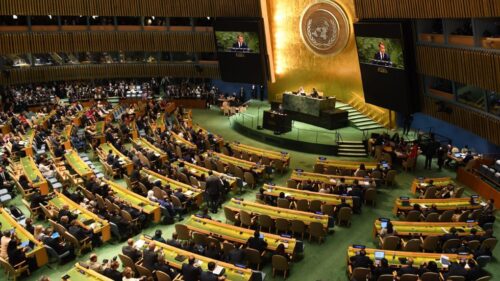
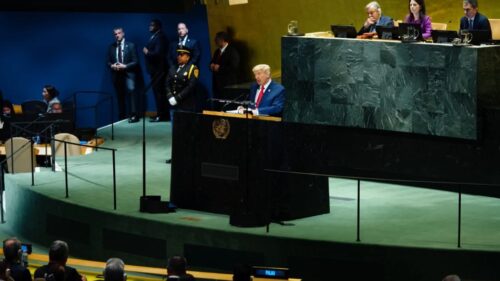
International human rights standards have come a long way since the adoption of the Universal Declaration of Human Rights in 1948. Yet, grave violations deemed unthinkable in some parts of the world continue to unfold elsewhere. The UN remains the highest-level forum where all states collectively define, protect and promote human rights. Still, it’s easy to roll your eyes at the UN — another session, another resolution, another statement. Yet beneath this rhythm lies a system that matters. Its fact-finding missions, special rapporteurs and normative guidance have advanced global standards in areas such as the absolute prohibition of torture or the global push to abolish the death penalty.
But how, exactly, are human rights addressed on the global stage? How does the UN set the tone, push boundaries and move the international consensus forward? The answer to these questions lies in the institution’s and its member states’ tremendous propensity to be extremely cautious. This quality explains not only how the UN functions but also why its progress on human rights is so often slower than we’d like. Finding a way to both navigate and overcome this issue may enable the UN to raise the bar moving forward.
Caution over ambition
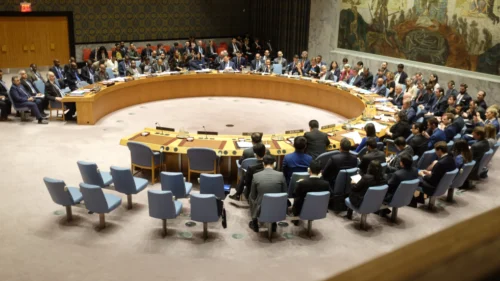
Anyone who observes the UN will quickly notice that caution, rather than ambition, is one of the most clear-cut themes in its culture. The UN Human Rights Council is the central UN body tasked exclusively with addressing human rights issues. Yet much of its work centers on maintaining the status quo: reintroducing the same thematic and country-specific resolutions, year after year, often with only minor updates to the text.
For instance, the EU’s flagship resolution on freedom of religion or belief has been introduced and adopted by consensus every year since 2010. In the beginning, each year extended the resolution’s scope, but over time, the added value of adopting the text annually became limited to political reaffirmation, continuation of core projects and signaling ongoing relevance. While introducing a resolution on the same topic every year or two helps to signal continued attention, track developments and reaffirm the issue’s relevance in an evolving context, excessive repetition of the Council’s resolutions diverts its attention from addressing new issues and extending the scope of human rights in more innovative ways.
States generally avoid introducing resolutions that are likely to be rejected — even when doing so might serve to highlight urgent violations or test the Council’s resolve. Failed resolutions are rare, and that rarity is no accident. The reputational cost of proposing a draft that fails to pass is high. As a result, states prefer to recycle what is already known to work rather than push for progress that might prove politically divisive.
Hidden progress
This risk-averse logic does not spare even the most norm-driven actors. The EU, widely regarded as a champion of multilateralism and human rights, also operates within this cautious framework. In recent years, the EU introduced only a few new resolution topics such as the promotion and protection of human rights in the context of climate change, the rights of child and family reunification, human rights of women and girls in Afghanistan, and the human rights situation in Ethiopia. Most resolutions introduced on behalf of the EU were not designed to break new ground but to renew existing mandates or reaffirm previously established standards by avoiding unfriendly amendments and securing consensus.
These efforts should not be taken for granted; maintaining the resolution is also an active contribution to human rights standards. For instance, the EU’s failure to reintroduce its resolution on human rights violations in Ethiopia in 2023 did not go unnoticed and marked a significant failure in the consistent international response to well-reported atrocities. At the same time, it is evident that a strategy based on reinforcing the existing resolutions alone does not push the bar for human rights standards much higher.
The missing champion
The UN’s ability to push the limits of its caution and ambivalence is chiefly prevented by the lack of any clear member-state champion of ambitious norm-setting in today’s human rights diplomacy. The EU could be a natural candidate, but its hands are tied. Its internal coordination process, which requires unanimity among 27 member states, naturally leads to lowest-common-denominator outcomes. This limits its ability to champion the rights of sexual minorities and stand against polarizing genocides. Moreover, the EU tends to avoid transactional diplomacy, even when its global partners do not. This can significantly limit its negotiation power in a world where issue linkage across political and economic matters is an increasingly common bargaining strategy.
Other powers, such as China, approach the Council differently. Despite often holding conflicting views on human rights, especially on issues such as individual freedoms and minority protections, China does not hesitate to use its economic and political leverage to gain support for its positions. It links issues strategically and mobilizes regional blocs to shape votes in its favour. The EU, by contrast, refrains from such tactics in principle, which limits its influence in an increasingly competitive multilateral environment.
Raising the bar for human rights at the UN requires the emergence of a champion willing to face significant political and procedural challenges. Introducing new or more progressive human rights standards entails a high risk of failure, especially in a system where consensus is valued over confrontation. The failure of a resolution can result in reputational costs, including the perception of weakened credibility and diminished influence in future negotiations. Moreover, a champion must be able to mobilize sufficient support in an increasingly fragmented international environment.
In the context of growing polarization and transactional diplomacy, this often requires building leverage across multiple policy areas, which may require controversial strategies such as issue linkage. Without sufficient bargaining power, even well-drafted and morally justified proposals risk being amended beyond recognition, postponed or rejected. Therefore, any attempt to raise the bar will inevitably require a departure from the cautious modus operandi that currently characterizes the functioning of the multilateral human rights debate.
If the Human Rights Council is to move beyond ritual reaffirmation, it needs actors willing to spend political capital on pushing the boundaries of what is possible. Progress will come not from consensus maintenance alone, but from the rare champions prepared to navigate fragmentation, confront transactional diplomacy and risk reputational setbacks in order to raise the global standard for human rights.
[Kaitlyn Diana edited this piece.]
The views expressed in this article are the author’s own and do not necessarily reflect Fair Observer’s editorial policy.
The UN at 80: The Superpowers Have No Clothes
Global leaders mark the 80th anniversary of the UN as its founding powers face political turmoil and declining credibility. The...
The Final Split: How Europe Broke Apart Over Gaza
European leaders sought influence in the Middle East as tensions rose over Gaza and pressure mounted for a two-state solution....
Can You See Why the UN Is Bad at Peace?
In the period leading up to World War II, the major European powers competed with one another by expanding their...
Support Fair Observer
We rely on your support for our independence, diversity and quality.
For more than 10 years, Fair Observer has been free, fair and independent. No billionaire owns us, no advertisers control us. We are a reader-supported nonprofit. Unlike many other publications, we keep our content free for readers regardless of where they live or whether they can afford to pay. We have no paywalls and no ads.
In the post-truth era of fake news, echo chambers and filter bubbles, we publish a plurality of perspectives from around the world. Anyone can publish with us, but everyone goes through a rigorous editorial process. So, you get fact-checked, well-reasoned content instead of noise.
We publish 3,000+ voices from 90+ countries. We also conduct education and training programs
on subjects ranging from digital media and journalism to writing and critical thinking. This
doesn’t come cheap. Servers, editors, trainers and web developers cost
money.
Please consider supporting us on a regular basis as a recurring donor or a
sustaining member.
Will you support FO’s journalism?
We rely on your support for our independence, diversity and quality.





Comment