







 | ||||||||||||||
| ||||||||||||||
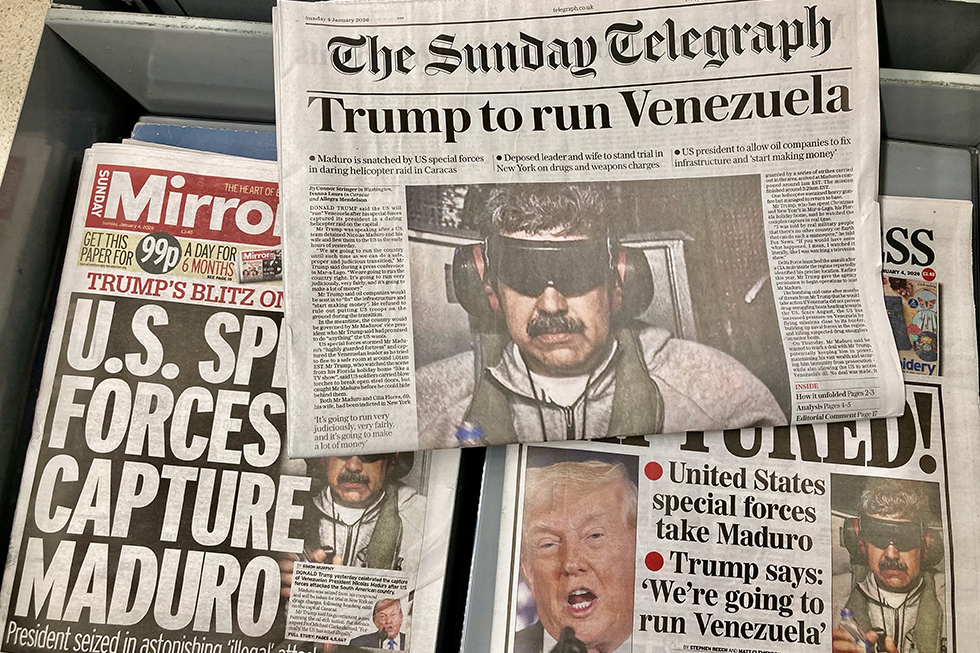
Dear FO° Reader, Greetings from the four corners of the world. Once again, we had a plan for what we wanted to write about this week, but the world scene decided otherwise; we had to adjust our goggles and change our route as the course of life in Venezuela took a sharp turn. The US’ arrest of Venezuelan President Nicolás Maduro is sparking interpretations and emotions from across the globe, so let us go on a tour — a media watch, as we called it back in the day. Sources: US ambassador to UN defends arrest of ‘narco-terrorist’ Maduro – NewsNation Trump’s intervention in Venezuela sparks mixed views of U.S. around the world – PBS News Hour A history of intervention Before we dive into this most recent intervention, it is important to look at the US’ history in Latin America. This is not the first time the US has invaded a South American country for regime change or to exploit wealth. There are many examples throughout the 20th century, divided into two sections: pre-World War II (WWII) and post-WWII. The first period was when the US’s aims were explicitly imperialist. This period included the Spanish–American War in 1898, which secured Cuba and the Philippines under America’s influence. Additionally, in 1903, the US waged a similar war against Colombia, Venezuela’s neighbor and a former member of Gran Colombia, to secure Panama and construct the Panama Canal.
via shutterstock Sources: U.S. interventions in Latin America and the Caribbean haven’t always gone as planned | NPR Gran Colombia | History, Attractions, Map, & Facts | Britannica Spanish-American War | Summary, History, Dates, Causes, Facts, Battles, & Results | Britannica The second period was explicitly about ideology: The US ran a campaign of political repression and supported fascists, juntas and right-wing dictators in the name of stopping the spread of Communism. This included overthrowing democratically elected governments at the behest of private companies, such as in Guatemala, to the failed Bay of Pigs invasion of Cuba and the complicated Iran–Contra deals. But by far the largest of these coups was Operation Condor, a prolonged series of campaigns that affected nearly every state in South America. This group of coups includes the bombing of Chile’s capital, the military dictatorship in Brazil and the support of human rights violations across the continent. Sources: History of Guatemala | Guatemala from 1931 to 1954 | Britannica Bay of Pigs invasion | Summary, Significance, & Facts | Britannica Views from around the world On Saturday, January 3, US Special Forces carried out a raid in Caracas, capturing President Nicolás Maduro and First Lady Cilia Flores. The Venezuelan leader faces US federal charges in the Southern District of New York, which include narcoterrorism conspiracy, cocaine trafficking conspiracy and weapons charges. These events followed months of rising tensions, resulting from numerous strikes on boats allegedly transporting narcotics to the US, seizures of Venezuelan oil tankers and a military buildup on Venezuela’s coast. Following the raid, Trump asserted that the US would “run” Venezuela until a “safe, proper and judicious transition” of power could occur. At a press conference and in subsequent remarks, Trump framed the operation as not only a law-enforcement action but a broader US responsibility to oversee the country during a period of political transition to ensure that Maduro’s departure did not leave a power vacuum or allow “someone else” hostile to Venezuelan or US interests to take control. Despite current tensions in the region, the US has continued to stir the geopolitical pot when it seized two Russian oil tankers with links to Venezuela in the North Atlantic and Caribbean, further escalating tensions with Russia. In the aftermath of the operation, many world leaders, including UK Prime Minister Keir Starmer and French President Emmanuel Macron, have welcomed the end of the Maduro regime. These states agree with the US and acknowledge Maduro’s lack of legitimacy. However, they criticize the US’s military action, emphasizing the importance of upholding international law. While many Venezuelan citizens celebrate, European and Latin American countries, as well as China, Russia and Iran, have condemned the use of force against a sovereign nation, and have encouraged using diplomatic measures to prevent further escalation. The global response to the Venezuela raid demonstrates two contrasting approaches to international order: one focused on institutional rules and legal restraint, and the other on strategic calculations and the perceived benefits of decisive action. As the political transition in Venezuela remains uncertain, the diplomatic and geopolitical repercussions of the operation continue to resonate across the hemisphere and beyond. Sources: ‘Deeply shocked’: World leaders react to US attack on Venezuela | BBC Trump says U.S. will run Venezuela after U.S. captures Maduro | Reuters World reacts to US strikes on Venezuela | Reuters A Timeline of Rising Tension Between the U.S. and Venezuela | The New York Times UK’s Starmer says it is for the US to justify actions in Venezuela | Reuters US sharply criticised by foes and friends over Maduro seizure | BBC US seizes two ‘shadow fleet’ tankers linked to Venezuelan oil | BBC The role of Congress, or lack thereof Domestically, the reactions to Trump’s act have been similarly vicious. Democrats decried the act, many calling it imperialism and a blatant attempt to extract oil from Venezuela, something Trump has confirmed. Republicans, Trump’s party, rushed to defend the strike, asserting that it was a justified act of law enforcement and that officials needed to remove dictator Maduro. Sources: Trump demands Venezuela kick out China and Russia, partner only with US on oil | ABC News Democrats decry Venezuela attack as Republicans defend Trump after Senate briefing | The Guardian More importantly, this signals what many experts are calling a breach of the US Constitution. Under the law, Congress, not the president, has the power to declare war, something the invasion of a foreign nation and the capture of their head of state certainly sounds like. Trump, who has grown more and more authoritarian through his two presidencies, does not seem to care and has even begun sabre-rattling against Greenland against the wishes of his party’s senior leadership. Sources: Overview of Congressional War Powers | Constitution Annotated GOP senators push back hard on talk of Greenland takeover by Trump officials | The Hill Congress, the President, and the Use of Military Force in Venezuela | Just Security However, this is far from the first time a US president has used the military without congressional approval. The Korean War, for instance, was initiated by President Harry Truman, who framed the conflict as a policing action. President Richard Nixon, despite congressional opposition, invaded Cambodia and received a second term as a result. Things became more complicated after 9/11. Congress passed the Authorization for Use of Military Force (AUMF), which granted presidents vast power and privilege over armed forces, allowing them to be deployed at the president’s discretion, so long as the executive branch believed there was a clear and pressing danger to American lives. Originally only targeted against the organizations responsible for the 9/11 attacks, the authorization has never been rescinded and has been broadly interpreted well beyond its original scope. Every president since has heavily used the AUMF to deploy American troops in numerous foreign countries across the world. As of the writing of this newsletter, the US Senate has voted to halt further military action in Venezuela, 52-47. The vote was unanimous among Democrats, with several Republicans also supporting the action. As with all things, we will see what comes of this vote and whether officials will enforce it over time. Sources: The United Nations in Korea | Harry S. Truman Library Nixon authorizes invasion of Cambodia, April 28, 1970 | POLITICO Authorization for Use of Military Force of 2001 | Wikipedia In short, this latest attack on a South American country is alarmingly common from a US perspective. Wishing you a thoughtful week, Liam Roman and Casey Herrmann Check out our coverage of the events in Venezuela:
For more views from around the world, check out these sources: China: China condemns Maduro capture, but some see it as a chance to assert its global position | BBC News France Beyond the seized oil tanker Marinera: Growing fleet reflags to Russia | France 24 What can Trump offer Big Oil to bring US capital back to Venezuela? | France 24 Germany US seizes Venezuela-linked Olina oil tanker in Caribbean | Deutsche Welle Venezuela’s Maduro arrives in New York after capture by US | Deutsche Welle Trump warns Venezuela’s interim leader to ‘do what’s right’ | Deutsche Welle Japan Japan’s ruling party shows reluctance to criticize Trump’s Venezuela strike | Nikkei Asia China caught off guard by US capture of Venezuela’s Maduro | Nikkei Asia Russia: Russia slams ‘neocolonial threats’ against Venezuela, backs new interim leader | Reuters Ukraine: US intervention in Venezuela arouses both hope and angst in Kyiv | Politico EU Ukrainians Welcome a U.S. Victory in Venezuela, and Lament a Double Standard – The New York Times Singapore Venezuela looks to rebuild diplomatic ties with US | The Straits Times Trump cancels second wave of attacks on Venezuela after cooperation | The Straits Times Mexico: Mexico condemns attack on Venezuela while seeking to avoid its fate | Reuters Mexico seeks to shore up its defenses following US incursion in Venezuela | International El Pais Trump’s attacks on Venezuela put Mexico on edge | Donald Trump News | Al Jazeera Brazil: Hundreds protest in Brazil against US intervention in Venezuela Brazil says US crossed ‘unacceptable line’ on Venezuela as officials track border | Reuters | ||||||||||||||
We are an independent nonprofit organization. We do not have a paywall or ads. We believe news
must
be free for everyone from Detroit to Dakar. Yet servers, images, newsletters, web developers and
editors cost money.
So, please become a recurring donor to keep Fair Observer free, fair and independent. 
| ||||||||||||||
| ||||||||||||||
| About Publish with FO° FAQ Privacy Policy Terms of Use Contact |




Explore More FO° Spotlight
Support Fair Observer
We rely on your support for our independence, diversity and quality.
For more than 10 years, Fair Observer has been free, fair and independent. No billionaire owns us, no advertisers control us. We are a reader-supported nonprofit. Unlike many other publications, we keep our content free for readers regardless of where they live or whether they can afford to pay. We have no paywalls and no ads.
In the post-truth era of fake news, echo chambers and filter bubbles, we publish a plurality of perspectives from around the world. Anyone can publish with us, but everyone goes through a rigorous editorial process. So, you get fact-checked, well-reasoned content instead of noise.
We publish 3,000+ voices from 90+ countries. We also conduct education and training programs
on subjects ranging from digital media and journalism to writing and critical thinking. This
doesn’t come cheap. Servers, editors, trainers and web developers cost
money.
Please consider supporting us on a regular basis as a recurring donor or a
sustaining member.
Will you support FO’s journalism?
We rely on your support for our independence, diversity and quality.





Comment