


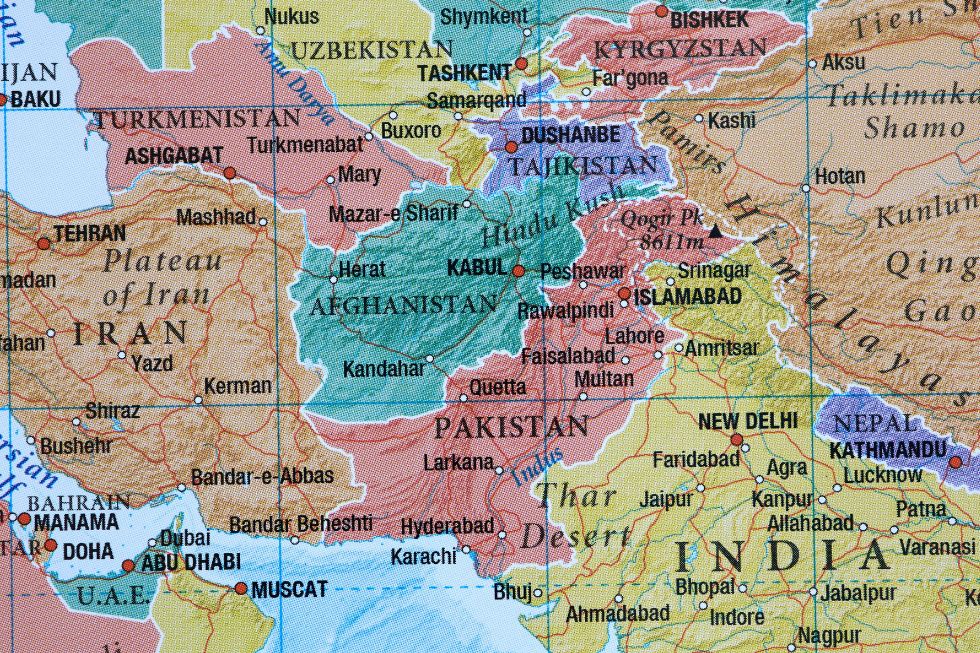



When Afghanistan collapsed into Taliban rule in August 2021, many of its neighbors quietly told themselves the fallout could be managed. Borders could be tightened. Risks could be pushed outward. Engagement could be kept transactional — just enough to protect narrow interests, not enough to carry responsibility.
Four years later, that comfort story has worn thin. Afghanistan has become the center of a self-reinforcing crisis — political illegitimacy, extremist permissiveness, economic fragmentation, mass displacement, and systematic repression — that no country in the region can truly escape. This reality helps explain why the UN Security Council has continued to keep a dedicated mission on the ground through the UN Assistance Mission in Afghanistan (UNAMA) and renewed its mandate again under UN Security Council Resolution 2777 (2025).
Afghanistan’s pain does not stop at the border. It moves through families forced to flee, through narcotics routes and smuggling networks, through illicit finance, through water disputes that turn tense in dry seasons and through militant pipelines that thrive where governance collapses.
The humanitarian strain alone now shapes the region’s politics and social fabric, with millions still needing assistance under the Afghanistan Humanitarian Needs and Response Plan 2025 coordinated by the UN Office for the Coordination of Humanitarian Affairs (UNOCHA). For Afghanistan’s neighbors, disengagement is not the same as neutrality. It is a choice — and an increasingly expensive one.
Illegitimacy, extremism, and regional blowback
The core problem is simple, even if it is often avoided: a state that lacks legitimacy cannot reliably deliver security. The Taliban governs through coercion rather than consent. They have narrowed political space, hollowed out institutions and treated basic rights — especially for women and girls — as negotiable. In that environment, fear becomes a governing tool, and trust becomes scarce. Extremist ecosystems do not need a grand invitation; they simply need permissive space, and Afghanistan’s fractured governance provides exactly that.
This is why a humanitarian-only posture cannot work. Food deliveries can keep people alive, but they cannot rebuild legitimacy, restore social trust, or create incentives for rule-based governance. The UN Independent Assessment on Afghanistan (S/2023/856) makes this explicit by calling for an integrated political, humanitarian, and development approach.
Afghanistan’s crisis is not a collection of separate problems; it is one system feeding itself. Decades of hedging — proxies, selective recognition, tactical bargains — have delivered neither durable influence nor durable security. They have delivered blowback, and not just for Afghanistan.
Pakistan now confronts intensified violence linked to Tehrik-i-Taliban Pakistan (TTP) sanctuaries. Iran grapples with volatile borders, refugee pressures, and water disputes. Central Asian states remain anxious about trafficking and militant diffusion. Russia and China expand intelligence and security postures to manage extremist risks emanating from Afghan territory. India continues to view Afghanistan through the lens of terrorism and regional encirclement.
Each capital sees a different slice of the problem, but the conclusion is shared: a fractured Afghanistan makes every neighbor less secure. Border incidents once dismissed as local are now widely recognized as regional risks, including those discussed in analyses of Afghanistan–Pakistan border violence and its Central Asian implications.
This moment, however, is not defined only by danger. It is also defined by leverage. The Taliban’s rule may appear immovable, but it rests on brittle foundations — an aid-dependent economy, internal factionalism, international nonrecognition, and deepening regional fatigue with unfulfilled promises.
Afghan society, meanwhile, has not given up. Women resist. Underground schools operate. Journalists speak out. Young people organize despite real risks. Their courage sends a clear signal: the legitimacy deficit at the heart of Afghanistan’s crisis remains unresolved — and therefore negotiable.
The strategic choice and the case for a regional compact
This brings the region to a moral and strategic crossroads. Neighbors can continue to manage Afghanistan as a problem to be contained and leveraged, or they can align on a different end state: an Afghanistan governed by an inclusive and legitimate political order capable of enforcing the rule of law at home and acting responsibly abroad. This is not idealism. It is strategic realism. Exclusion breeds resistance. Illegitimacy empowers extremism. Instability never stays contained.
A regional compact for durable stability offers a way forward. Its foundations are straightforward but demanding. Afghanistan’s neighbors must converge on three principles: noninterference, nonuse of Afghan territory for militant proxies, and support for an inclusive political process that restores legitimacy. Without this consensus, bilateral deals will remain temporary patches over structural collapse. With it, Afghanistan can begin to shift from a battlefield of competition to a platform for cooperation — trade corridors that function, energy transit that endures, regulated labor mobility that replaces smuggling, and shared water and climate adaptation that reduces future tensions.
This compact is not about resolving every rivalry or erasing deep-seated mistrust. It is about stopping the export of those rivalries through Afghanistan. A stable Afghanistan cannot be built if its politics are continually manipulated from the outside, if armed factions are treated as tools or if security is defined in ways that tolerate insecurity for everyone else. The promise of a compact is practical: it establishes a floor of mutual restraint and then links restraint to shared gains.
Institutions, leverage, and sequencing
The tools for this already exist. The question is whether neighbors will use them with discipline. The Shanghai Cooperation Organisation (SCO), which includes nearly all of Afghanistan’s key neighbors, can move beyond statements toward coordinated benchmarks — counterterrorism commitments, border management cooperation and economic incentives tied to measurable progress. If Afghanistan is to become a corridor rather than a crater, regional mechanisms must reward cooperation and penalize destabilization.
The United Nations remains indispensable for legitimacy and sequencing. The framework built around UNAMA’s Security Council mandates exists because Afghanistan’s crisis requires sustained political coordination alongside humanitarian and human-rights engagement.
A UN-backed political process — Afghan-owned and inclusive of women, civil society, ethnic minorities, opposition voices, and the Taliban — must aim to restore basic governance and reconnect Afghanistan to international norms. That process cannot be symbolic; it must be structured, time-bound, and anchored in verifiable commitments, particularly on counterterrorism obligations and basic rights.
Parallel diplomacy matters as well. Engagement through the Organization of Islamic Cooperation (OIC) and credible religious institutions can help dismantle the Taliban’s claim that repression is a religious duty, affirming that education, women’s participation, and peace are consistent with Islamic principles and human dignity. Pressure and incentives must be calibrated. Sanctions, travel bans, and nonrecognition should remain tools against repression, while phased incentives — economic access, development cooperation, and normalization steps — should be tied to verifiable progress.
The goal is not to reward bad behavior, but to build a ladder that makes better behavior more rational than continued defiance. This sequencing works best when UN political engagement aligns with regional leverage rather than drifting alongside it, a point reinforced in the analysis of UNAMA mandate prioritization and sequencing.
Above all, Afghan civil society cannot be an afterthought. It is easy to invoke “the Afghan people” in speeches; it is harder to protect the teachers, journalists, women’s groups, and community networks that keep social trust alive under pressure. Supporting women’s organizations, educators, independent media, and local service providers is not charity. It preserves the infrastructure of legitimacy without which no settlement can endure.
Choosing stability over drift
Afghanistan’s neighbors face a defining choice. They can repeat the habits that helped break Afghanistan for decades, or they can lead a regional reset that protects their own societies from the next wave of spillover. Peace will not arrive by accident. Stability cannot be purchased through hedging. It must be built through regional ownership, institutional coordination, and moral clarity grounded in strategic realism and the principles of the UN Charter.
The prize is not abstract. It is dignity and hope for Afghans who have lived through too many betrayals. It is predictable security for neighbors weary of managing perpetual crises. It is a region able to trade, connect, and prosper without feeding the forces that keep it trapped in conflict.
The cost of inaction is equally real — and rising. Peace begins with a choice. The region should choose wisely.
[Kaitlyn Diana edited this piece.]
The views expressed in this article are the author’s own and do not necessarily reflect Fair Observer’s editorial policy.
The Taliban’s Broken Promises Undermine Global Diplomacy
The Taliban regime in Afghanistan has failed to fulfill its obligations to the international community to curb its terrorist militants....
Afghanistan, Proxy Warfare and the Regional Crisis the World Overlooks
Pakistan’s long-held fear and concern that militant groups are using its neighboring Afghan territory is now echoed by international organizations...
FO° Talks: Is the Taliban-Ruled Afghanistan Now Becoming a Normal State?
In this episode of FO° Talks, Atul Singh and Thomas Barfield express that Taliban-ruled Afghanistan is drifting into crisis. No...

Afghanistan Under the Taliban Four Years Later: No School, No Future, No Problem
Every August, Afghanistan makes headlines as experts try to decipher “what went wrong” since the Taliban took control. They imposed...

Support Fair Observer
We rely on your support for our independence, diversity and quality.
For more than 10 years, Fair Observer has been free, fair and independent. No billionaire owns us, no advertisers control us. We are a reader-supported nonprofit. Unlike many other publications, we keep our content free for readers regardless of where they live or whether they can afford to pay. We have no paywalls and no ads.
In the post-truth era of fake news, echo chambers and filter bubbles, we publish a plurality of perspectives from around the world. Anyone can publish with us, but everyone goes through a rigorous editorial process. So, you get fact-checked, well-reasoned content instead of noise.
We publish 3,000+ voices from 90+ countries. We also conduct education and training programs
on subjects ranging from digital media and journalism to writing and critical thinking. This
doesn’t come cheap. Servers, editors, trainers and web developers cost
money.
Please consider supporting us on a regular basis as a recurring donor or a
sustaining member.
Will you support FO’s journalism?
We rely on your support for our independence, diversity and quality.





Comment