






|
||
|
||
|
||
|
Dear FO° Reader,
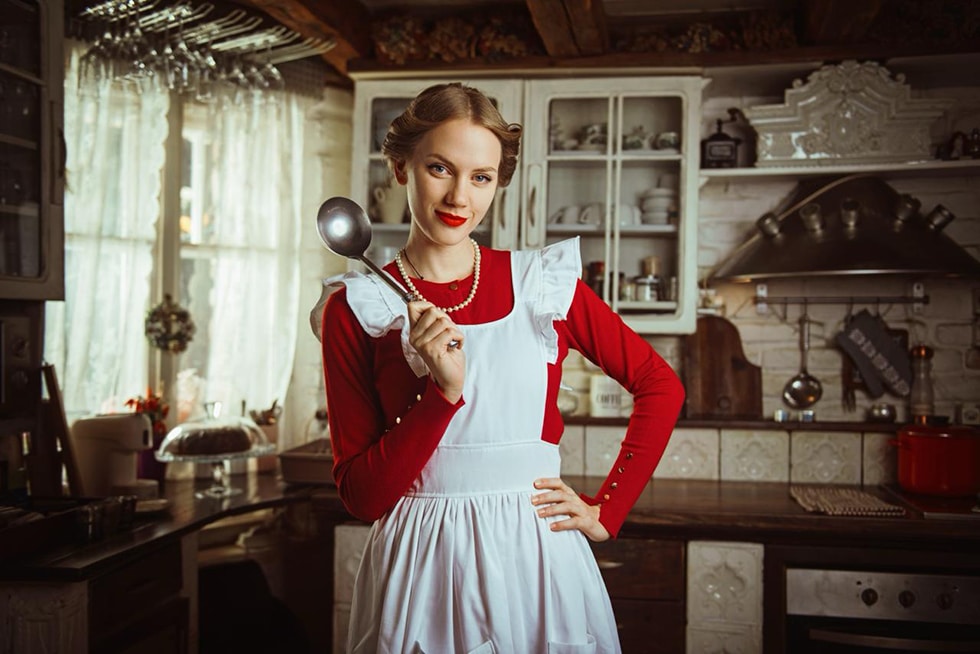
I’m in my kitchen, where I often work, partly because the view of the garden is soothing. Also, I can keep an eye and an ear on the various appliances, the dishwasher, the washing machine, the rice cooker and maybe the oven, depending on whether dinner demands it. Those machines perform my grandmother’s work almost silently, using primarily electrical energy. In some ways, I could be considered a trad-wife if it weren’t for the fact that I don’t like what they represent. I make bread, sometimes with my own sourdough starter, and there’s often some soup bubbling on the stove. I have sewn all the curtains in our three-storied house, and I also make shirts and jackets for the men in the family. All these things require presence, time, intention and skills acquired over decades, as well as careful planning. How is the tradwife lifestyle now “a thing”? The “trad-wife” lifestyle only became feasible when the ratio between wages and the cost of housing, education and basic necessities was favorable. After World War II, strong post-war employment guarantees, union contracts and industry-wide wage standards gave a single male earner enough purchasing power to buy a home, send children to school and still afford a household that could be run entirely by his spouse. And, most likely, childcare was done informally with aunts, neighbors and grandmothers. Those protections have been steadily eroded — largely by the very political forces that champion an unshakable faith in the free market, even more when no one taxes the rich! Today, a handful of polished, social media-savvy women present themselves as “traditional wives” while, in effect, I suspect that they (unwittingly?) run a large-scale public relations campaign that glorifies a nostalgic, orderly society that no longer exists for the majority. The result is a paradox: a trend that promises stability while simultaneously sacrificing the ability of both women and men to express their full potential in a modern economy.
Shutterstock For comparison, I could mention my grandmother in Northern Italy in the 20s and 30s. She was born in 1906 and was sent to live with an older woman to learn her trade: that of a mammana, a role akin to a doula or a midwife today. Then she married, and by the time she was 40, she had 12 children, of whom one only was stillborn. The husband, my grandfather, got some viral infection and half of his body was paralyzed, quite a predicament for a farmer and a mezzadro (similar to a sharecropper). They were hardworking people with no health insurance, no decent pension and no chance to ever buy a home and some land. She worked 18-hour days and raised her children; the older ones had to work for the farm, my father recalls taking the oxen out on scorching days, going hungry because of growth and hard work. They shared a sausage, one for all the siblings. Talk about the protein intake fad of today! But they did have a lot of polenta.
Working Italian women, c. 1900, Wikimedia Commons. Real tradition was communal; labor was shared; killing a pig and preserving every bit were village activities and celebrations; and survival depended on networks and larger families, not on isolated nuclear families. Why are today’s women exhausted? Because they were told in the 70s and 80s that they could have it all. But then housing became way more expensive, childcare had to be paid for and school tuition increased dramatically while many other services became underfunded. To understand why this romanticized vision is increasingly out of sync with reality, we need to examine three intertwined dimensions: historical labor conditions, the contemporary media narrative and the gendered consequences of a single-breadwinner model. Historical labor conditions & economic feasibility
Right after World War II, a single male earner could actually afford a house, schooling and save for retirement. For instance, in 1955, the median male salary was about $3,400 (approximately $41,000 today), and a house cost about $18,000, which was about 5.4 times the salary. Today, that lifestyle is more closely associated with upper-class economic stability. Collective bargaining and strong union agreements also helped to secure minimum wages, health benefits and job security. Informal networks (aunts, grandparents, neighbors) provided free childcare, reducing the need for a second income. A mother could leave a newborn in the care of a nearby aunt while she worked a six-day work week, a safety net that modern gig-economy families simply do not possess. Why the post-war “one-breadwinner” model fell apart The collapse of this model began with the steady erosion of manufacturing unions. Union density in the private sector peaked in 1970 (about 17 million members). Then it fell to roughly half that number by the early-2000s, a decline driven by corporate resistance, weaker labor-law enforcement and the loss of union-heavy factories. At the same time, the economy shifted toward services: between 1970 and 2005, the share of employment in the service sector more than doubled, while manufacturing’s share fell sharply. This structural change brought a surge of precarious, contract-based jobs that offered few benefits or long-term security, a trend Norwegian social scientist and professor Arne L. Kalleberg describes as the rise of “polarized and precarious employment” that began in the 1970s. Compounding these labor-market shifts, housing became dramatically less affordable. The composite Housing Affordability Index, which was above 85% in the early 1970s, slid to just 31% by 2024, meaning a typical family now needs more than three times the income to qualify for a mortgage compared with the post-war era. Add today’s average childcare bill of $13,000 per child, and the old single-breadwinner equation no longer balances. Together, weaker unions, a service-dominant economy, insecure work and exploding home prices stripped away the economic foundation that once made a single-earner household viable. The contemporary media narrative
The typical visual elements of the Instagram feed show pristine countertops, homemade bread, mason-jar preserves and lush backyard gardens, vintage-style interiors, the whole captioned with hashtags like #tradwife, #homemaking, #slowliving. Social media algorithms prioritize eye-catching, nostalgic visuals, pushing the “tidy kitchen” aesthetic to the top of users’ feeds. This amplification creates a self-reinforcing echo chamber: the more polished the image, the more engagement it receives and the more the platform surfaces similar content, further entrenching the myth that this lifestyle is both ordinary and attainable. When I let sourdough loaves rise in glass bowls, the countertop won’t be pristine and shining, and rows of mason-jar preserves labeled in cursive script often leak or explode and leave a puddle of gooey stuff — which, by the way, critters love. The captions celebrate “slow living,” “family harmony” and “return to roots,” painting a picture of effortless domestic bliss. I can tell you there’s nothing effortless! What the feed omits What the feed never mentions is the time sink behind the scenes. Even a modern front-load washer demands five to seven cycles per week, each followed by a meticulous folding and ironing ritual that adds up to four to five hours of labor. Meal planning, grocery runs and prep easily consume another couple of hours each day. Most importantly, the entire tableau rests on a partner whose salary exceeds $75,000 per year, a figure that, today, only a minority of households can realistically achieve. Gendered consequences of the single-breadwinner model Hours spent on cooking, cleaning and laundry could be redirected toward education, career development or creative pursuits. That’s opportunity cost in your very first Economy 101 class. And perhaps even worse, self-worth becomes tied to domestic perfection, leading to anxiety and burnout. So, studies (American Psychological Association, 2022) show women in single-breadwinner households report 30% higher stress levels than those in dual-income families. It may be still lower than single mothers’ stress levels, but it’s high. Insecurity and difficulty planning ahead, because something is always demanding one’s attention, make it very hard. Men, too, bear a heavy load. The entrenched expectation that they must be the sole provider pushes many into extended workweeks and discourages them from taking paternity leave. Men who desire a more equitable split of household chores often encounter social stigma, reinforcing a rigid gender binary that harms both partners and leaves families financially exposed to any disruption in the sole earner’s income. Societal ripple effects: higher divorce rates
The repercussions extend beyond the couple. When women are systematically excluded from the labor market, overall productivity suffers and economies lose the innovation that a diverse workforce generates. Moreover, couples trapped in the provider-dependent model report higher divorce rates, and children absorb these gendered scripts, perpetuating the cycle across generations. Yes, much to the dismay of traditionalists, single-income households are more exposed to divorce because of expectations, instability and much more. We like debate, so here are some counterarguments. “Some women genuinely love full-time homemaking,” and I am one of those, but kids grow up, and finances aren’t always stable, and a bored mother is not fun for anyone. So personal choice is valid, but can an 18-year-old be wise enough to make that kind of choice? This trend, by the way, transforms a voluntary lifestyle into a societal expectation. This marginalizes those who’d rather choose different endeavors. The danger is not that some women choose homemaking. The danger is that an aesthetic — prettified, filtered and algorithmically amplified — is being sold as a substitute for political imagination. We clearly don’t need a return to 1955. We need something far braver: communities where care is shared, where work is dignified and where no one’s future hinges on a single paycheck or a single person. If we have the courage to stop romanticizing the past, we might finally build a present in which women — and men — can choose their lives freely, without fear, without nostalgia and without pretending that the price of bread and the price of dignity never changed. Keep kneading, keep sewing, keep creating good memories; eventually, we’ll build a future that’s good for all. Roberta Campani Communications and Outreach |
||
|
We are an independent nonprofit organization. We do not have a paywall or ads. We believe news
must
be free for everyone from Detroit to Dakar. Yet servers, images, newsletters, web developers and
editors cost money.
So, please become a recurring donor to keep Fair Observer free, fair and independent. 
|
||
|
||
| About Publish with FO° FAQ Privacy Policy Terms of Use Contact |





Explore More FO° Reflections



Support Fair Observer
We rely on your support for our independence, diversity and quality.
For more than 10 years, Fair Observer has been free, fair and independent. No billionaire owns us, no advertisers control us. We are a reader-supported nonprofit. Unlike many other publications, we keep our content free for readers regardless of where they live or whether they can afford to pay. We have no paywalls and no ads.
In the post-truth era of fake news, echo chambers and filter bubbles, we publish a plurality of perspectives from around the world. Anyone can publish with us, but everyone goes through a rigorous editorial process. So, you get fact-checked, well-reasoned content instead of noise.
We publish 3,000+ voices from 90+ countries. We also conduct education and training programs
on subjects ranging from digital media and journalism to writing and critical thinking. This
doesn’t come cheap. Servers, editors, trainers and web developers cost
money.
Please consider supporting us on a regular basis as a recurring donor or a
sustaining member.
Will you support FO’s journalism?
We rely on your support for our independence, diversity and quality.





Comment