


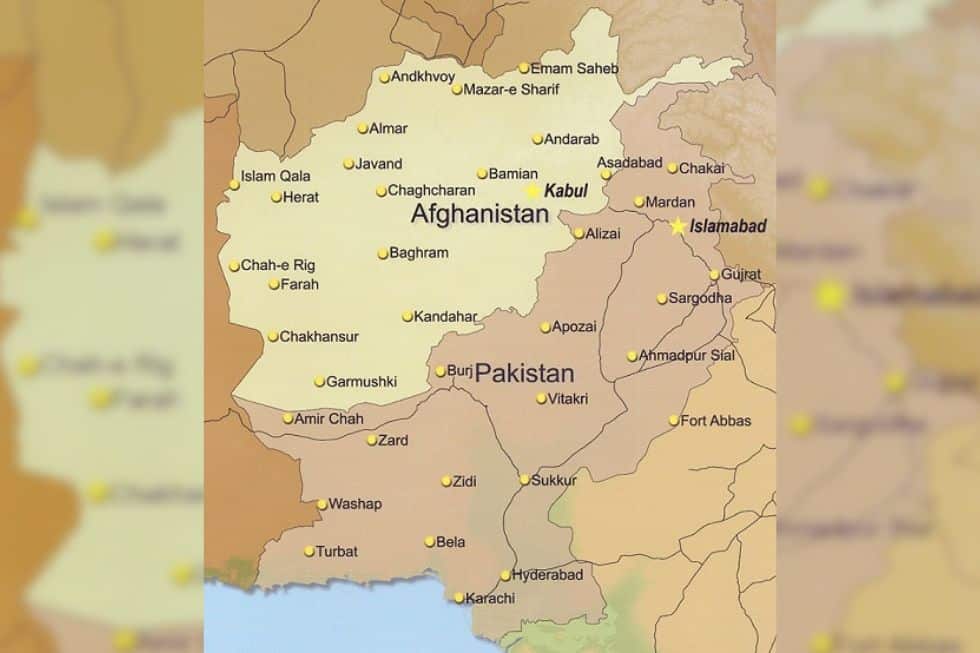


On October 9, 2025, Pakistani fighter jets violated Afghanistan’s airspace and conducted airstrikes on a civilian market in the Margha area of Paktika province. Explosions were also heard in parts of the capital on that same day, with the Afghan Defense Ministry accusing Pakistan of being responsible. The next day, Afghanistan’s Ministry of Defense confirmed the airstrikes and stated that the country has the right to defend its sovereignty against such violations.
On October 12, 2025, a spokesperson for the Afghan government stated that Afghan forces had conducted retaliatory strikes against Pakistani military targets. Pakistan, in turn, claimed that it had undertaken cross-border counterstrikes within Afghan territory, targeting both Afghan military installations and militant bases allegedly used to launch attacks on Pakistan. Subsequently, on October 15 and 17, Pakistan conducted additional airstrikes in Kandahar, Kabul and Paktika provinces, which struck civilian homes and marketplaces, reportedly killing and injuring hundreds of civilians.
Initially, Pakistan’s Ministry of Foreign Affairs (MoFA) remained silent after the October 9 airstrikes, but later stated — following the Afghan retaliatory operations — that Pakistan had exercised its right of self-defense against both the Afghan government and the Tehrik-i-Taliban Pakistan (TTP).
In December 2024, following a separate set of airstrikes in Afghanistan, Pakistan’s MoFA had claimed that its operations targeted the Hafiz Gul Bahadur Group, a nonstate actor, which, along with the TTP, was accused of carrying out multiple terrorist attacks inside Pakistan.
Pakistan argued that the Afghan authorities are either unwilling or unable to effectively address the threat posed by these groups, thereby necessitating Pakistan to take measures to protect its national security interests. Nonetheless, these actions have raised serious concerns about their potential illegality and their ability to undermine broader regional stability.
Use of force and the right to self-defense under international law
Under international law, states are generally prohibited from using or threatening to use force in their international relations. This rule is found in Article 2(4) of the UN Charter and is considered a peremptory norm (jus cogens), meaning no state is allowed to violate it. However, there are three exceptions to this rule: (1) when a state exercises the right to self-defense under Article 51 of the UN Charter, (2) when a State uses force at the invitation or with the consent of another state and (3) the UN Security Council authorizes the use of force under Chapter VII of the UN Charter. Any use of force outside these exceptions constitutes a clear violation of Article 2(4) of the UN Charter.
The justification for Pakistan’s airstrikes in Afghanistan relies on the right of self-defense, as outlined in Article 51 of the UN Charter. However, this right applies only when a state has been subjected to an “armed attack”, and international law sets clear conditions for invoking it: (1) self-defense, whether individual or collective, must be in response to an “armed attack” under international law.
The Charter does not define “armed attack.” Nonetheless, it is generally believed that an armed attack occurs when the regular forces of one state attack another’s territory, whether by land, sea, or air. (2) The attack must be carried out by a state that is a member of the UN, and (3) the state using the right of self-defense must report its actions to the UN Security Council.
The question arises as to whether the right to self-defense extends to “armed attacks” by nonstate actors operating from the territory of another state. The wording of Article 51 does not explicitly say so, but the International Court of Justice’s (ICJ) rulings — including the Palestinian Wall opinion and the Armed Activities case — indicate that Article 51 applies only to armed attacks by states, unless the nonstate actors’ conduct can be legally attributed to a state.
Nevertheless, some scholars argue that the right to self-defense includes armed attacks by nonstate actors. These scholars rely on two UN Security Council resolutions adopted after 9/11 to support this view. However, Resolutions 1368 and 1373 recognize that the right of individual and collective self-defense must be exercised only in accordance with the UN charter, clearly implying that the use of force in self-defense must still adhere to the conditions established under Article 51.
Particularly, the need to establish a clear link (attribution) between the host state and the nonstate actor responsible for the attack. Because attacks by the TTP cannot be attributed to Afghanistan, Pakistan’s unilateral military operations inside Afghan territory do not meet the requirements of Article 51 of the UN Charter. Therefore, they constitute a violation of the international legal prohibition on the use of force.
“Unable and unwilling” standard
The “unable or unwilling” standard suggests that if a state harbors nonstate actors who launch attacks against another state, and if that state either fails to act against them or lacks the capacity to do so, the victim state can claim its right to self-defense. For instance, Pakistan maintains that TTP operates from Afghan territory and has repeatedly urged Afghanistan to address the issue.
If Afghanistan is either unwilling or unable to confront TTP, Pakistan claims it may resort to self-defense measures against the group. The United States and its allies have previously invoked this standard to justify unilateral military intervention against the Islamic State of Iraq and Syria (ISIS) in Syria, arguing that Syria was unable or unwilling to suppress ISIS activities threatening Iraq. They also argued that their actions were taken at Iraq’s request, which faced an imminent threat from ISIS.
However, this doctrine lacks formal legal status under the UN Charter or customary international law. Instead, it is a unilateral reinterpretation of Article 51, primarily advanced by the United States and some of its allies to legitimize unilateral use of force that would otherwise constitute clear violations of the Charter.
In practice, the “unable or unwilling” standard has been invoked only by a few states so far, typically to justify their unilateral military actions without the consent of the territory’s state or any authorization from the UN Security Council. Similarly, Pakistan’s use of this legally unfounded standard to justify airstrikes inside Afghanistan reflects the same domineering unilateralism that the US and its allies have used against weaker states, bypassing the UN Charter’s explicit prohibition on the use of force.
The recent Pakistani airstrikes
In recent months, Pakistan has conducted a series of airstrikes within Afghan territory, marking a significant escalation in regional tensions and raising serious questions about respect for international law by even postcolonial states. Pakistan previously defended its December 2024 air operations as lawful measures directed against the Hafiz Gul Bahadur Group, a nonstate actor along with Tehrik-i-Taliban Pakistan (TTP) — alleged to have orchestrated multiple terrorist attacks inside Pakistan.
However, following the airstrikes of October 9, 2025, Pakistan refrained from issuing an official explanation. It was only after Afghanistan reportedly launched retaliatory strikes on the night of October 11-12, 2025, that Islamabad released two official statements — one from its military and another from the MoFA.
The military statement warned that if the “Taliban government” failed to take effective action against terrorist groups operating from Afghan soil, Pakistan would continue to exercise its right to defend its people by the persistent neutralization of terror targets. This statement effectively left open the possibility of further cross-border unilateral military operations inside Afghanistan under the pretext of self-defense.
The MoFA statement also noted that Pakistan has exercised its right of self-defense against the “unwarranted aggression” from the Afghan side. It warned that “any further provocations would be met with an unwavering and befitting response.” Both statements thus explicitly framed Pakistan’s use of force within the broader legal discourse of self-defense, but with little visible effort to articulate a clear legal basis for its actions within the established framework of self-defense under international law.
Pakistan’s justification rests on the argument that Afghanistan has failed to address the threat posed by the TTP, and that such failure demonstrates either unwillingness or inability on the part of the Afghan authorities to prevent their territory from being used as a base for attacks against Pakistan.
By invoking this rationale, Pakistan clearly seeks to rely on the legally unfounded “unwilling or unable” standard. Politically, these actions also expose Pakistan to charges of hypocrisy. Islamabad has repeatedly condemned similar unilateral military strikes conducted by neighboring states — particularly India — labeling them as acts of aggression and violations of its sovereignty.
Pakistan’s recent actions mirror the very justifications it has historically rejected, thereby weakening its credibility and normative commitment to international law. Finally, by normalizing the cross-border unilateral use of force against non-state actors inside the territory of another sovereign state under the guise of self-defense, Pakistan risks legitimizing similar actions by other states inside its own territory.
[Elliott Frey edited this piece.]
The views expressed in this article are the author’s own and do not necessarily reflect Fair Observer’s editorial policy.
FO° Talks: Pashtuns vs Punjabis — The Ethnic Rift Fueling Clashes Between Pakistan and Afghanistan
In this episode of FO° Talks, Atul Singh and Thomas Barfield trace how Pakistan’s decades-long bet on a pliant Taliban...
Tehrik-i-Taliban Pakistan: Targeting Civilians to Instill Fear and Control
The militant group Tehrik-i-Taliban Pakistan escalated its attacks across Khyber Pakhtunkhwa in May 2025 as it pursued territorial control and...
Pakistan’s Taliban Problem and the New Fight for the Durand Line
Pakistan supported the Afghan Taliban to gain influence in South Asia and a better negotiating position with the Pakistani Taliban....
Support Fair Observer
We rely on your support for our independence, diversity and quality.
For more than 10 years, Fair Observer has been free, fair and independent. No billionaire owns us, no advertisers control us. We are a reader-supported nonprofit. Unlike many other publications, we keep our content free for readers regardless of where they live or whether they can afford to pay. We have no paywalls and no ads.
In the post-truth era of fake news, echo chambers and filter bubbles, we publish a plurality of perspectives from around the world. Anyone can publish with us, but everyone goes through a rigorous editorial process. So, you get fact-checked, well-reasoned content instead of noise.
We publish 3,000+ voices from 90+ countries. We also conduct education and training programs
on subjects ranging from digital media and journalism to writing and critical thinking. This
doesn’t come cheap. Servers, editors, trainers and web developers cost
money.
Please consider supporting us on a regular basis as a recurring donor or a
sustaining member.
Will you support FO’s journalism?
We rely on your support for our independence, diversity and quality.





Comment