






In his 1946 groundbreaking book The Concept of the Corporation, Peter Drucker argued that corporations had replaced the Church as the most representative institution of modern society. In 2004, in turn, The Economist made the famous statement: “The company is the most important institution of our day”. Following the historical evolution of this institution, thus becomes necessary to understand its meaning and significance.
Materiality
The earliest manifestation of this institution, in its modern sense, dates back to 17th-century Holland. Its main characteristics were a permanent share capital, publicly tradable shares, separation of ownership and management, limited liability for shareholders and a State charter granting it monopoly rights. It wouldn’t take long, though, before England emerged as a rival. The Glorious Revolution, which put the Dutch Stadtholder on the throne of England under the name of William III, was responsible for bringing these new notions to London.
France, however, remained reluctant to the concept of publicly tradable shares. There, the company’s capital tended to be state-owned. This resulted from the resounding failure of its first major private company, which John Law founded at the beginning of the 18th century.
However, notwithstanding their publicly tradable shares, Dutch and English companies placed their aims at the service of the grand purposes of the State or the Crown. In this regard, they were not all that different from the French ones. They all became, indeed, implementing tools of the State’s mercantilist and imperialist policies.
In the case of Dutch and English companies, the conquest and colonization of overseas territories was entrusted to them through State charters that granted them commercial monopolies. To this end, these companies had their own armies and fleets, administered territories autonomously and waged war against rival countries and companies. All of this, while the State not only retained a significant share of the profits but also had its flag flying over the conquered territories.
The Dutch East India Company (VOC), responsible for the spice trade with the Far East, was the first major global corporation. It boasted 150 ships, 40 large warships, 50,000 employees and a highly equipped private army of 10,000 soldiers. The English and the French East India companies would equal the VOC’s size some years later, and the three would vie for control over countries, raw materials and trade routes.
England would eventually reach the top of this competition, bringing this corporate vision of trade and international relations to its highest expression. By 1757, Robert Clive, at the head of the army of the British East India Company (EIC), had conquered a large share of India.
Contrary to the Virginia Company and the Plymouth Company, dating back a century earlier — both English joint-stock companies chartered by the Crown to establish permanent English colonies in North America — the function of government in India remained in the hands of the EIC. Indeed, whereas in the former two cases the Crown retained government, it would take until 1856 for it to assume direct governmental responsibilities over India.
In the final years of the 19th century and the beginning of the 20th century, the British South Africa Company, a public joint-stock company headed by Cecil Rhodes, also had its own private army. With it, it conquered the territory of what was to be called Rhodesia (present-day Zambia and Zimbabwe). By Royal Charter, this company was entitled to raise its own police, exert control over taxation, make administrative regulations, grant land rights and establish courts. For all practical purposes, it behaved like a private government very much in the same manner in which the East India Company had done before.
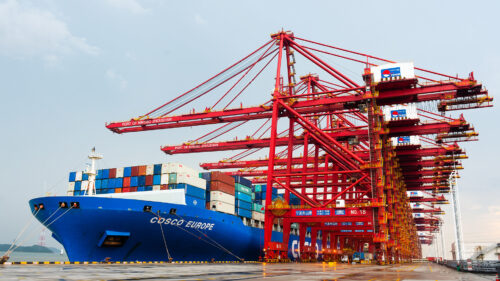
If something characterized institutions such as the VOC, the EIC or the British South Africa Company, it was their sheer materiality. This means: armies, war fleets, territories and their capacity to wage wars. To an important extent, they represented the most visible manifestation of the power of their states.
Immateriality
Fast forward to the end of the 20th century and the beginning of the 21st (100 years after Rhodes’s exertions in Southern Africa), the nature of the company as an institution changed completely. From its raw materiality, it had evolved into an increasing immateriality. Indeed, globalization led big corporations to divest from everything that wasn’t core to their business, making them more and more bodyless.
The assembly line, which since the time of Henry Ford had become the essence of the manufacturing process, reached such a point of specialization during the height of globalization that it got fragmented. The different components of a single final product came to be manufactured in numerous factories scattered across multiple countries.
Within this model, the large corporation focused on finding the lowest-cost worker for each constituent part of the manufacturing process. Wherever he could be found. But, at the same time, it went on the hunt for the most economical engineer, designer, accountant, financial analyst or customer service representative, also, anywhere in the world. This, of course, required targeting those countries where a higher level of qualifications and lower costs converged for each specific function.
As Thomas L. Friedman argued, with the global economy transformed into a level playing field of sorts, there was little impediment to having not only production, but also design, research or services, broken up and scattered around the world. All of the above, needless to say, implied a massive outsourcing of blue-collar and white-collar jobs.
This process not only involved outsourcing manufacturing and service operations to other countries but, even more significantly, outsourcing them to other companies. Increasingly, manufacturing and services were not performed directly by the multinational corporations themselves, but were outsourced to local companies in the countries involved. That is, smaller companies were scattered across the most diverse latitudes. As a result, big corporations were able to rid themselves of labor obligations that had traditionally burdened their finances.
Following this trend, the large corporation of the early 21st century tended to strip itself of everything that was not core to its business. Ultimately, the corporation jealously guarded brands and patents, its two fundamental assets, while outsourcing as many functions as possible. Hence, corporation’s notorious contrast with the Dutch or the British East Indian companies, whose materiality runs counter to the disembodiment hereby pursued.
Materiality or immateriality?
Recent but fundamental changes, though, have brought back materiality into the life of big corporations. The resurgence of geopolitics, the disruption of global supply chains brought about by COVID, the reduction of production costs in developed countries driven by technology, and, most recently, US industrial policies and increasing tariffs, have profoundly undermined globalization.
Under these circumstances, divesting itself from noncore functions lost its meaning. Nowadays, companies are integrating vertically once again, strengthening themselves by adding functions and, above all, returning home.
Is this newfound materiality, thus, the prevailing trend within the corporate world of our day? Not necessarily. Jointly with it, immateriality is the main characteristic of the most consequential technology shaping the future: Artificial Intelligence. A technology based on data, algorithms and computing. Meaning, soft assets that can be shared or duplicated without depletion. AI companies, indeed, do not depend on the accumulation of people or of huge assets, beyond those necessary to make their ethereal nature functional: energy, computer hardware, and networking and data storage infrastructures.
Let’s just consider the event that took place on November 23, 2023, inside OpenAI, the pioneer of ChatGPT. Reacting against the dismissal of its President and founder, Sam Altman, by the board of directors, 70% of the company’s staff rebelled, threatening to resign. Indeed, 738 of the company’s 770 employees forcefully demanded the reinstatement of Altman and the departure of the board members. In other words, a company that was revolutionizing the modern economy had a workforce of fewer than 800 employees.
Since then, OpenAI has somewhat grown. As of 2025, it has 3,000 employees. Meanwhile, Anthropic, one of its main competitors, valued at $61.5 billion, has just 1,097 employees. Mistral AI, with a reported value of $12 billion, has 150 employees, while Thinking Machines Lab, also with a valuation of $12 billion, has even fewer personnel: just 50 employees.
The main characteristic of companies like these is that they have very leveraged teams. Meaning, a small group of people that produces an unusually large amount of output, economic impact or value. Within them, each employee can generate high amounts in revenue, as, by its own nature, AI is scalable. That is, able to grow significantly without needing a proportional increase in costs or efforts.
However, the scalability of Artificial Intelligence is not limited to the companies that produce it. As countless corporations in other fields are in the process of engaging with AI for their own business purposes, jobs will undoubtedly be lost to it. The implications of this are clear: Increasing immateriality could be the sign of the corporate world of the future — a very costly immateriality, indeed, when measured in human terms.
The gigantic level of power that can be attained through immaterial algorithms (including machine learning or pattern-recognition ones) is something that Robert Clive, despite his soldiers, war fleets, weaponry and huge territories under his control, could never have imagined possible.
[Kaitlyn Diana edited this piece.]
The views expressed in this article are the author’s own and do not necessarily reflect Fair Observer’s editorial policy.
Geopolitics by Design: Rethinking Power in the Age of Critical Technologies
In this era of techno-sovereignty, national power increasingly depends on one’s ability to develop and integrate critical technologies like AI,...

Unwitting Pawns: Companies Are on the Front Lines of a New Global Conflict
The security landscape combines physical and cyber threats, placing businesses in geopolitical conflicts. Companies are targets for hostile state actors...

The Truth About China and Global Supply Chains
China is at the heart of most global supply chains, but shipping disruptions and skyrocketing freight prices are raising questions...
Support Fair Observer
We rely on your support for our independence, diversity and quality.
For more than 10 years, Fair Observer has been free, fair and independent. No billionaire owns us, no advertisers control us. We are a reader-supported nonprofit. Unlike many other publications, we keep our content free for readers regardless of where they live or whether they can afford to pay. We have no paywalls and no ads.
In the post-truth era of fake news, echo chambers and filter bubbles, we publish a plurality of perspectives from around the world. Anyone can publish with us, but everyone goes through a rigorous editorial process. So, you get fact-checked, well-reasoned content instead of noise.
We publish 3,000+ voices from 90+ countries. We also conduct education and training programs
on subjects ranging from digital media and journalism to writing and critical thinking. This
doesn’t come cheap. Servers, editors, trainers and web developers cost
money.
Please consider supporting us on a regular basis as a recurring donor or a
sustaining member.
Will you support FO’s journalism?
We rely on your support for our independence, diversity and quality.





Comment