


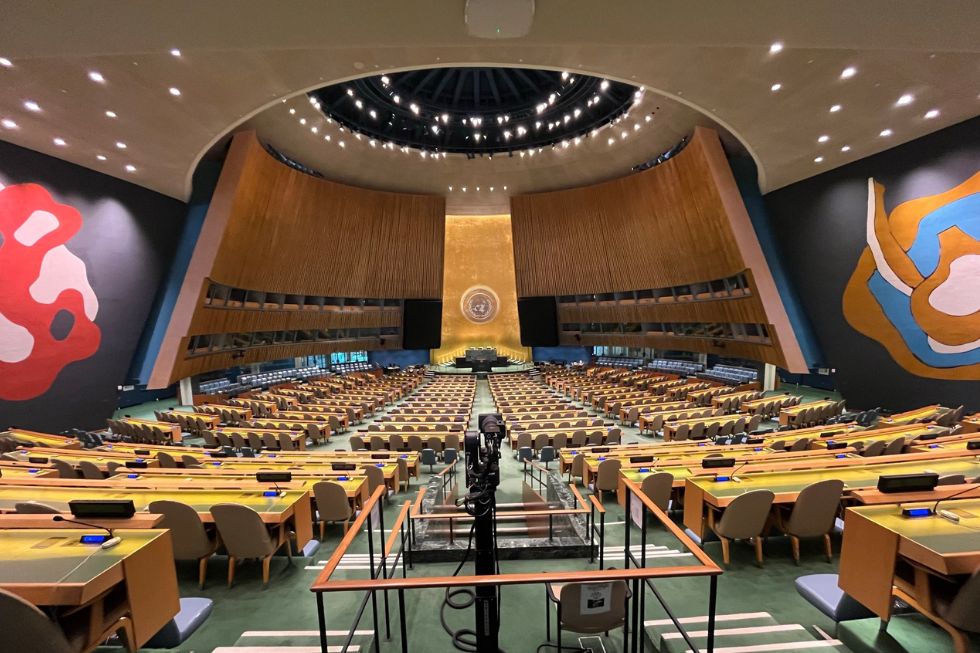



When the United Nations General Assembly voted 142–10, with 12 abstentions, in favor of a “New York Declaration” outlining a phased approach to a two-state solution on September 12, 2025, it achieved something rare: It turned long-standing diplomatic sentiment into a near-universal political moment. That majority is not just symbolic. It is both an invitation and a challenge.
Most of the world’s states have indicated that a negotiated, sovereign Palestine alongside Israel remains the clear goal. The real issue now is practical: Can diplomats and leaders transform that declaration into enforceable, step-by-step actions that protect civilians and secure progress, or will it stay as a loud, moral vow that the parties — and geopolitics — gradually dismantle?
The vote itself revealed as much about global politics as it did about sympathy for Palestinian statehood. All Gulf Arab states backed the declaration; The United States, Israel and nine smaller countries voted no.
A dozen states abstained, from small European and Pacific states to African partners and Latin American allies. Those abstentions were not uniform expressions of opposition but pragmatic hedges: Some governments signaled closer ties with Israel and caution in voting, while others cited a need to balance strategic relations when choosing to abstain.
A history of rhetoric
In short, the vote exposed a fault line that every advocate of a durable settlement must address: Winning global sympathy is not the same as building a multilateral mechanism capable of translating consensus into credible incentives and safeguards. That distinction is important because the resolution includes both principles and risks.
It condemned Hamas’s October 7 attacks and called for disarmament, while also demanding an end to siege strategies and attacks on civilians in Gaza — the duality that many capital governments say they support but that few have effectively put into practice.
The United Nations can outline a roadmap; However, implementation needs institutions, funding, monitoring and political backing. Currently, the international community risks repeating an old pattern of strong UN rhetoric followed by fragmented implementation. The Palestinian leadership and its allies must bridge that gap between voting support and actual delivery. So what makes a political declaration into a deliverable plan?
Steps for the future
First, convert symbolism into a Two-State Implementation Compact: a time-bound, measurable framework hosted by the UN that ties phased recognition and political steps to clear, verifiable benchmarks — humanitarian access, de-escalation, credible disarmament mechanisms and concrete governance reforms in Palestinian institutions.
Donors would commit finance to a multilateral trust fund; Propose a guarantor group composed of key regional actors, Gulf Cooperation Council (GCC) states, EU members and willing Global South partners, anchored in clear multilateral commitments and calibrated bilateral pledges tied to verifiable benchmarks. The General Assembly’s overwhelming vote gives moral legitimacy to such a compact; Diplomatic ingenuity can turn it into leverage.
Second, tailor diplomacy to the abstainers. The dozen states that abstained are instructive: Their decisions were often driven by bilateral ties, domestic coalitions or sober doubts about immediate feasibility. Rather than treating them as an undifferentiated bloc, Palestinian and international envoys must offer bespoke pathways to convert hedging into commitment.
For some Pacific and African states, that may mean development partnerships, climate funds and visible humanitarian cooperation; For some European microstates, clearer legal language on security guarantees and refugee solutions; For Latin American partners, concrete trade and technology cooperation linked to recognition. Diplomacy that listens and incentivizes will be far more effective than moral reproach.
Third, Palestinian leaders must make the case domestically and institutionally. International support will always ask, implicitly or explicitly: Who will govern? The resolution presumes the post-conflict Palestinian Authority will play a central role — but its credibility is contested. A credible, accountable roadmap for governance, anticorruption measures, security sector reform and inclusive political representation will make international commitments politically safer and more likely to stick.
In practice, that means immediate steps: Preparing transparent electoral timelines, beefing up civil-service capacity, publishing anticorruption benchmarks and creating independent monitoring mechanisms that give donor states confidence that their investments foster a viable state, not a failed one.
Fourth, tie recognition to rapid humanitarian stabilizers. Where the compact signals phased recognition, donors must pair that political momentum with fast-disbursing aid channels and reconstruction pledges tied to verified protection of civilians and unfettered humanitarian corridors.
The next steps, forward or backward
A pooled “Palestine Stabilization Fund” could unlock cash within 72 hours of verified access, ensuring that diplomacy does not merely salute principles but immediately eases suffering. This practical linkage — diplomacy backed by deliveries — will prove the proposition that peace dividends are real.
The General Assembly vote was a rare moment of international clarity. But history will judge today’s states on whether they convert a declaration into structures that make two states politically viable and materially possible.
The alternative — allowing the momentum to fade into bilateral maneuvering and symbolic votes — risks consigning another generation to conflict and displacement. The task is urgent, morally compelling and, crucially, still within reach: Craft a compact, fund it sensibly, convince the skeptics with targeted offers and demand credible Palestinian governance and verification.
If the world can do that, it will remember the September vote as the start of a process; If it cannot, it will remember another squandered moral moment. The difference between those outcomes will be measured in lives — and that responsibility now rests on the diplomats and leaders who said yes.
[Casey Herrmann edited this piece]
The views expressed in this article are the author’s own and do not necessarily reflect Fair Observer’s editorial policy.
The Final Split: How Europe Broke Apart Over Gaza
European leaders sought influence in the Middle East as tensions rose over Gaza and pressure mounted for a two-state solution....
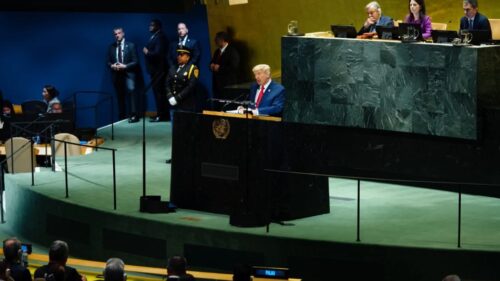
FO° Talks: France, UK, Canada and Australia Recognize Palestine, What Does It Mean for Israel?
In this episode of FO° Talks, Atul Singh and Josef Olmert discuss how the coordinated recognition of Palestine by Western...

Western Recognition of Palestine Challenges US-Israel Position
Western governments face mounting pressure over the Israeli-Palestinian conflict as public opinion hardens and alliances shift. The UK, France, Australia,...

How the UN Can Act Decisively to End Genocide in Gaza
Israel has escalated its assault on Gaza and ignored international rulings against its occupation of Palestinian territories. Few of the...
Support Fair Observer
We rely on your support for our independence, diversity and quality.
For more than 10 years, Fair Observer has been free, fair and independent. No billionaire owns us, no advertisers control us. We are a reader-supported nonprofit. Unlike many other publications, we keep our content free for readers regardless of where they live or whether they can afford to pay. We have no paywalls and no ads.
In the post-truth era of fake news, echo chambers and filter bubbles, we publish a plurality of perspectives from around the world. Anyone can publish with us, but everyone goes through a rigorous editorial process. So, you get fact-checked, well-reasoned content instead of noise.
We publish 3,000+ voices from 90+ countries. We also conduct education and training programs
on subjects ranging from digital media and journalism to writing and critical thinking. This
doesn’t come cheap. Servers, editors, trainers and web developers cost
money.
Please consider supporting us on a regular basis as a recurring donor or a
sustaining member.
Will you support FO’s journalism?
We rely on your support for our independence, diversity and quality.





Comment