

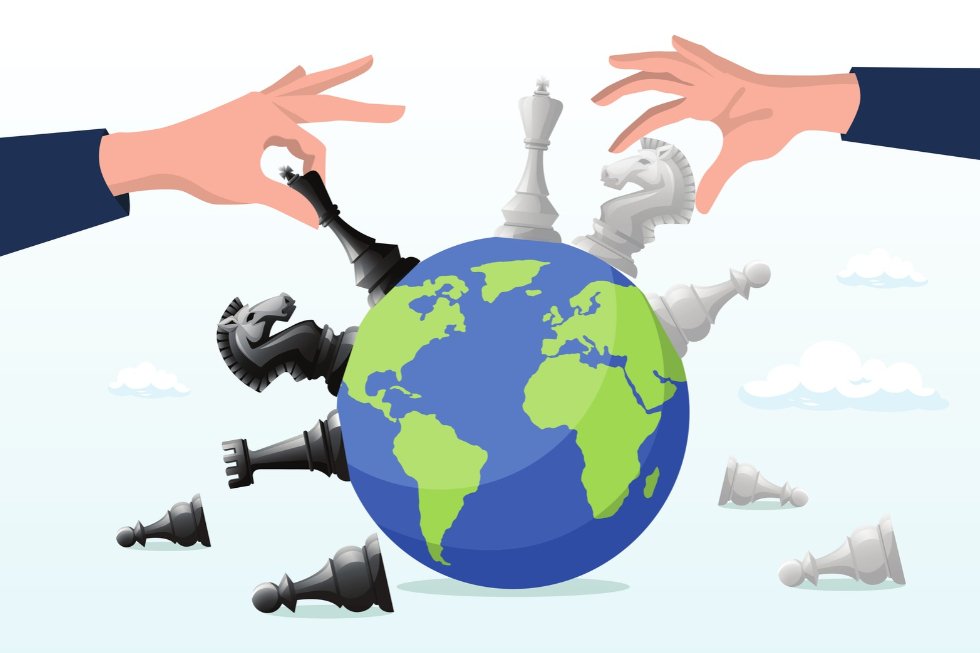



A peculiar contradiction lies at the heart of international politics today. Never before have the world’s leading powers possessed such extraordinary reserves of wealth, military capability, scientific knowledge and technological sophistication. Yet rarely have they appeared so hesitant, so reactive or so incapable of converting those resources into durable political outcomes.
The United States remains the most powerful military and financial actor in the international system. China commands industrial capacities that would have seemed unimaginable a generation ago. Europe retains immense economic weight and regulatory influence. Russia, despite sanctions and isolation, has demonstrated a capacity for endurance that many observers failed to anticipate. A new generation of middle powers, from India and Türkiye to Saudi Arabia and Brazil, has gained a degree of diplomatic flexibility that once belonged only to the great powers. And yet, despite all this apparent strength, the world feels increasingly ungoverned.
The lack of governance
Wars continue without decisive resolution. Trade routes become contested only to be temporarily secured before the next disruption emerges. Alliances expand, but confidence within them often appears to contract. Governments announce ambitious industrial strategies while simultaneously confronting mounting fiscal pressures. Every crisis seems to be managed, but few are truly settled.
The conventional explanation is that one era is ending and another is beginning: American primacy is fading, China’s rise is slowing, Europe is searching for relevance and the developing world is demanding a greater voice. These observations contain some element of truth, but they describe the symptoms more than the condition.
The deeper problem is that the major powers are not simply competing with one another. They are all becoming victims of the same structural reality. The 21st century has produced an accumulation of strategic responsibilities that is expanding faster than states’ capacity to manage them. The defining scarcity of our age may not be money, energy or even technology. It may be strategic attention.
A new reality
For most of modern history, great powers confronted a relatively limited number of existential challenges at any given time. Even during the Cold War, the geopolitical map was, in a sense, easier to read. The ideological divide between East and West created a framework that organized priorities and imposed discipline. Policymakers could rank threats because the strategic environment itself possessed a certain clarity. That clarity has disappeared.
The contemporary state operates in a world where military competition, technological rivalry, cyber conflict, supply-chain resilience, demographic change, migration pressures, energy security, climate adaptation, financial stability and domestic political fragmentation are not separate issues but overlapping layers of the same strategic landscape. None can be ignored for long. None can be solved permanently. Each interacts with the others in ways that generate new vulnerabilities.
A disruption in semiconductor production becomes a national-security problem. A cyberattack on a logistics network turns into an inflationary shock. The growing use of export controls on advanced semiconductors and critical minerals illustrates how technologies once viewed primarily through an economic lens have become instruments of national strategy. A conflict in one region alters shipping costs, energy prices and electoral politics thousands of miles away. The boundary between domestic policy and grand strategy has steadily eroded. This is not simply the consequence of globalization. It is the consequence of complexity.
The woes of political alliances
Modern states are discovering that success itself creates obligations. Every alliance requires reassurance. Every supply chain requires protection. Every technological breakthrough requires regulation. Every economic dependency creates a strategic liability that policymakers are expected to reduce. The architecture of international power has become more intricate, more interconnected and more administratively demanding than at any point in history.
The result is not collapse. It is exhaustion. Strategic exhaustion should not be confused with decline. Decline implies a measurable reduction in power. Exhaustion describes the widening gap between available resources and the ever-expanding list of responsibilities those resources are expected to sustain.
The United States offers the clearest example. It remains capable of projecting military force across the globe while underwriting the world’s financial system and maintaining an unparalleled alliance network. Yet every new commitment now arrives alongside questions about fiscal sustainability, industrial capacity, political polarization and public willingness to bear long-term costs. Washington increasingly faces the challenge not of choosing between action and inaction, but of choosing which urgent priority deserves attention first.
China confronts a different version of the same dilemma. Its extraordinary economic rise created the material foundation for geopolitical ambition, but the very scale of that ambition now collides with slower growth, demographic headwinds, debt burdens and a more contested international environment. Beijing’s challenge is no longer simply how to accumulate power, but how to preserve strategic flexibility while carrying the weight of a vastly larger system.
Europe, meanwhile, has spent much of the last decade rediscovering the language of geopolitics. Energy dependence, defense spending, technological sovereignty and industrial policy have all returned to the center of political debate. Yet the ambition to become a more autonomous strategic actor arrives at a moment when many European societies are simultaneously managing aging populations, fiscal constraints and increasingly fragmented domestic politics.
Even states that appear to be gaining influence often do so because they have avoided becoming overcommitted. India’s growing diplomatic leverage rests partly on its ability to maintain multiple partnerships without fully binding itself to any single geopolitical block. Gulf states have diversified their external relationships with remarkable agility, recognizing that strategic flexibility has become a valuable resource in its own right.
This may be one reason why the contemporary international system often appears indecisive. Not necessarily because leaders lack resolve, but because they operate within political and administrative environments where every decision carries a widening chain of second- and third-order consequences.
A generation ago, strategic planning could often assume a degree of compartmentalization. Defense ministries planned for security. Finance ministries managed budgets. Trade officials negotiated market access. Today, these distinctions are increasingly artificial. Rare-earth minerals, cloud infrastructure, undersea cables, data centers, advanced chips, shipping corridors and energy grids have all become elements of national strategy. Governments increasingly treat these systems as strategic infrastructure rather than simply commercial assets. The geography of power has become embedded in the infrastructure of everyday economic life.
The irony is that technological progress, which was expected to simplify governance, has frequently done the opposite. Digital systems increase efficiency, but they also multiply dependencies. Global markets lower costs, but they create concentrated vulnerabilities. Instant communication expands awareness, but it also forces governments into a permanent cycle of reaction. The information age has not merely accelerated events. It has accelerated the number of events that demand political attention.
The increase in political attention
Fiscal realities are reinforcing these pressures. Across much of the developed world, governments are balancing higher defense expenditures, industrial investment, infrastructure renewal, aging populations and rising interest costs simultaneously. Public debt accumulated through financial crises, pandemics and geopolitical shocks is no longer a temporary burden waiting to be reduced during calmer times.
It is becoming a permanent feature of the strategic environment. Even optimistic assumptions about technological growth are unlikely to remove the underlying tension between expanding commitments and finite state capacity. Recent assessments by international institutions and market analysts suggest that slower global growth, aging societies and the rising cost of financing both public debt and next-generation technologies are converging rather than offsetting one another.
This fiscal dimension matters because strategy is ultimately an exercise in allocation. Power is not measured only by what a state possesses. It is measured by what it can sustain. Rising debt-service costs, aging populations, defense spending and climate adaptation are placing simultaneous demands on public finances across advanced economies, reducing government room for strategic maneuver.
Running off in all directions at once
History is often written as a sequence of dramatic rises and falls, but the erosion of strategic capacity is usually quieter. Great powers rarely wake up one morning to discover that they have become weak. More often, they continue to manage one crisis after another until the accumulation of obligations gradually limits their freedom of action. The machinery of the state keeps functioning, but with diminishing reserves of political attention, administrative energy and financial flexibility.
That may be the defining characteristic of the current era. The world’s leading powers are not failing because they have lost the ability to act. They are struggling because they must act in too many places, on too many issues, at the same time.
This is also why the language of “multipolarity” can be misleading. The transition now underway is not simply a redistribution of power among several competing centers. It is a redistribution of strategic burdens across an increasingly interconnected world. As responsibilities proliferate, even powerful states become more selective, more cautious and more inclined to seek temporary management rather than permanent solutions.
The temptation is to interpret this caution as weakness. In reality, it may reflect an emerging logic of statecraft. In an age of strategic exhaustion, survival increasingly depends not on maximizing commitments but on preserving optionality. The most successful states may not be those that attempt to dominate every domain, but those that understand the value of restraint, redundancy, and institutional resilience.
This suggests that the central geopolitical contest of the coming decade may not be between democracies and autocracies, East and West, or established and rising powers. It may be between political systems that can adapt to mounting complexity and those that cannot.
The new age
The post-Cold War era encouraged the belief that globalization would gradually reduce the number of strategic problems governments needed to solve. The opposite has happened. Economic integration, technological acceleration and geopolitical fragmentation have combined to create an environment in which nearly every challenge has become simultaneously domestic and international, economic and military, immediate and long-term.
The age we are entering is not one of imperial collapse. It is not even necessarily one of relative decline. It is an age in which states discover that accumulating power and managing power are fundamentally different tasks.
Great powers rarely disappear because they lose a single war or suffer a single economic setback. More often, they survive every individual crisis, absorb every isolated shock and adapt to every immediate challenge — until they discover that they no longer possess the strategic energy to manage all of them at once.
[Zania Morgan edited this piece.]
The views expressed in this article are the author’s own and do not necessarily reflect Fair Observer’s editorial policy.
Going, Going, Gone! The President of Decline May Take the Planet Down with Him
US President Donald Trump has followed many American presidents by waging nigh-endless wars in the Middle East and Africa. Yet...


Support Fair Observer
We rely on your support for our independence, diversity and quality.
For more than 10 years, Fair Observer has been free, fair and independent. No billionaire owns us, no advertisers control us. We are a reader-supported nonprofit. Unlike many other publications, we keep our content free for readers regardless of where they live or whether they can afford to pay. We have no paywalls and no ads.
In the post-truth era of fake news, echo chambers and filter bubbles, we publish a plurality of perspectives from around the world. Anyone can publish with us, but everyone goes through a rigorous editorial process. So, you get fact-checked, well-reasoned content instead of noise.
We publish 3,000+ voices from 90+ countries. We also conduct education and training programs
on subjects ranging from digital media and journalism to writing and critical thinking. This
doesn’t come cheap. Servers, editors, trainers and web developers cost
money.
Please consider supporting us on a regular basis as a recurring donor or a
sustaining member.
Will you support FO’s journalism?
We rely on your support for our independence, diversity and quality.




Comment