





The last four years at Georgetown University’s Edmund A. Walsh School of Foreign Service, my peers and I coexisted within an elite sphere of the most influential foreign policy minds, US diplomats and international correspondents. We aspired to join these ranks, contributing to a better and safer world guided by American leadership.
From the US withdrawal from Afghanistan, the COVID-19 pandemic and Russia’s invasion of Ukraine, I witnessed international affairs unfold in real-time that challenged my ideas about the US-backed global order and tested the very theories taught in my International Relations courses. Our Georgetown community reeled together through current events. With discussion and transparency, we always found a way through with open conversation, even if the lack of precise explanations of global calamities by trusted adults unsettled me.
The war between Israel and Hamas undoubtedly marks the biggest foreign policy conundrum of my time at Georgetown. Georgetown’s School of Foreign Service is widely regarded as the best undergraduate international affairs school in the country, with a mission that values free speech, critical thinking and mutual respect. Why then did it feel so taboo to talk about Gaza?
The taboo about Gaza
The general consensus on campus agreed with US support and defense of Israel following October 7, but with new daily headlines of mounting civilian casualties, the restriction of humanitarian and food assistance and the possibility of starvation in Gaza, there seemed to be a reluctance to openly discuss US policy.
The Biden administration matched Israel’s escalated offensive with increased arms sales and military assistance to the Israel Defense Forces (IDF), and I entered my junior year at Georgetown. My peers and I witnessed this foreign policy play out in real time. US strategy mirrored what we largely believed: Israel is our strongest and most vital Middle Eastern ally, whom we must support to ensure democracy, security and stability across the region.
However, as the civilian death toll increased and multiple violations of international humanitarian law came to light in Gaza, many people began to wonder if there was a red line in US support for Israel.
Many students at Georgetown grasped the complexities behind the Israel-Hamas war. Hamas is a terrorist organization that has weaponized civilian infrastructure, yet Israel has bombed hospitals and schools. Israel has blocked humanitarian aid and food into Gaza, engineering a man-made famine that Hamas has exacerbated by not releasing the hostages.
The United States, under both former President Joe Biden and current President Donald Trump, has supplied billions of dollars in military assistance and arms sales to Israel. This assistance has contributed to nearly 70,000 deaths, especially women and children, in Gaza as of October 2025, yet skepticism persists over the reported casualties by the Hamas-run Health Ministry.
Instead of talking, a taboo emerged when it came to the ongoing conflict. Why did it feel bold to question the actions of the Israeli government, while also condemning October 7th and the terrorist attack by Hamas? Why was it so uncomfortable to contemplate unrestricted US military assistance to the IDF, while also supporting Israel’s right to defend itself and affirming the US responsibility to stand by its strongest Middle East ally?
The foreign policy hot potato
The irony of the taboo at Georgetown to talk about Israel and Gaza is that Georgetown intends to create future policymakers, strategists and diplomats, yet discussing the conflict felt like a foreign policy hot potato. Students avoided the topic as if it were an active land mine or a political trip wire. Rather than fostering discussion, the complexity behind the war seemed only to foster a culture of silence.
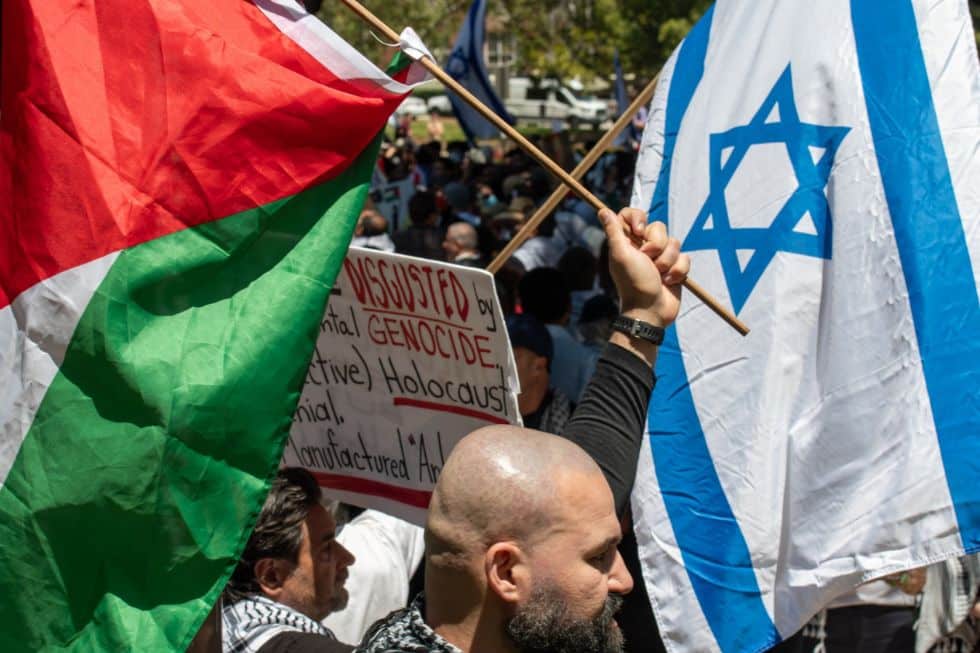
During the spring of 2024, Georgetown’s campus remained eerily silent while widespread protests took over numerous elite universities around the US. Georgetown students held some small protests, but they paled in comparison to the widespread encampments and sit-ins seen at Columbia University, University of California, Los Angeles and more.
This omerta was self-inflicted. In reality, Georgetown’s faculty provided ample educational opportunities through the Center for Jewish Civilization and the Center for Muslim-Christian Understanding, including the Gaza Lecture Series, a Conversation with Families of Hostages in Gaza, guest speaker events and related classes to learn about the ongoing conflict. Still, a lack of free, open discussion among the student body persisted. Unlike other foreign policy issues my peers and I confronted during our time at Georgetown, Israel’s war in Gaza seemed to blur lines of good and evil, right and wrong.
Understanding the taboo
Fear of saying the wrong thing inhibited students from saying anything at all. The anticipated lack of empathy and understanding behind discussing the conflict, as well as the potential career repercussions of public opinion, drove the silence at Georgetown.
On campus, the pervasive fear of being called anti-Semitic prevented much of the criticism of the actions of Israel’s government. In the hyperpolarized and tense atmosphere relating to the ongoing conflict, any criticism against Israeli Prime Minister Benjamin Netanyahu was feared to be taken out of context as criticism against the Jewish people themselves. Speaking out against Israel’s offensive, the civilian death toll and the starvation in Gaza could result in being labeled a sympathizer of Hamas.
At the same time, the rise of anti-Semitism across the US posed a real threat to many students’ identities and comfort level to speak their minds. Many students were afraid to express their support for Israel, for fear of being met with anti-Semitism or being labeled as heartless and immoral because of the crisis in Gaza.
There appeared to be no middle ground or safe space to reach a common understanding. Social media and mainstream news had whittled the image of student protestors for Palestine into American-flag-burning, angry anarchists unable to have a conversation but more than willing to pitch a tent and protest. Criticism against the incursion in Gaza and ongoing international law violations seemingly grouped one in with the latter.
I remember one professor recommending that my class not join any protests. The long-standing, revered instructor of both introductory and seminar classes respected students’ rights to assemble and speak freely, but warned against the repercussions of doing so and being part of an unpredictable crowd. To him, we all had bright futures in policy and government, and one photograph at a protest gone wrong was not worth the risk.
The recent politicization of the federal government under the Trump administration further raised the risk of speaking up and out. For the many students at the School of Foreign Service who aspire to work in government, taking a public opinion that differs from the current administration’s could jeopardize future professional opportunities due to new hiring loyalty tests and heightened examination of social media activity.
The cost of silence
The sad truth is that this taboo isn’t unique to Georgetown. When I shared my idea to write an article about the taboo of talking about Gaza, many of my friends from Harvard, the University of Pennsylvania and George Washington University immediately resonated with my thinking. I heard about a student from Columbia University who thought of writing a similar article, but ultimately feared having their name attached to any opinion piece traceable to the ongoing conflict.
If students at the highest-ranked international affairs schools in the US shy away from discussing Israel and Gaza, we will lose many thoughtful leaders who speak with the courage of their convictions. The mission statement at Georgetown’s School of Foreign Service includes “educating future leaders who will make the world safer and more equitable, prosperous and peaceful,” but if we are too afraid to speak up and have real, genuine and difficult conversations, we are doing ourselves and our country a disservice.
The United States needs bold, thoughtful and courageous leaders now more than ever. The failure to speak truth to power comes from the failure to speak openly, honestly and respectfully within our communities. At Georgetown, this starts by confronting the taboo behind talking about Israel and Gaza. We cannot be so afraid to speak that we say nothing at all.
[Kaitlyn Diana edited this piece.]
The views expressed in this article are the author’s own and do not necessarily reflect Fair Observer’s editorial policy.
Communal Resilience as a Young Person in an Increasingly Volatile US
In the US, many members of Generation Z (Gen Z) believe that democracy is at risk from threats that Gen...

America Against Itself: The University as a Casualty of Israel’s War
What are the implications of suppressing free thought and critical dialogue on campuses across the US? America’s repression of student...
Student Protests in America Now: Is the Juice Worth the Squeeze?
Liberal campuses have long been illiberal with conservatives. Now, entitled students have teamed up with outside agitators to wreak havoc...
Support Fair Observer
We rely on your support for our independence, diversity and quality.
For more than 10 years, Fair Observer has been free, fair and independent. No billionaire owns us, no advertisers control us. We are a reader-supported nonprofit. Unlike many other publications, we keep our content free for readers regardless of where they live or whether they can afford to pay. We have no paywalls and no ads.
In the post-truth era of fake news, echo chambers and filter bubbles, we publish a plurality of perspectives from around the world. Anyone can publish with us, but everyone goes through a rigorous editorial process. So, you get fact-checked, well-reasoned content instead of noise.
We publish 3,000+ voices from 90+ countries. We also conduct education and training programs
on subjects ranging from digital media and journalism to writing and critical thinking. This
doesn’t come cheap. Servers, editors, trainers and web developers cost
money.
Please consider supporting us on a regular basis as a recurring donor or a
sustaining member.
Will you support FO’s journalism?
We rely on your support for our independence, diversity and quality.





Comment