


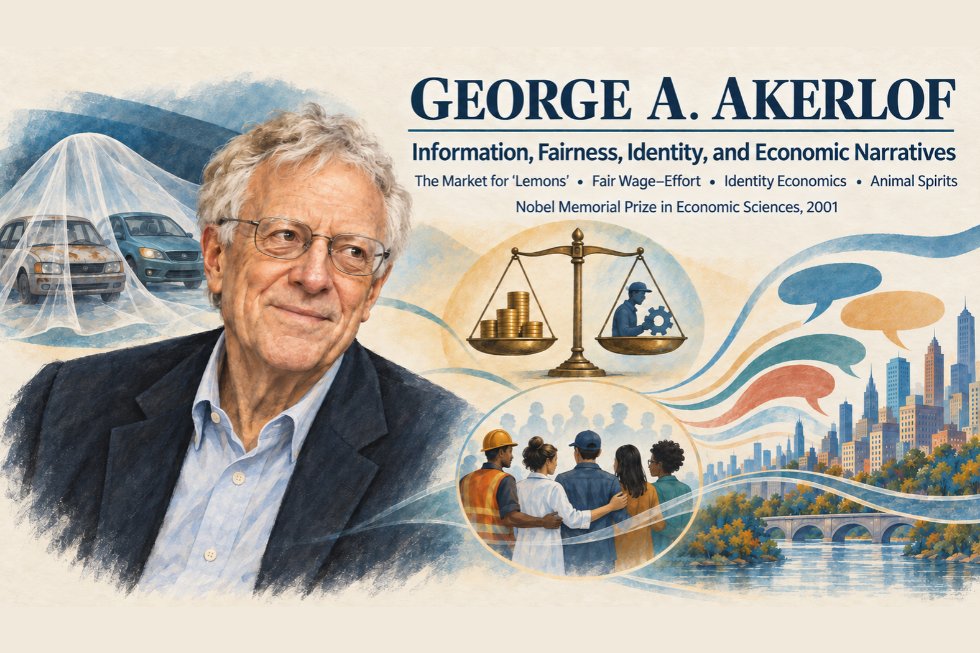



Professor George Akerlof was born in New Haven, Connecticut, in 1940, the son of a Swedish-born chemist at Yale. He got his bachelor’s degree at Yale in 1962 and his doctorate at the Massachusetts Institute of Technology (MIT) in 1966, in the department of Robert Solow and Paul Samuelson. He then joined the University of California, Berkeley, and spent 1967 to 1968 at the Indian Statistical Institute in Delhi. He has said that the year in India, where moneylenders charged very high rates to borrowers they could not assess, shaped the paper that made his name.
In 1978, he married former Fed chair and US Treasury secretary Janet Yellen, with whom he later wrote several papers. Their son, Robert “Robin” Akerlof, also became an economist working at the intersection of behavioral, organizational and social economics. His research examines how esteem, legitimacy, social norms, narratives and group identity shape individual behavior and organizational outcomes. Akerlof shared the 2001 Nobel Memorial Prize in Economic Sciences with fellow economists Michael Spence and Joseph Stiglitz. He served as a senior economist on the White House Council of Economic Advisers and as a senior resident scholar at the International Monetary Fund.
His work over five decades rests on a recurring method. He begins with an observation that standard models handle poorly: a market that fails to form, a firm that declines to cut wages when workers are plentiful or a soldier who fights when effort cannot be observed. He then adds a single assumption, such as unequal information, a social norm or an identity, and works out the consequences with the discipline of formal theory. The addition is small, but the results have often been large enough to change how the field thinks.
This essay concentrates on three bodies of work. The first is the 1970 paper on used cars, which founded the economics of asymmetric information. The second is the identity model developed with Professor of Economics Rachel Kranton, especially their 2005 article ”Identity and the Economics of Organizations.” The third is the collaboration with Sterling Professor Emeritus of Economics Robert Shiller, which carried both lines of thought into macroeconomics and the study of markets. The piece aims to explain what these works actually say and why economists regard them as major achievements.
The market for “lemons”
Akerlof’s article “The Market for “Lemons: Quality Uncertainty and the Market Mechanism” appeared in the Quarterly Journal of Economics in 1970. Akerlof’s research demonstrated how asymmetric information between buyers and sellers can drive higher-quality products out of the market and, in extreme cases, cause trade to collapse, such as a defective car known as a “lemon.” His work demonstrates that asymmetric information can cause markets to shrink considerably.
“The Market for Lemons” became highly influential in subsequent literature on asymmetric information. It is often reported that other leading journals had turned it down, one on the ground that the point was trivial and another because its conclusion seemed too sweeping to be right. Whatever the exact history, the paper is now among the most cited in economics.
The argument is built on a simple case. A used car may be a good car or a “lemon,” a car with hidden defects. The owner knows which. The buyer can only observe that a car is for sale, and so is willing to pay a price that reflects the average quality of cars on offer. At that price, owners of good cars find the offer too low and keep their cars, while owners of poor cars are happy to sell. The average quality of cars actually offered falls, the buyer’s willingness to pay falls with it and still more good cars are withdrawn.
Akerlof made the point exact with a numerical example, which is worth following step by step because it shows that the failure has nothing to do with bad faith or irrationality. Suppose the quality of used cars is spread evenly between zero and two, and that each seller values a car at its quality q. Suppose also that every buyer values a car of quality q at 1.5 times q, so that trade would benefit both sides if quality were visible. If buyers know only the average, then at any price p only owners with cars of quality up to p will sell. The average quality on the market is therefore p/2, and buyers value that average car at 0.75p. Because that is always less than p, no buyer will pay p.
| Price, p | Average quality offered, p/2 | Buyer’s valuation, 0.75p | Will buyers pay p? |
| 0.5 | 0.25 | 0.375 | No |
| 1.0 | 0.50 | 0.750 | No |
| 1.5 | 0.75 | 1.125 | No |
| 2.0 | 1.00 | 1.500 | No |
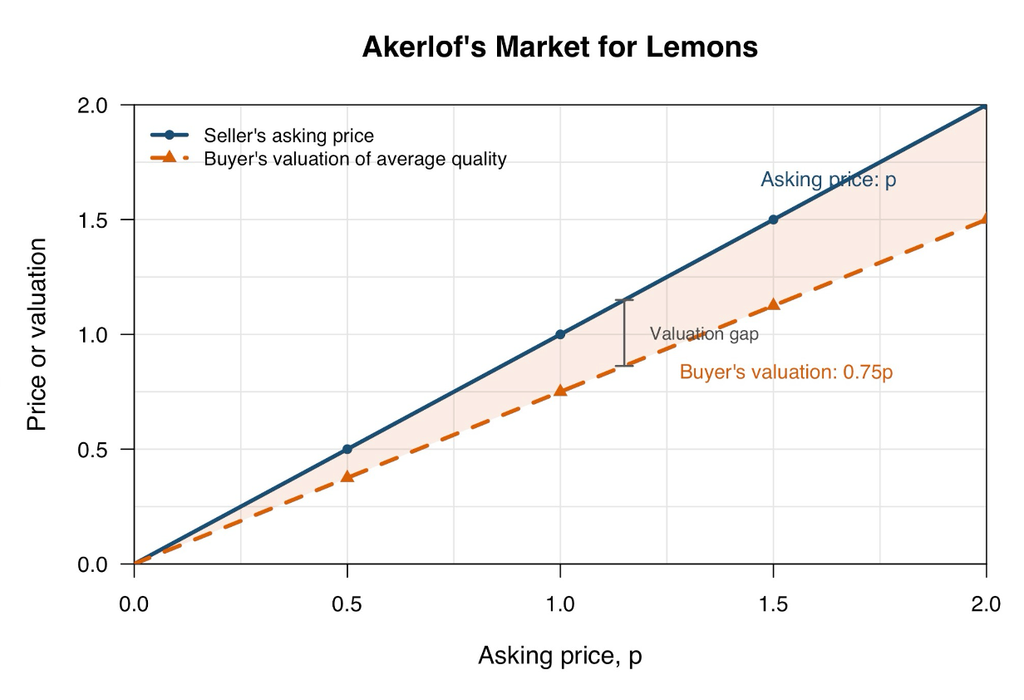
The table repeats at every price. Even though a buyer would pay up to 1.5q for a car worth q to its seller, no trade takes place. Trades that would be mutually beneficial when individual quality is observable disappear when buyers can observe only the average quality of cars offered. The mechanism is now called adverse selection.
The paper’s importance comes from what it overturned. Textbook models assumed that price adjusts until supply equals demand. Akerlof showed that when quality is unobserved, price also carries information about quality, so a lower price can reduce the quality of what is supplied and shrink the market instead of clearing it.
The article then shows that the logic reaches well beyond cars. In health insurance, higher premiums drive out low-risk customers, leaving a costlier pool, and Akerlof used insurance for the elderly as an example. In labor markets, an employer who cannot observe individual productivity and treats a group by its average may fail to reward its better members, which gives a source of persistent disadvantage that does not require any dislike of the group. Dishonesty carries a cost beyond the fraud itself, since it prevents honest trades that would otherwise occur. In developing-country credit markets, lenders who cannot judge borrowers may charge very high rates, a point drawn from his observations in India.
The paper’s last section turns to the institutions that arise in response: guarantees, brand names, chains, licensing and certification. Each gives buyers information or shifts risk to sellers, and Akerlof argued that these arrangements exist because of the problem the paper describes.
The 2001 Nobel Prize treated the lemons paper as one of three complementary contributions. Spence’s 1973 work on job-market signaling showed how informed parties can convey quality through costly actions such as education. Rothschild and Stiglitz, in 1976, showed how uninformed parties can design contracts, in their case insurance contracts, that lead different types to reveal themselves. Together, the three works produced a research program that now spans insurance, finance, labor and industrial organization, and that informs practical rules such as disclosure requirements, warranties and the lemon laws that protect vehicle buyers.
From information to norms: wages, fairness and sticky prices
After the lemons paper, Akerlof turned to a second puzzle: why wages and prices behave as they do when standard theory says they should not. If unemployment exists, wages should fall until it disappears, but firms often refuse to cut pay when workers are available.
His 1982 paper ”Labor Contracts as Partial Gift Exchange” offered an explanation drawn from sociology. Workers hold norms about a fair day’s work, and the firm’s treatment of them influences those norms. A firm that pays somewhat more than it must can therefore receive more effort than it must be given. In this view, a wage is both a payment and a signal that shapes the worker’s attitude to the firm. Two earlier papers, on social custom and on caste, had shown how a norm can persist because those who break it are penalized by others, even when a different custom would leave everyone better off.
With Janet Yellen, his wife, Akerlof developed these ideas into a body of work on efficiency wages and fairness. Their 1990 paper on the fair wage-effort hypothesis formalized the idea that effort depends on how a worker’s pay compares with what they regard as fair. A firm that pays less than the fair wage gets less effort, so cutting wages in a slump can raise unit costs rather than reduce them, and unemployment can persist. Their 1985 work on near-rational behavior added a further point. A firm that follows a simple rule of thumb instead of fully optimizing may lose only a little, yet the combined effect of many such decisions on output and employment can be large, which helps explain slow adjustment of wages and prices after demand changes.
The 1996 paper “The Macroeconomics of Low Inflation,” written with William Dickens, a University Distinguished Professor Emeritus of Economics and Public Policy, and George Perry, a Senior Fellow Emeritus of Economic Studies, applied the same reasoning to monetary policy. If workers and firms resist nominal wage cuts, then at very low inflation real wages cannot adjust downward through rising prices, and the long-run tradeoff between inflation and unemployment may become less favorable. The paper entered debates about how low a central bank’s inflation target should be.
Professor Emeritus of Economics Truman Bewley’s later interviews with managers gave field support for this line of work. Managers said they avoided wage cuts in recessions because of the effect on morale and on workers’ attachment to the firm. Akerlof and Kranton cite this finding in the 2005 paper discussed next.
Identity and the economics of organizations
Akerlof’s collaboration with Rachel Kranton began with “Economics and Identity” (Quarterly Journal of Economics, 2000) and continued with an application to schools in the Journal of Economic Literature (2002). Their 2005 article in the Journal of Economic Perspectives applied the idea to organizations, while the 2010 book Identity Economics presented the framework to a broader audience.
The 2005 paper opens with West Point. On their first day, cadets have their hair cut, put on uniforms, and repeat a prescribed salute and statement until every detail is correct, while being reprimanded for even small mistakes. The authors draw this account from David Lipsky’s description of four years spent with a company of cadets. Their point is that the Army is not merely regulating the cadets’ behavior; it is also changing how they understand themselves. Cadets are taught to identify as officers and to experience a personal loss when their behavior falls short of the standards associated with that identity. Standard models, in which preferences are fixed and motivation depends only on income and effort, have difficulty capturing this process. Yet organizational identity can be a powerful way of motivating people whose effort is difficult to observe or reward directly, as it is in battle.
The paper’s central contribution is to incorporate identity into the analysis of individual motivation. A person belongs to social categories, such as soldier, manager or worker. Each category carries norms about how its members should behave and ideals represented by real or imagined examples of appropriate conduct. A person who identifies strongly with a category gains satisfaction from conforming to its norms and experiences a psychological cost when her behavior departs from them. Motivation therefore depends not only on income and the cost of effort but also on social identity and on the distance between a person’s actual behavior and what they believe someone in their position should do.
The model modifies the conventional principal-agent problem. The firm cannot observe a worker’s effort directly, although it can observe whether revenue is high or low, and greater effort makes high revenue more likely. The worker chooses between high and low effort. They may be an insider, who identifies with the organization and regards high effort as appropriate, or an outsider, who does not share the organization’s objectives and regards minimum effort as normal.
The results follow directly. Because an insider experiences a psychological cost from shirking, only a small difference between the payments associated with high and low revenue is needed to induce them to work hard. An outsider, by contrast, experiences a psychological cost from working harder than their own norm requires and must therefore be offered a larger financial incentive. Because workers generally dislike uncertainty in their compensation, a pay system with less variation is less costly for the firm. An insider may also accept a lower average wage because identification with the organization provides satisfaction in itself. When these savings are sufficiently large, the firm benefits from investing in practices that transform outsiders into insiders — precisely what the Army attempts to accomplish at West Point.
The authors state when such investment is most likely to pay: when changing identity is cheap, uncertainty is high, effort is hard to observe, output depends on special exertion at critical moments and workers are highly averse to risk. The military meets these conditions, and the model predicts that it will rely more on identity than on pay. Consistent with this, the authors report that pay varies less across military ranks than in corporate hierarchies. They also stress that identity and money are not always substitutes. In a model with more than two effort levels, identity that lowers the cost of effort might lead the firm to ask for more, and pay differences could then increase.
| Feature | Insider | Associated with strict supervision and reporting | Workgroup member |
| Ideal effort | High, as preferred by the firm | Minimum | Intermediate |
| Pay difference required to induce high effort | Small | Large | Between the two |
| Typical organizational arrangement | Investment in organizational identity | Strict supervision with reporting to management | Associated with loose supervision |
The second model in the paper adds a supervisor. Under strict supervision, in which the supervisor reports to management, workers see him as part of management and become outsiders. Under loose supervision, they see him as one of them and adopt the workgroup’s norm, whose effort level is typically above the outsider’s minimum and below what the firm would like. The firm therefore faces a tradeoff. Strict supervision gives management information for setting pay, but it costs the firm the workers’ identification and requires higher wages. Loose supervision yields a middle level of effort at lower cost.
The evidence comes from a wide range of studies outside economics. In a Chicago machine shop observed by two sociologists, workers held to an unwritten rule against earning more than about 140% of base pay, and treated “making out” as a game that expressed their self-image. Management, aware of the evasion, chose not to press for information, which the model explains as satisfaction with the workgroup’s results.
At the Western Electric Bank Wiring Observation Room in 1931, workers held output to two switches a day and sabotaged a strict supervisor until the company moved him. In a heavy machinery plant studied by Seashore, productivity varied less within cohesive groups than within loose ones, and more between cohesive groups, as the workgroup model predicts.
Lincoln Electric pays piece rates yet also builds a strong sense of community, which the authors read as commitment and pay incentives working together. Individual accounts, such as a steelworker who suppresses anger at his foreman and takes it out in taverns, and a photocopy employee who stays composed with a rude client because they think of themself as a member of her company, illustrate the outsider and the insider. The General Social Survey offers a measure: In its 1991 module, about 90% of employees said they were proud to work for their organization and about 78% said their values resembled the organization’s. The authors caution that the survey cannot say why workers feel this way, whether from firm investment, selection or adaptation.
The paper concludes that identification with the organization is a form of capital, which the authors call motivational capital. They point to further applications, including executive pay, mergers between firms with different identities, the legal notion of fiduciary duty, and differences in organizations between rich and poor countries.
Shiller, animal spirits and the legacy
Robert Shiller, a Yale economist, was known for showing that stock prices fluctuate far more than dividend changes can explain, and for the Case-Shiller house price index. He shared the 2013 Nobel Prize with Eugene Fama and Lars Peter Hansen. He co-authored two books with Akerlof.
Animal Spirits (2009) appeared during the financial crisis. The title comes from British economist John Maynard Keynes, who used the phrase for the spontaneous urge to act rather than wait and believed it underpins much economic decision-making. The authors argue that mainstream macroeconomics dropped this part of Keynes and, with it, the ability to explain events like the crisis.
They propose five psychological factors that should return to macroeconomic models. Confidence affects spending and investment independently of current income and can reinforce itself, which leads the authors to describe a confidence multiplier. Fairness shapes wages and prices, drawing directly on Akerlof’s earlier work and Bewley’s interviews. Corruption and bad faith tend to grow in booms with weak oversight and, when exposed, add to the damage, as in the savings and loan episode that Akerlof and Paul Romer analyzed in their 1993 paper ”Looting.” Money illusion, the habit of thinking in nominal terms, bears on wage setting and on the inflation-unemployment relationship, connecting to the 1996 low-inflation paper. Stories about the economy spread among people and influence what they expect and do.
Phishing for Phools (2015) extends the argument. In a free market, the authors claim, sellers have an incentive to exploit buyers’ emotional and cognitive weaknesses, and competition does not remove it, because a seller who declines to exploit loses customers to one who does. Their examples include advertising, financial products and the ratings given to mortgage securities before 2008. The book returns to the theme of the lemons paper, but in reverse. In 1970, the seller’s superior information about the good reduced the quality of what was traded. In 2015, the seller’s superior knowledge of the buyer’s psychology alters the buyer’s choice.
Assessments of his work differ by area. The lemons paper is uncontroversial in its importance: It became a foundational contribution to modern analysis of adverse selection and gave policymakers a rationale for disclosure and warranty rules. The work on fairness and wages is widely regarded as an alternative to simple market-clearing models.
Identity economics has spread into studies of education, gender, race and organizations. Critics observe that identity and norms are harder to measure than prices, and that a model in which the ideal for each category can be chosen freely risks explaining any behavior. Akerlof and Kranton reply that their models yield definite predictions about how pay, supervision and group membership interact, and they point to the case evidence. Their 2005 paper itself acknowledges that some of the evidence fits other explanations, such as firms selecting workers who already share their values.
In his 2020 article “Sins of Omission and the Practice of Economics,” Akerlof turned the same criticism on his profession, arguing that economists favor topics that suit their standard methods and leave out those that do not. That claim summarizes his career. The lemons paper added to market theory, the wage papers added fairness, the identity papers added the worker’s sense of self, and the Shiller books added confidence and stories. Each addition began with an observation that the standard model could not accommodate, and each made the model more accurate in describing how people behave.
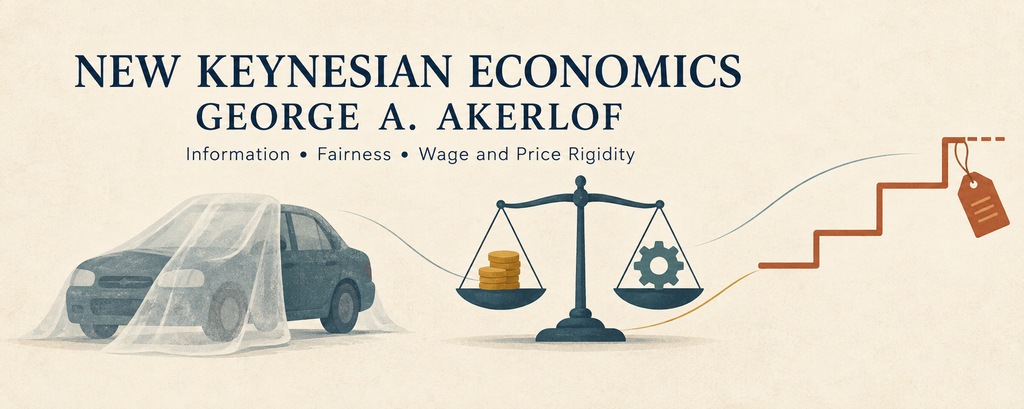
Akerlof’s lasting contribution lies not in a single model but in a way of doing economics: beginning with behavior that conventional theory overlooks and then showing how it can be analyzed rigorously. His work demonstrates that markets and organizations cannot be fully understood without considering information, fairness, identity and the stories people tell themselves and one another. In that sense, Akerlof did more than expand economic theory; he helped bring economics closer to the world it seeks to explain. He is my best professor.
[Kaitlyn Diana edited this piece.]
The views expressed in this article are the author’s own and do not necessarily reflect Fair Observer’s editorial policy.
Who Should Form Expectations?: The Future of Monetary Policy
Modern monetary policy should balance central bank guidance with independent market learning. While forward guidance effectively stabilizes expectations during crises,...
Connection, Not Isolation, Has Carried Humans Through Every Age
From early human migrations to today’s interconnected global economy, human progress has been driven by movement, adaptation and exchange. Genetic...

Keynes and Friedman, Prophets of the World’s Most Popular Religion
Capitalism is a religion. Like all religions, it must adapt to changing times in order to keep and win followers....
Support Fair Observer
We rely on your support for our independence, diversity and quality.
For more than 10 years, Fair Observer has been free, fair and independent. No billionaire owns us, no advertisers control us. We are a reader-supported nonprofit. Unlike many other publications, we keep our content free for readers regardless of where they live or whether they can afford to pay. We have no paywalls and no ads.
In the post-truth era of fake news, echo chambers and filter bubbles, we publish a plurality of perspectives from around the world. Anyone can publish with us, but everyone goes through a rigorous editorial process. So, you get fact-checked, well-reasoned content instead of noise.
We publish 3,000+ voices from 90+ countries. We also conduct education and training programs
on subjects ranging from digital media and journalism to writing and critical thinking. This
doesn’t come cheap. Servers, editors, trainers and web developers cost
money.
Please consider supporting us on a regular basis as a recurring donor or a
sustaining member.
Will you support FO’s journalism?
We rely on your support for our independence, diversity and quality.





Comment