





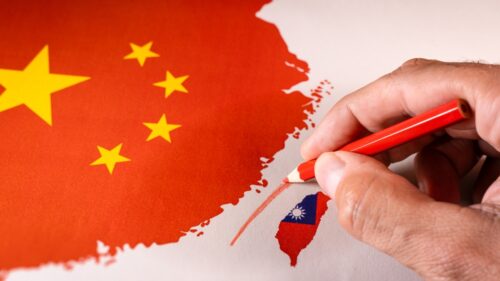
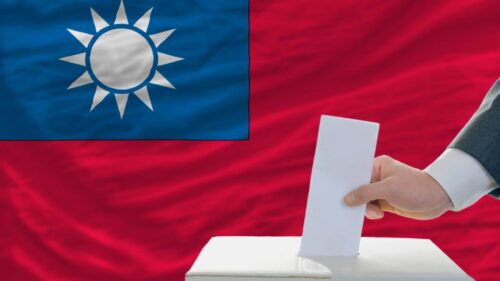
On January 13, 2024, Taiwan elected a new president and members of the 113-seat Legislative Yuan. Vice President Lai Ching-te (also known as William Lai), from the Democratic Progressive Party (DPP), emerged victorious with 40% of the vote. The DPP is a Taiwanese nationalist party, and thus Lai’s election has ruffled feathers in Beijing, which sees Taiwan as its rightful territory.
The DPP’s main rival is the Chinese nationalist Kuomintang party. The Kuomintang once ruled mainland China but evacuated to the island of Taiwan in 1949 after losing the Chinese Civil War to Mao Zedong’s Chinese Communist Party (CCP). The Kuomintang claimed to be the rightful government of the entire Republic of China (RoC) and vowed one day to return to the mainland. To this day, the official name of Taiwan is still “Republic of China.”
The Kuomintang established an authoritarian rule over their new island home which lasted for decades. During the 1980s and 1990s, however, Taiwan democratized. Unlike the CCP-ruled mainland, Taiwan today boasts a robust multiparty democracy.
The Kuomintang has long since abandoned dreams of rescuing the mainland from communism by force. Still, they see themselves as Chinese, hope one day to achieve a peaceful reunification of China and seek to maintain cordial relations with the mainland.
In contrast, the DPP believes that Taiwan and China are two separate nations. In the mainstream DPP view, the Republic of China is Taiwan, an independent nation distinct from mainland China. They favor closer ties with Washington and seek to distance Taipei from Beijing. Thus, Zhongnanhai views the DPP, and Lai in particular, with hostility.
Taiwan’s new president is weaker
Lai identifies himself as a "pragmatic worker for Taiwanese independence." In his May 20, 2024 inauguration speech, Lai demonstrated a departure from Tsai's approach, signaling a more assertive stance on Taiwanese sovereignty.
Beijing saw Lai’s speech as a provocation and, three days later, launched two days of intensive military exercises around Taiwan. These maneuvers, labeled by the Chinese military as "strong punishment" for Taiwan’s "separatist acts," marked a significant escalation in cross-strait tensions. The exercises were not limited to the vicinity of Taiwan's main island but extended to target Taipei-controlled islands such as Kinmen, Matsu, Wuqiu, and Dongyin for the first time. These islands lie close to the Chinese coast, according to maps released by China's People's Liberation Army (PLA). The Chinese Communist Party (CCP) distrusts Lai and is using these exercises to send Lai a clear signal.
Despite Beijing's firm stance, immediate escalation appears unlikely. Although the DPP kept control of the presidency in this year’s elections, it lost its majority in the legislature. The Kuomintang now controls three more seats than the DPP does. Thus, Beijing perceives Lai as potentially wielding less influence than Tsai.
Lai is clearly weaker than his predecessor. He took the presidency with 40% of the vote; in 2016 and 2020, Tsai had dominated with 56% and 57%, respectively.
With the DPP losing its majority in the Legislative Yuan, Lai confronts significant challenges in advancing his agenda. In May, the Kuomintang joined with the third party, the Taiwan People's Party, to pass a controversial reform bill. This legislation significantly enhances the Legislative Yuan's authority to oversee the executive; to interrogate officials, military figures and citizens; and to demand documentation. Tens of thousands of protestors filled the streets of Taipei, calling the reforms unconstitutional. Lawmakers engaged in scuffles on the Legislative Yuan floor. Amid incidents of inter-party violence on the street, Taiwan’s future political trajectory remains uncertain.
[Ting Cui wrote the first draft of this piece.]
The views expressed in this article/video are the author’s own and do not necessarily reflect Fair Observer’s editorial policy.








































Comment