


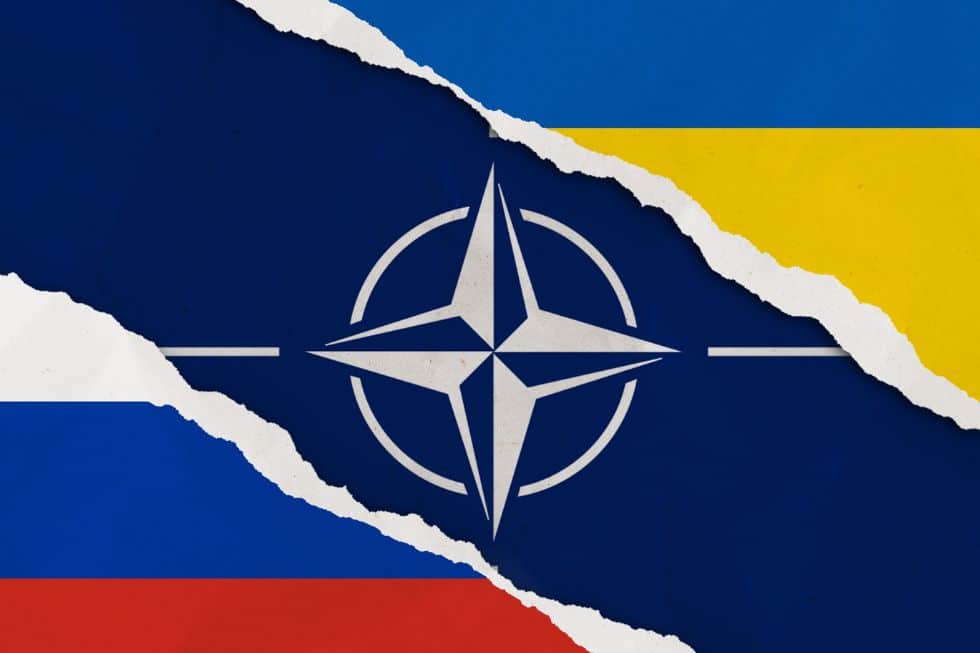



Ukraine is the frontline of a deliberate Russian assault on the Euro-Atlantic order. Far from a contained regional war, Moscow’s campaign represents a coordinated hybrid strategy that blends conventional military force with nuclear intimidation, cyber operations, disinformation and political coercion. The aim is not simply to seize territory, but to expose the limits of Western resolve, fracture NATO cohesion, and demonstrate that borders and sovereignty can be rewritten by force. How the West responds will determine not only Ukraine’s survival, but whether the foundations of European security can withstand sustained pressure in the 21st century.
Moscow’s strategy blends cyber warfare with nonmilitary coercion. Alongside battlefield offensives, Russia has employed staged referendums, systematic disinformation, energy pressure and calibrated nuclear signaling. Its revised nuclear doctrine, lowering the threshold for nuclear use against non-nuclear states supported by nuclear powers, is designed to constrain NATO decision-making and deter more decisive Western military assistance. The objective extends beyond controlling Ukrainian territory. It is a deliberate effort to weaken the principles of sovereignty and self-determination that have underpinned European security since the end of the Cold War.
Western Strategy Under Strain
The conflict has also exposed structural weaknesses in Western strategy. Sanctions, while politically significant, have not decisively degraded Russia’s capacity to sustain the war. Loopholes in oil price caps, the continued operation of a “shadow fleet” and sustained demand from nonaligned states have allowed Moscow to stabilize its war economy. Meanwhile, incremental and delayed arms deliveries, though essential for Ukraine’s defense, risk signaling hesitation rather than resolve, feeding long-term fatigue and eroding deterrence.
NATO now faces its most consequential credibility test since its founding. The alliance has reinforced its eastern flank and adopted a revised Strategic Concept, yet persistent constraints remain. Uneven defense spending, divergent political priorities among member states and fears of escalation continue to limit collective effectiveness. Russia exploits these vulnerabilities through drone incursions, cyberattacks, airspace violations and disinformation campaigns, probing for hesitation and testing whether NATO can translate consultations under Article 4 or, in a crisis, commitments under Article 5 into unified action. Deterrence has not collapsed, but alliance cohesion is under visible strain.
The stakes extend far beyond Ukraine. If territorial conquest by force is normalized, NATO’s security guarantees to the Baltic states, Poland and Central Europe would be fundamentally weakened. Russia’s deepening cooperation with Iran and its alignment with destabilizing actors in the Middle East further underscore a strategy aimed at stretching Western attention and diluting its ability to manage multiple crises simultaneously.
The Imperative for NATO Credibility
For NATO, the lesson is unambiguous. Credibility cannot rest on rhetoric alone. It requires accelerated force mobility, binding defense investment commitments and a demonstrated willingness to impose costs on Russia that exceed its capacity to absorb them. Deterrence ultimately depends on shaping adversary expectations. If Moscow concludes that the alliance is prone to delay, division or risk aversion, the likelihood of further Russian adventurism will rise.
Ukraine has thus become the frontline defense of the Euro-Atlantic order. Russian hybrid tactics now extend well beyond Ukrainian territory, directly testing NATO and targeting European political cohesion. Proposals for alternative “security guarantees” outside NATO lack the binding authority and deterrent weight of Article 5, while fragmented responses and political ambiguity increase Europe’s vulnerability.
The war in Ukraine is therefore not approaching a diplomatic off-ramp; it is approaching a strategic verdict. If the West responds with hesitation, ambiguity or managed decline, Moscow will draw a clear lesson: that hybrid coercion works and collective defense can be bent without being broken. Ukraine’s fate will then become a precedent, not an exception. The erosion of the Euro-Atlantic order would follow not through sudden collapse, but through accumulated concessions that normalize aggression and hollow out deterrence. This war will not only determine borders on Europe’s map, but it will also decide whether power or principle governs European security in the decades ahead.
[Kaitlyn Diana edited this piece.]
The views expressed in this article are the author’s own and do not necessarily reflect Fair Observer’s editorial policy.
FO° Talks: Russia and China’s Hybrid Warfare Explained | What Are NATO and the EU’s Options?
In this episode of FO° Talks, Rohan Khattar Singh and Maurizio Geri examine how Russia and China use hybrid warfare...
NATO and European Defense in the Face of Russian Resurgence and America First
The Russo-Ukrainian War and the trend for US disengagement from Europe, particularly under the Trump administration, have brought the inadequacy...
Russian Imperialism, Not NATO Expansion, Caused the Ukraine War
With Vladimir Putin evoking Peter the Great, it is clear that Russian imperialism is alive and kicking. Neighbors fled to...

Support Fair Observer
We rely on your support for our independence, diversity and quality.
For more than 10 years, Fair Observer has been free, fair and independent. No billionaire owns us, no advertisers control us. We are a reader-supported nonprofit. Unlike many other publications, we keep our content free for readers regardless of where they live or whether they can afford to pay. We have no paywalls and no ads.
In the post-truth era of fake news, echo chambers and filter bubbles, we publish a plurality of perspectives from around the world. Anyone can publish with us, but everyone goes through a rigorous editorial process. So, you get fact-checked, well-reasoned content instead of noise.
We publish 3,000+ voices from 90+ countries. We also conduct education and training programs
on subjects ranging from digital media and journalism to writing and critical thinking. This
doesn’t come cheap. Servers, editors, trainers and web developers cost
money.
Please consider supporting us on a regular basis as a recurring donor or a
sustaining member.
Will you support FO’s journalism?
We rely on your support for our independence, diversity and quality.





Comment