


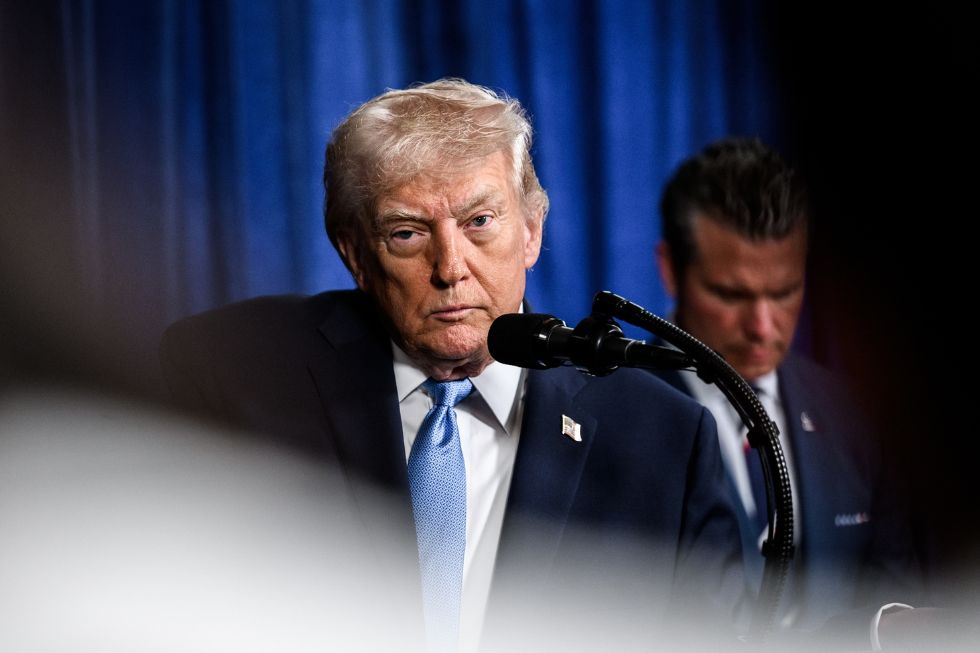



Russia’s invasion of Ukraine in 2022 triggered Germany’s Zeitenwende, which can be translated as a historic turning point. Then-Chancellor Olaf Scholz put it in motion as a response to Germany’s need to adapt to the changing European geopolitical landscape. This policy included a €100 billion special fund for defense and a pledge to long-term military modernization.
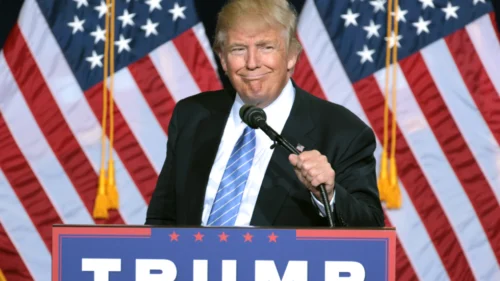
US President Donald Trump, however, is not only pushing the historic turning point that Scholz put in motion in 2022 too far, but also sowing disruption in German domestic politics. In doing so, he is bringing the so-called “German Question” back into the current geopolitical scene. This term is historically associated with European anxieties about Germany’s strong tradition of militarism and nationalism.
The German question
After Germany’s reunification in October of 1990, fears emerged that the country’s central geographic position, industrial might and warmongering history could transform it into a potential threat to the rest of Europe. With the sudden strengthening of Germany, indeed, the delicate balance of power upon which the European Economic Community had been built was turned upside down. A newly empowered Germany, it was believed, could always trigger back latent nationalistic instincts.
Not surprisingly, British Prime Minister Margaret Thatcher strongly opposed such reunification, dreading that a too-powerful Germany could undermine European stability and endanger her country’s security.
To deal with these fears, Germany’s Chancellor Helmut Kohl and French President Francois Mitterrand came up with the same answer: transforming the European Economic Community into a European political union. On this basis, the December 1991 Treaty of the European Union, approved in the Dutch city of Maastricht, came into being.
The reasons that had motivated both leaders in creating the European Union, however, were exactly the opposite. Kohl wanted to strengthen his country’s links with Europe to keep his fellow citizens’ nationalistic instincts in check, while Mitterrand wanted to strengthen Europe to keep Germany in check.
Three decades after the emergence of the European Union, Scholz’s Zeitenwende did not raise fears among their fellow Europeans. With an aggressive Russia at the borders, the idea of a stronger military Germany was well received by them. If anything, European distress came not from a strong Berlin, but from a weak one.
Trump 2.0’s actions, however, are turning things upside down by generating European anxieties about a Germany that could become militarily too strong and politically too nationalistic. In the words of historian and political scientist Liana Fix:
But left unchecked, German military dominance might eventually foster division within the continent, France remains uneasy about the fact that its neighbor is becoming a major military power … In the worst-case scenario, competition might return. France, Poland and other states could attempt to counterbalance Germany, which would divert attention away from Russia and leave Europe divided and vulnerable”.
Trump’s three-lane avenue
But how is Trump turning things upside down? This takes shape through a three-lane avenue. The first lane propels NATO European members to invest up to 5% of their GDP in defense. The second materializes by threatening to abandon NATO, or, even without doing so, by threatening to disregard the alliance’s Article 5 — the cornerstone of collective security — thus sowing anxieties about America’s reliability. The third takes shape by legitimizing and seeking to empower Germany’s ultra-right Alternative für Deutschland (AfD), which is considered an extremist organization.
The first and second avenues have converged, forcing European NATO members to make much larger defense disbursements while seeking European strategic autonomy. However, this is not as easy as it sounds. No other European country can match Berlin’s military expenditure, which by 2029 would budget $189 billion annually. That is, three times more than in 2022. In total, Germany plans to expend more than $750 billion on defense over the next four years. If this is accomplished, Germany would again become a great military power before the end of the decade.
However, with smaller economies, larger public debt or tight social welfare commitments, the rest of Europe will not be able to follow suit. Having the largest economy in Europe translates into much larger absolute spending, although, as a percentage of GDP, it could equal what smaller economies allocate to defense. Moreover, countries with higher public debt or tighter social welfare obligations, like France or Italy, have less fiscal space to raise defense outlays. As a result, while Germany was able to loosen its debt brake to invest heavily in defense, many others cannot do the same. All of the above create the conditions for Germany becoming Europe’s military Lemuel Gulliver. At least in conventional military terms.
As if this were not enough to create a tremendous power imbalance in Europe, Trump’s third avenue lane aims at putting an extreme right party, the AfD, at the helm of Germany. As Deutsche Welle’s Hans Pfeifer affirms:
The party is also becoming increasingly openly extremist. AfD officials use Nazi slogans, pose with their hands on their hearts in front of Adolf Hitler’s bunker, wear clothing from the mail-order catalogue of Germany’s largest neo-Nazi organization, and call themselves the “friendly face of National-Socialism.”
Not surprisingly, AfD was labeled as an “extremist” organization by Germany’s intelligence services.
A military Gulliver under an extremist government
Although important sectors of the population see with fear the rise of AfD, opinion polls show that it has already surpassed Chancellor Friedrich Merz’s conservative bloc as the country’s strongest political force. Under those circumstances, the active support this party receives from the President of the US and top members of his administration plays an important role in legitimizing and normalizing it in the eyes of the German people. Specially relevant in this regard was the Trump administration’s dismissal of the validity of a 1,100-page report by the German intelligence agency, labeling AfD as “a proven right-wing extremist organization.”
The possibility of a European military Gulliver controlled by a “proven right-wing extremist” government is thus an important one, courtesy of Mr. Trump. If this materializes, a powerful bulwark against liberal Europe would emerge. The largest economy and military in Europe would be at odds with both the EU and NATO, representing a major historical shift in post-1945 German foreign policy. If so, the “German Question” rather than Russian aggression would become Europe’s biggest problem.
Contrariwise, Germany’s military strength will certainly not be a bulwark against an aggressive Russia. Indeed, AfD is known as the most Russophile party in German politics, maintaining a friendly, mutually supportive relationship with the Kremlin.
After the first eight decades of continuous peace in Western Europe’s recorded history, Trump is actively sowing the seeds of upheaval.
[Kaitlyn Diana edited this piece.]
The views expressed in this article are the author’s own and do not necessarily reflect Fair Observer’s editorial policy.
Imagine There’s No NATO: Germany as a New Middle-Sized Military Power in an Anarchic International Order
The fracturing of the Atlantic alliance under US President Donald Trump’s erratic leadership forces Germany to reconsider its security strategy...
The Returning Nightmare: Europe’s Far Right and the Fading of Democratic Memory
The resurgence of far-right movements throughout Europe is a result of several converging issues: a decline in historical awareness, unchecked...
The Dialectic: Can Germany Outgrow Its Postwar American Model?
In this episode of The Dialectic, Atul Singh and Glenn Carle explore how Germany faces acute economic, political and social...
Trump Two Is a Formula for Hell on Earth
Donald Trump is a modern-day Joe McCarthy with exponentially more destructive reach — set to supercharge climate chaos, social disintegration...
Support Fair Observer
We rely on your support for our independence, diversity and quality.
For more than 10 years, Fair Observer has been free, fair and independent. No billionaire owns us, no advertisers control us. We are a reader-supported nonprofit. Unlike many other publications, we keep our content free for readers regardless of where they live or whether they can afford to pay. We have no paywalls and no ads.
In the post-truth era of fake news, echo chambers and filter bubbles, we publish a plurality of perspectives from around the world. Anyone can publish with us, but everyone goes through a rigorous editorial process. So, you get fact-checked, well-reasoned content instead of noise.
We publish 3,000+ voices from 90+ countries. We also conduct education and training programs
on subjects ranging from digital media and journalism to writing and critical thinking. This
doesn’t come cheap. Servers, editors, trainers and web developers cost
money.
Please consider supporting us on a regular basis as a recurring donor or a
sustaining member.
Will you support FO’s journalism?
We rely on your support for our independence, diversity and quality.





Comment