


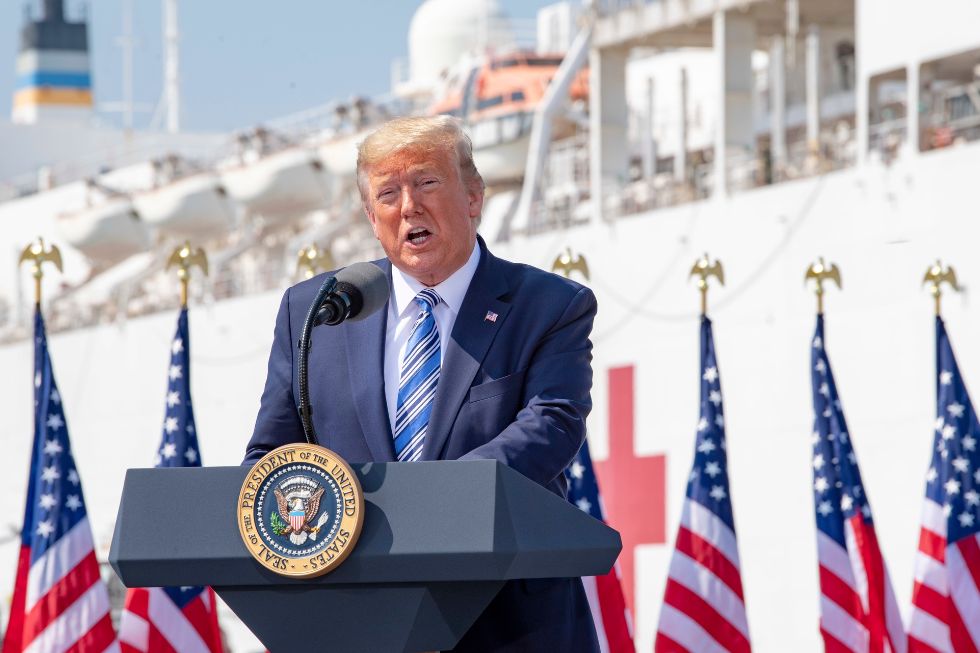



Two decades ago, in Prague — at the heart of the European continent, then US Defense Secretary Donald Rumsfeld met with leaders of Central and Eastern European states and recent NATO inductees amid a grand coalition-building effort. Nineteen-hundred miles to the southeast, the War in Iraq had irrevocably redefined the US’s geopolitical posture and single-handedly ended its unipolar moment.
The continent was split over support for the US-led coalition in the Middle East. Paris and Berlin refused to back it, whereas leaders from mainly former communist states, like Poland, Hungary and the Czech Republic, alongside a few Western allies, stood with Washington’s call for action. Donald Rumsfeld, the American Secretary of Defense, stated in a press conference at the NATO headquarters in 2003:
You’re thinking of Europe as Germany and France. I don’t. I think that’s “old Europe.” If you look at the entire NATO Europe today, the center of gravity is shifting to the East. And there are a lot of new members.
Rumsfeld, effectively a political ambassador of US President George W. Bush, dismissed the assembled Franco-German opposition in the manner that only a superpower that felt itself globally predominant could. This controversial distinction between “Old” and “New” Europe captured the geopolitical reality of that moment: On security matters, recent EU entrants aligned more closely with the US, while the traditional Western European powers charted a more independent course. This would endure as one of the signals of how the “war on terror” changed the US perspective of its European allies and vice versa.
Fast forward to the 2020s, and US President Donald Trump’s foreign policy has begun to mirror this divide. There is no shortage of parallels between the hawkish assertiveness of the Bush era and Trump’s revival of the “with us or against us” ethos, often pitting the White House’s will against allied consensus.
In both cases, Europe’s major powers have struggled to restrain Washington’s impulsiveness when its leader is fixated on a course of action. But there is a distinct element to Trump’s invocation of such turn-of-the-century paradigms, and it has more to do with security and the cohesion of the European theater than with anything else.
The new transatlantic reality
Back in December, a leaked draft of Trump’s National Security Strategy allegedly laid out a plan to prioritize American support for a select few European governments, explicitly listing Austria, Hungary, Italy, and Poland as countries the US should “work more with … with the goal of pulling them away from the [EU].” The document advocated backing European political forces that champion “sovereignty,” a serious pivot from most of the US’s post-1945 stance of bolstering European integration.
The strategy hints that officials in the current US administration might view a nonmonolithic Europe as an opportunity rather than an obstacle. Decades ago, a certain US secretary of state reportedly asked whom Washington should call if it wanted to speak to Europe, implying the fragmented nature of the continent’s political authority.
Today, the question may no longer need to be asked. If governments more sympathetic to the American leadership can offset Brussels, then America might be able to advance its interests by working with a more ideologically aligned subgroup of states rather than the EU as a single bloc. Seen in context, this goes beyond a single policy proposal and toward a broader rethink of Washington’s approach toward the EU, with a strategic emphasis on some of its members. Throughout the history of European integration, the Brussels elite has consistently avoided a two-tier or multispeed Europe, but this might suit the White House’s priorities just fine today.
Such a strategy could be particularly challenging for European governments because, while transatlantic rifts have occurred before (some more alarming than others), US administrations have traditionally exercised a degree of restraint and strategic calculation rather than seeking to weaken or undo the European project.
During the Suez Crisis of 1956, Washington compelled Britain and France to withdraw from Egypt, yet did so in defense of a broader postwar order in which European integration remained central to American interests. Similarly, West Germany’s Ostpolitik in the 1970s went against US containment policy at the time, but America regarded it as a disagreement within the alliance rather than a reason to undermine Europe’s unity.
In the 1990s, Washington’s frustration with the European governments’ divided and stalled response to the wars in Bosnia and Kosovo exposed the serious limits of Europe’s ability to act. Still, it did not turn the US away from the idea of working together with its allies. Even later disputes, such as the US hesitation during NATO’s intervention in Libya, were still treated as disagreements over who should lead and who should pay, not as attempts to undermine Europe’s institutional core.
Alas, this might be changing. What seems to set the current US administration apart from its predecessors after World War II is that its differences with Europe now seem less about specific policy disputes and more about viewing divisions within the continent as strategically advantageous.
The east and the west
This hinges on two separate but overlapping divides: Rumsfeld’s “Old” vs. “New” Europe paradigm, which splits the European project along geographic and historical lines, and the decades-old distinction between so-called “Atlanticist” and “Europeanist” states. Within a longstanding debate in European affairs, Atlanticist-oriented countries tend to prioritize NATO and a tight bond with Washington when it comes to their security, whereas Europeanists emphasize Europe’s capacity to act independently of the US, both on defense and on the global stage. Historically, the latter has appeared through several conceptions, be it a Gaulist view of independence, French President Emmanuel Macron’s strategic autonomy or European sovereignty.
The two rifts often reinforce each other. Poland and its neighbors, for example, have long seen the US as their ultimate security guarantor, a view shaped by their history and proximity to Russia. During the Iraq War, these countries stood firmly by the US, and today they remain more inclined to trust American protection than the prospect of a joint EU defense force, even amid current ruptures within NATO. They firmly believe the US security umbrella remains indispensable for the continent, at least for now.
While this is slowly shifting due to the Trump administration’s rhetoric, Eastern and Central European states have been moving away at a much slower pace than their Western allies. By contrast, nations like France have historically championed a self-reliant Europe, and President Macron has warned that the EU must not be merely “America’s follower,” repeatedly urging the development of a European defense capacity that can operate without US involvement.
Certainly, internal divisions beyond geographical and regional context play a considerable role here as well. In Poland, for instance, Prime Minister Donald Tusk’s pro-European stance coexists uneasily with the more Trump-sympathetic voice of President Andrzej Duda, while in the Czech Republic, President Petr Pavel’s steadfast support for a stronger European pillar of NATO clashes with the MAGA-like rhetoric from recently elected Prime Minister Andrej Babiš.
These splits suggest that Europe’s response to the current U.S. administration remains shaped not only by regional security concerns but increasingly by domestic political competition – perhaps another point of contention welcomed in Washington.
Nevertheless, as both sides seem to be gradually adopting a confrontational posture in response to the White House’s strategy, there are signs that even in Central and Eastern European capitals, such alarming rhetoric will not go uncontested. European states have pushed back against Trump’s attempt to reframe the EU’s trajectory much as they did against Bush’s attempts in 2003. What’s more, Trump’s approach may be inadvertently strengthening the Europeanist position and catalyzing the very European unity and self-reliance that America has demanded, at least publicly.
As a result, every time Washington floats an idea like a punitive tariff on EU goods or throws doubt into whether it will come to the defense of its NATO allies if needed, it strengthens the hand of those in Europe, even in Central and Eastern European capitals, who argue for “strategic autonomy,” or at least a stronger European defense pillar within the alliance. Yet, recent defense spending and preparedness mean Eastern European Atlanticists now see themselves as the upholders of Western security and, though welcoming the recent increase in NATO spending from Western European capitals, have been criticizing “Old Europe” leaders for their delayed response and a supposed lack of resolve.
United and divided
Understandably, many new variables play into these emerging divisions, as the issues of today and the discourse across the Atlantic have inevitably changed. It might no longer be only about coalition building, defence spending, and the survival of NATO, as tensions are brewing over migration policy, relations with China and Russia, and the very future of European integration. But the pattern is familiar. Trump is effectively encouraging a “New Europe within Europe” in an alliance of sovereignist, America-friendly governments, positioned against an “Old Europe” often perceived as too multilateralist and liberal.
Thus, it is no understatement to say we are witnessing uncharted territory for the transatlantic alliance in the post-1945 era. From the late 1940s through the 1960s, Washington played a key role in fostering European integration, beginning with the Marshall Plan, which tied US economic aid to cooperation among participating European countries. Subsequent American Presidents had often been ambivalent about this emerging “Brussels,” especially when it came with what they inevitably saw as a Gaulist, anti-American agenda. But throughout the Cold War, the strategic conclusion was that European unity was inevitably in the American interest. When President Bush occupied the White House at the turn of the century, he asked whether this should change. As President Trump sits in the Oval Office today, the answer is becoming clearer and clearer.
[Patrick Bodovitz edited this piece]
The views expressed in this article are the author’s own and do not necessarily reflect Fair Observer’s editorial policy.
Imagine There’s No NATO: Germany as a New Middle-Sized Military Power in an Anarchic International Order
The fracturing of the Atlantic alliance under US President Donald Trump’s erratic leadership forces Germany to reconsider its security strategy...
We’re Racing Down the Highway to a Mad Max World
Relentless fossil fuel use and economic growth are driving a climate crisis that demands a shift toward degrowth to avoid...

The End of the Liberal Garden Era
US President Donald Trump’s military operation in Venezuela marks a revival of the Monroe Doctrine, prioritizing transactional geopolitics and control...
Support Fair Observer
We rely on your support for our independence, diversity and quality.
For more than 10 years, Fair Observer has been free, fair and independent. No billionaire owns us, no advertisers control us. We are a reader-supported nonprofit. Unlike many other publications, we keep our content free for readers regardless of where they live or whether they can afford to pay. We have no paywalls and no ads.
In the post-truth era of fake news, echo chambers and filter bubbles, we publish a plurality of perspectives from around the world. Anyone can publish with us, but everyone goes through a rigorous editorial process. So, you get fact-checked, well-reasoned content instead of noise.
We publish 3,000+ voices from 90+ countries. We also conduct education and training programs
on subjects ranging from digital media and journalism to writing and critical thinking. This
doesn’t come cheap. Servers, editors, trainers and web developers cost
money.
Please consider supporting us on a regular basis as a recurring donor or a
sustaining member.
Will you support FO’s journalism?
We rely on your support for our independence, diversity and quality.
FO° Talks: Will France, Germany, Poland and UK Send Troops to Ukraine to Fight Russia?
In this episode of FO° Talks, Sebastian Schäffer shares first-hand insights from Ukraine, underscoring the urgency of EU and NATO...






Comment