





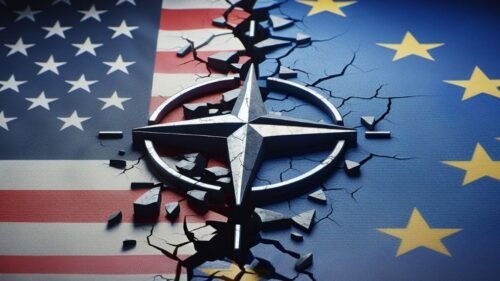
Fair Observer’s Video Producer Rohan Khattar Singh and Maurizio Geri, an EU Marie Curie global fellow and lieutenant reservist in the Italian Navy, discuss how Russia and China use hybrid warfare to pressure NATO and the European Union. Geri delivers a stark message: The West is already immersed in a permanent gray-zone struggle where politics, economics, technology and conflict merge into one continuum.
What is hybrid warfare?
Geri explains that hybrid warfare is ancient in logic — ancient Chinese philosopher Sun Tzu wrote about defeating an enemy without fighting — but unprecedented in reach because modern societies are hyper-connected, digitized and vulnerable at countless points. It is a low-intensity, sub-threshold conflict that can spike or ebb yet never stops. “The battlefield practically is everywhere… in society, in politics, in the economy,” Geri says.
He organizes state tools through the “Diamond Field” acronym, spelled “DIMEFIL:” Diplomacy, Information, Military, Economic, Finance, Intelligence and Lawfare. Diplomacy now includes intimidation and the use of diplomats for covert operations. Information warfare ranges from disinformation and bots to synthetic media and election interference. Military tools are mostly non-kinetic: GPS jamming, drone incursions, airspace violations and maritime sabotage. Economic and financial tools weaponize energy, sanctions, markets and strategic dependencies. Intelligence and lawfare cover espionage, influence networks, IP theft and legal gray areas exploited to pressure diaspora communities.
Russia and China vs NATO
Geri argues that Moscow and Beijing increasingly synchronize their efforts. They echo each other’s narratives, coordinate influence campaigns and run joint air patrols near Japan and South Korea. Iran and North Korea reinforce their cooperation with drones, cyber capabilities and manpower. Thus, they form an expanding axis of upheaval. This alignment is transactional rather than ideological but still effective, as it aims to fracture Western unity and overwhelm democratic decision-making.
Russia increasing hybrid attacks
The Ukraine war accelerates Russia’s hybrid strategy. Geri cites assessments showing attacks quadrupling from 2022 to 2023 and tripling again from 2023 to 2024. Russia targets transportation networks, government institutions, critical infrastructure and defense industries, often probing for weak spots rather than seeking decisive impact.
Energy remains Russia’s sharpest lever. Moscow manipulates gas flows, pressures economies in the European Union, sabotages pipelines and underwater cables and uses its “shadow fleet” to skirt sanctions. Cyber and physical disruptions, from railway failures to airport blockages, create political fragmentation rather than battlefield gain.
China’s hybrid tactics
China employs similar instruments but anchors its strategy in long-term economic leverage. Beijing is linked to undersea cable damage in the Baltic Sea while maintaining deniability. As Geri notes, hybrid warfare’s problem is the possibility of one side denying an attack, as it is difficult to detect and attribute responsibility to any given party.
China’s control of critical minerals, rare earths and clean-tech supply chains gives it extraordinary coercive power. Export threats instantly affect Western industries that depend on Chinese batteries, turbines, solar panels and semiconductors. Beijing also extends influence through Belt and Road Initiative projects, local partnerships, surveillance of diaspora communities and coordinated messaging that often complements Kremlin narratives.
NATO’s counter
Since 2016, NATO has treated hybrid attacks as potential Article 5 triggers. It now reinforces that with concrete actions. Baltic Sentry patrols underwater infrastructure, while Eastern Sentry strengthens air defenses and drone detection along the eastern flank. Allies pledge to move toward 5% of GDP on defense, with 1.5% dedicated to hybrid resilience and technology. NATO also expands intelligence-sharing, cybersecurity cooperation and joint defense production to reduce fragmentation among member states.
The EU adds its own toolkit: Defense Readiness 2030 to strengthen Europe’s defense capacity, new fiscal flexibility for defense budgets, RepowerEU to end Russian energy imports by 2027 and the Critical Raw Materials Act to reduce reliance on China. Yet democracies face inherent constraints, specifically transparency, accountability and law, which shape how they can respond to covert or deniable attacks.
An endless war?
Khattar Singh raises the “mirror image” claim that Russia and China see NATO encirclement and therefore act defensively. Geri disagrees, arguing that Western engagement and economic integration only fueled authoritarian militarization rather than moderation. From a realist perspective, he says, imperial regimes expand because the international system is anarchic — “There is no world government, so the big fish eat the small fish.” Democracies cluster in alliances; authoritarian states project power outward. The result is a durable, structural rivalry rather than a misunderstanding.
What’s next for hybrid warfare?
Geri sees energy and technology as the core drivers of the next era. Artificial intelligence systems, autonomous platforms, quantum computing and space assets will open new arenas for gray-zone activity. Still, he believes democratic strengths of innovation, open debate, civic participation and critical thinking remain powerful advantages. Hybrid warfare will grow more constant and more personalized, but societal resilience can rise with it.
The conflict may be endless, he suggests, but so is the democratic capacity to adapt.
[Lee Thompson-Kolar edited this piece.]
The views expressed in this article/video are the author’s own and do not necessarily reflect Fair Observer’s editorial policy.





























Comment