





Fair Observer’s Video Producer Rohan Khattar Singh and Joanna Lillis, a leading journalist who has covered Central Asia since 2001, discuss why Kazakhstan, the region’s largest Muslim-majority country, has decided to join the Abraham Accords — diplomatic agreements designed to build partnerships between Israel and several Arab nations. Lillis explains the strategic logic behind the move, how Kazakhstan’s multi-vector foreign policy adapts to shifting geopolitical currents and why domestic reaction remains muted despite strong emotions over the war in Gaza.
Kazakhstan joins the Abraham Accords
Khattar Singh questions why Kazakhstan has taken this surprising diplomatic leap. Lillis emphasizes that the decision is driven primarily by Kazakhstan’s desire to strengthen its relationship with Washington at a moment when Trump is actively expanding the Accords. As she puts it, “Kazakhstan’s joined the Abraham Accords as part of its efforts to … forge good relations with the United States under Donald Trump.”
Kazakhstan carries significant weight in Central Asia. The country is geographically vast, resource-rich and historically viewed as a stable regional actor. Lillis notes that Washington has long encouraged Muslim-majority nations to join the Accords, and Kazakhstan’s capital of Astana is well aware that doing so aligns with American strategic preferences. More importantly, the political cost for Kazakhstan is low. The move secures goodwill in Washington without creating serious consequences at home or jeopardizing key relationships abroad.
Does Kazakhstan receive something tangible in return? Lillis explains that the relationship with the US has indeed become more transactional. Deals in technology, security, defense cooperation and especially critical minerals are increasingly part of the conversation. Kazakhstan is not simply a passive recipient of US investment; it is also channeling money into the American economy. Just before a recent summit between Trump and Central Asian leaders in Washington, Kazakhstan announced a major purchase of US-made locomotives — a signal that Astana wants the relationship to deepen on both sides.
The US and its allies are seeking reliable suppliers for tungsten and other critical minerals, and Kazakhstan’s deposits make it a desirable partner. Lillis notes that this agenda now sits near the top of US–Central Asia discussions. By joining the Abraham Accords, Kazakhstan positions itself as a stable, Western-friendly source of resources at a time when governments are rethinking supply chains disrupted by Russia’s war in Ukraine, sanctions and global competition.
Kazakhstan’s foreign policy
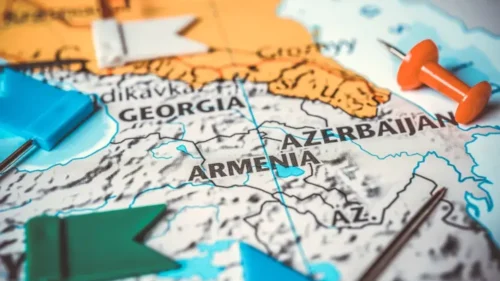
Khattar Singh then turns to a larger question: How does joining the Abraham Accords fit within Kazakhstan’s long-standing approach to diplomacy, especially given its enormous borders with Russia and China? Lillis stresses that Astana has always balanced between these two powers and the West. For decades, Kazakhstan has managed what it proudly calls a multi-vector foreign policy. This “basically means being friends with everyone, not necessarily allies.”
The doctrine allows Kazakhstan to navigate regional tensions without provoking its more powerful neighbors. Geography alone forces a careful approach: a 7,000-kilometer border with Russia, a long frontier with China and enduring economic interdependence with both.
Kazakhstan sees this balancing act as essential to its national security. The country does not possess overwhelming military power, so avoiding unnecessary enemies becomes a strategic imperative. She also notes that while Astana appears to be moving closer to the West, officials would likely insist that the shift is driven by Western outreach rather than Kazakh initiative. In their view, the US and Europe have turned to Central Asia because they need new trade routes, seek to bypass Russia and want secure access to critical minerals. Kazakhstan is responding to opportunity, not seeking confrontation.
Are Kazaks celebrating?
Khattar Singh asks how ordinary Kazakhs feel about joining the Abraham Accords. Lillis replies that the issue barely registers for most citizens. “I don’t think it’s something anybody’s particularly celebrating,” she answers. The government itself has kept the announcement low-key. In fact, Washington publicizes Kazakhstan’s decision before Astana makes its own statement. This is an indicator that the leadership prefers not to draw too much attention.
The muted tone reflects political sensitivity. Segments of the population hold strong views about Israel’s conduct in Gaza, and they may be uncomfortable with the decision. Yet Kazakhstan has maintained diplomatic relations with Israel for decades, making this move more evolutionary than revolutionary. Ultimately, domestic reaction remains limited because the state manages public discourse tightly. Kazakhstan’s political system tolerates little open dissent, and foreign policy rarely becomes a mass-mobilizing issue.
Khattar Singh comments that Kazakhstan’s decision unfolds against a backdrop of quiet competition between the West, Russia and China. Lillis agrees, suggesting that the Abraham Accords highlight a subtle but intensifying struggle for influence across Central Asia.
[Lee Thompson-Kolar edited this piece.]
The views expressed in this article/video are the author’s own and do not necessarily reflect Fair Observer’s editorial policy.









































Comment