


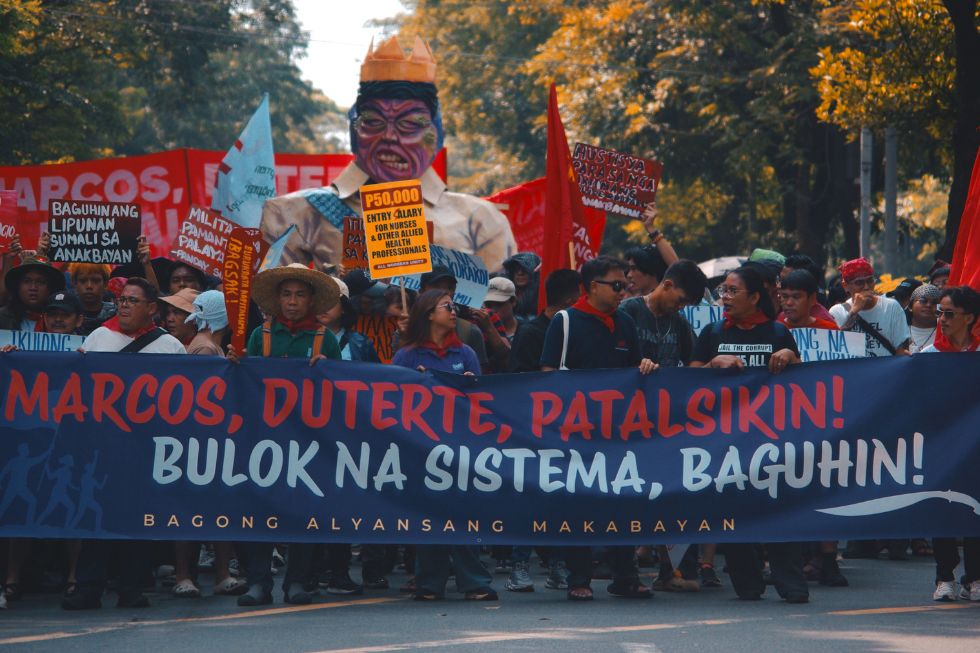



In April, the Philippines experienced a headline inflation rate of 7.2%, the highest in three years and surpassing both forecasts and the central bank’s upper limit. According to National Statistician Dennis Mapa, transport and fuel costs were the primary drivers behind this inflation surge. The persistent rise in commodity prices directly affects the daily lives of Filipino citizens. Gasoline prices rose 59.6%, while diesel prices rose 122.7%, according to the Philippine Statistics Authority.
The Philippines relies on imports for approximately 90% of its oil supply, leaving the economy vulnerable to global market disruptions and geopolitical crises in the Middle East. Recent regional tensions have led to double-digit fuel price hikes, thereby eroding consumer purchasing power. This susceptibility to external shocks is amplified by domestic institutional weaknesses, especially those associated with political dynasties and incumbency bias.
The economy has now slowed for three consecutive quarters. Full-year 2025 growth settled at 4.4%, the weakest since the COVID-19 pandemic. The country now faces a stagflationary episode, threatening to regain the “Sick Man of Asia” label (the label given to the Philippines near the end of the Marcos Sr. era, when the country saw contracting GDP, inflation of around 50% in 1984, rising unemployment and a debt crisis) if regression continues.
Monopolizing the ballot: incumbency advantage and the low-information electorate
Persistent susceptibility to external shocks is not only driven by global volatility but also by institutional deficiencies rooted in incumbency bias and political dynasties. By monopolizing power and favoring patronage over public investment, entrenched elites have weakened the state’s ability to manage economic crises, leaving the most disadvantaged households to shoulder rising costs. For example, during periods of oil price spikes, political leaders often respond by selectively distributing cash aid to supporters rather than investing in comprehensive social protection or infrastructure improvements that could cushion poor households from such shocks. This cycle perpetuates the exposure of marginalized groups.
The dynastic status of candidates is an important individual-level predictor of campaign tactics. A defining feature of candidates with dynastic status is that they inherit personal support bases from their family members who have previously served in Congress.
Incumbents enjoy massive electoral advantages through name recognition, easier access to campaign finance and the indirect use of government resources to bolster re-election bids. Dynastic status is an important background characteristic that can differentiate legislators, and few studies examine the role of political heredity. Some studies show that dynastic legislators tend to enter office earlier than nondynastic legislators and are consequently more likely to hold ministerial positions. Elections featuring incumbents often become a referendum on their record rather than a choice between competing policy platforms, creating safe seats that discourage high-quality challengers from entering the race.
In developing countries, political parties commonly lack strong organizations or credible programmatic reputations. These parties do not provide reliable information about a candidate’s policy preferences. This lack of information gives voters strong incentives to use the incumbent’s in-office performance as a shortcut for learning about their competence.
In high-information environments, parties are strong and programmatic. Party labels reliably inform citizens about candidates’ policy preferences, past performance and other attributes. This enables voters to make choices based on candidates’ intrinsic qualities rather than merely on incumbency. In contrast, in low-information environments, citizens commonly rely on the incumbent’s record, using it as a proxy for candidate competence against an ex ante expectation of good performance.
When the incumbency advantage is pronounced, the safest bet becomes re-electing the sitting official. This pattern undermines the democratic ideal of electoral uncertainty, reducing genuine competition and accountability that are fundamental to democratic systems. Consequently, entrenched incumbency can hamper political renewal and limit the electorate’s ability to demand responsive or innovative governance.
Regulatory capture and dynastic stranglehold
In the Philippines, the incumbency advantage is so pronounced that in many cases, candidates from warlord political clans run virtually unopposed. Recent examinations have found that political dynasties have grown stronger and increasingly linked, occupying a rising share of elected positions in the Philippines and reducing electoral competition and weakening incentives for effective economic governance.
This structure characterizes public office as a “government-as-family-business,” in which the primary focus shifts from national development to the protection of clan wealth and prestige. Dynasties engage in practices such as regulatory capture to influence key public institutions, making sure that the bureaucracy serves the interests of the clan rather than the state, consistent with documented associations between political clans and detrimental practices in Philippine politics.
Patronage politics and food insecurity
The projected 2026 GDP growth of 2.8% is mainly attributed to issues in public investment, which have been worsened by governance-related hesitancy following high-profile corruption investigations. Although the World Bank expects the Philippine economy to grow above 5% until 2027, persistent concerns remain regarding the impact of dynastic leaders’ preference for personality-based dole-outs over efforts to strengthen the social safety net. This approach particularly exposes the bottom 30% of households by income to the risks posed by oil shocks and food supply disruptions.
Public responses to global oil price spikes frequently focus on rising gasoline costs, with headlines highlighting the threat of transport strikes, higher tricycle fares and motorists’ anxieties. However, as the Philippine Institute for Development Studies (PIDS) notes, the oil shock extends beyond transportation and has become a significant food security issue. The resulting crisis unfolds most acutely in the kitchens of the poorest Filipino families, where the primary casualty of the current global oil shock is ultimately the dinner table of the marginalized.
Dynastic political leaders often undermine the creation of a strong social welfare safety net. Elites prioritize consolidating power through patronage and targeted handouts rather than building resilient, universal institutions. As a result, the bottom 30% of households remain exposed to macroeconomic shocks, food price increases and disruptions in global supply chains.
Empirical evidence links high concentrations of political power to higher poverty rates and lower human development effectiveness. While theories indicate that the impact of political dynasties on development is an empirical question, international evidence indicates that governments dominated by dynasties are closely associated with misgovernance. Empirical evidence shows that dynasties self-perpetuate in Congress.
However, some proponents of political dynasties argue that established families may contribute to governance stability or offer experienced leadership, thereby likely enhancing policy continuity. Nevertheless, prevailing empirical evidence indicates that any potential benefits are outweighed by the negative consequences for development, including entrenched inequality and diminished government effectiveness.
The accumulation of power by political dynasties in local government can reduce local economic growth and deter the provision of public goods and good governance. Incumbency bias sustains a dynastic status quo that favors short-term survival over the structural reforms needed, such as rice tariffication or energy sector diversification, which help anchor inflation expectations.
PIDS notes that fuel inflation affects more than transport and electricity. Higher fuel prices raise production and transport costs, quickly increasing food prices and squeezing real incomes, pushing struggling households closer to poverty as wages lag.
Breaking the cycle: institutional feasibility and the path to structural resilience
The core policy issue is not primarily about managing pump prices or employing broad fiscal subsidies for oil use, which tend to disproportionately benefit wealthier groups. Rather, the difficulty consists in addressing the resulting distributional imbalances. While some may argue that measures such as price controls or subsidies provide immediate assistance to consumers, these interventions often create inefficiencies and lead to regressive outcomes, especially when benefits accrue disproportionately to higher-income groups. Effective policy ought instead to focus on targeted support, such as direct assistance to poorer households, subsidies for at-risk sectors, measures to protect real wages and strategies to ensure secure food supplies. However, implementing such focused interventions confronts several challenges, notably administrative limitations, insufficient capacity at both the local and national levels, and the complexity of precisely identifying and reaching eligible beneficiaries.
Additionally, there is a persistent risk of political capture or leakage, in which resources intended for at-risk groups are diverted for partisan purposes or distributed in a non-transparent manner. These implementation barriers make it difficult to ensure that support consistently reaches those most in need. Breaking this cycle requires more than technocratic solutions. It requires a true Anti-Political Dynasty Law to realize the 1987 Constitution’s mandate for equal access to public service.
Political restructuring must accompany the shift in social protection from reactive relief to proactive resilience-building. Group needs must differentiate interventions. Insurance and income-stabilization mechanisms must shield the majority from income volatility, but care must be taken to ensure they are adequately funded and resistant to elite manipulation. Targeted poverty-reduction programs must cushion the low-income population while remaining flexible enough to adapt to evolving macroeconomic shocks.
To guarantee sustained stability and achieve the 2040 vision, the state must enact bold reforms that expand social protection to universal coverage, meeting upper-middle-income country standards. Strengthening household resilience requires investment in protective factors: strong infrastructure, quality education, effective climate risk management and a sectoral shift from agriculture to more productive fields such as services, industry and manufacturing.
Until the monarchical nature of Philippine electoral politics is fundamentally reformed, the economy will remain exposed to global shocks, with state institutions incapable of effectively defending citizens or resolving the root causes of enduring vulnerability. Although enacting an Anti-Political Dynasty Law is still a critical objective, its political feasibility is currently constrained by the entrenched influence of dominant political families. Nonetheless, incremental strategies, such as coalition-building among reform-minded legislators, advocacy through civil society groups and strengthened public scrutiny, can incrementally increase the likelihood of passing such reforms.
Similarly, policy recommendations to improve local governance through participatory mechanisms such as the Barangay Assembly and community education programs must account for implementation barriers, including resource constraints and variable local institutional capacity. Establishing realistic benchmarks for openness along with inclusiveness can act as a catalyst for gradual progress. Although these measures may not immediately achieve full structural equity, emphasizing pragmatic pathways and flexible strategies improves the feasibility of institutional transformation and supplies a foundation for broader, sustainable reform.
[Rosa Messer edited this piece]
The views expressed in this article are the author’s own and do not necessarily reflect Fair Observer’s editorial policy.
In ASEAN’s Balancing Act, India Expands the Middle Ground
Despite economic and strategic limitations, India is becoming a useful partner for Southeast Asia by expanding the region’s strategic options...
A Nation’s Rivers Remember What Was Cut Away: Indonesia’s Flood Crisis
Legal deforestation has stripped Sumatra’s watersheds of natural flood defenses, turning extreme rainfall into a predictable humanitarian disaster. Plantation expansion...
Philippine Energy Crisis Threatens to Escalate Tensions With China
The Philippines relies heavily on the electricity and natural gas acquired from the Malampaya gas field. This reserve is expected...

Support Fair Observer
We rely on your support for our independence, diversity and quality.
For more than 10 years, Fair Observer has been free, fair and independent. No billionaire owns us, no advertisers control us. We are a reader-supported nonprofit. Unlike many other publications, we keep our content free for readers regardless of where they live or whether they can afford to pay. We have no paywalls and no ads.
In the post-truth era of fake news, echo chambers and filter bubbles, we publish a plurality of perspectives from around the world. Anyone can publish with us, but everyone goes through a rigorous editorial process. So, you get fact-checked, well-reasoned content instead of noise.
We publish 3,000+ voices from 90+ countries. We also conduct education and training programs
on subjects ranging from digital media and journalism to writing and critical thinking. This
doesn’t come cheap. Servers, editors, trainers and web developers cost
money.
Please consider supporting us on a regular basis as a recurring donor or a
sustaining member.
Will you support FO’s journalism?
We rely on your support for our independence, diversity and quality.





Comment