



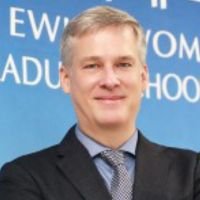

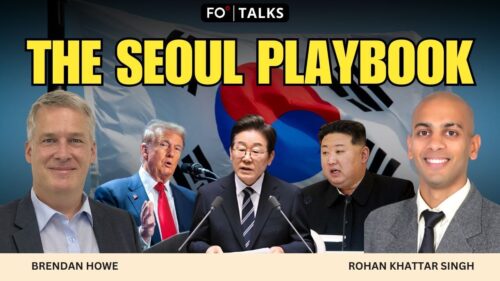
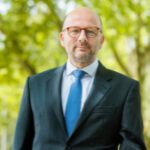
Fair Observer’s Video Producer Rohan Khattar Singh speaks with Brendan Howe, Dean at Ewha Womans University in Seoul, about South Korea’s transformation from a vulnerable regional actor into a consequential “second-tier power.” They challenge the outdated label of South Korea as merely a middle power and instead situate it as a pragmatic state with significant military, economic and cultural influence — even as demographic decline casts a long shadow over its future.
Beyond the “middle power” label
Howe begins by rethinking how power is categorized in today’s international system. Traditional middle powers such as Canada or Australia historically pursued what he calls “niche diplomacy,” acting as normative brokers at the United Nations and advancing global humanitarian agendas. By contrast, Howe introduces the idea of “second-tier powers:” states with greater-than-middling resources that deploy them pragmatically in pursuit of national interest rather than moral leadership.
South Korea, Howe argues, fits this category better than almost any other country. Long described as a “shrimp among whales,” the South Korean capital of Seoul has never aspired to great-power status. After all, it is surrounded by far larger neighbors such as China, Russia, Japan and the United States. Yet its economic growth, political consolidation and expanding global reach have pushed it well beyond the middle-power bracket. Rather than seeking global dominance, South Korea concentrates its influence where it can be most effective — economically, technologically and strategically.
Military strength without full autonomy
One of the clearest markers of South Korea’s rise is its military capability. Howe notes that, by most measurements, South Korea ranks between the sixth and eighth most powerful militaries in the world and is now the eighth-largest arms exporter globally. Its development of NATO-compliant systems, including the KF-21 stealth fighter jet, has made South Korean defense exports attractive to countries ranging from Poland to Australia.
At the same time, Seoul’s alliance with Washington remains central. South Korea still relies on the US for key technologies such as aircraft engines and for extended nuclear deterrence. Howe questions, however, how decisive that nuclear umbrella really is. As he puts it, “the real threat to South Korea from North Korea does not come from the nuclear weapons,” but from conventional soviet-era artillery positioned near the demilitarized zone that could devastate Seoul in the opening moments of a conflict.
This leads to one of Howe’s more provocative conclusions: South Korea’s reliance on the US is now “much more psychological than physical.” While US support remains important symbolically and politically, Howe suggests that South Korea has developed sufficient conventional strength and institutional resilience to survive even a dramatic reduction in American backing.
North Korea and a “crisis democracy”
Turning to North Korea, Howe observes a striking gap between outside perceptions and domestic attitudes. International commentators often speculate about an imminent Korean War 2.0, but most South Koreans are far less alarmed. They are more concerned with cyberattacks, environmental risks and nuisance provocations such as waste-carrying balloons than with a full-scale invasion.
Howe is sharply critical of former South Korean President Yoon Suk Yeol’s use of the North Korean threat for domestic political purposes, calling it scaremongering. He argues that exaggerated security claims contributed to Yoon’s downfall and reinforced public resistance to politicizing national defense.
Domestically, South Korea’s frequent prosecutions of former leaders are often portrayed abroad as signs of instability. Howe rejects this framing, describing the country instead as a “crisis democracy” — a system that repeatedly confronts and resolves political turmoil. The willingness to hold presidents accountable signals democratic consolidation rather than decay, even if it complicates South Korea’s image as a model to emulate.
Economic, cultural and demographic futures
South Korea’s economic ascent rests on what Howe calls the “triple miracle on the Han River:” rapid industrialization, democratic consolidation and sustained development under conditions of unresolved conflict. Centralized planning, defiance of US advice to remain agrarian and relentless investment in education and research turned this war-ravaged country into a manufacturing and technological powerhouse.
That same intensity, however, has produced social costs. Howe links South Korea’s high suicide rate to the extreme pressures of its education system, where competition begins early and never truly ends. Soft power, too, reflects this double edge. Hallyu — the global popularity surge of K-pop music, Korean films and television — emerged from deliberate government support and has generated enormous global influence. Yet Seoul often conflates public diplomacy with soft power, risking backlash by trying to manage cultural attraction too aggressively.
Looking ahead, the gravest challenge is demographic. With one of the world’s lowest fertility rates, South Korea faces an aging population and a shrinking workforce. Howe suggests that automation, artificial intelligence and advanced military technology may offset some losses, but sustaining the welfare state will likely require a politically difficult shift toward greater immigration.
In the broader global context, Howe predicts a move away from large-scale multilateralism toward smaller, issue-focused coalitions. He argues that initiatives led by second-tier powers may prove more inclusive and less polarizing than those dominated by great powers. That offers South Korea a path to influence without forcing others to choose between Washington and Beijing.
[Lee Thompson-Kolar edited this piece.]
[Note: This FO Talks/FO Live is part of the Osaka School of International Public Policy’s “Peace and Human Security in Asia: Toward a Meaningful Japan-Korea Partnership” project supported by the Korea Foundation.]
The views expressed in this article/video are the author’s own and do not necessarily reflect Fair Observer’s editorial policy.




















Comment