


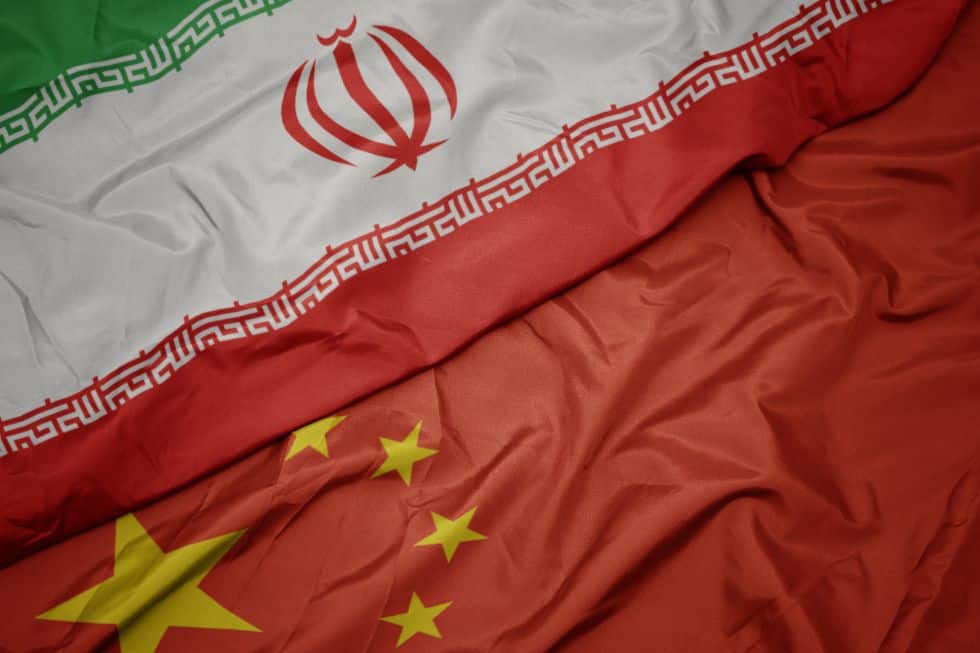



Within hours of the start of the Iran War, Beijing issued a statement condemning the operation as a violation of international law and calling for an immediate ceasefire. As Iran began to burn, China did nothing else. That gap — between the rhetoric and the reality — is perhaps the most important story emerging from the ruins of the Islamic Republic. Not the oil disruption, not the regionalization of the War, not the unknown unknowns about the future. What may matter most in the long term is that China has lost its most important Middle Eastern partner while Beijing watched.
The collapse of China’s Iranian oil ecosystem
Iran supplied about 13% of all the crude oil China imported by sea last year, with more than 80% percent of Iran’s total oil exports flowing to Chinese refineries — most of it to smaller “teapot” operations along the coast that had quietly built their business models around sanctioned, discounted barrels. That ecosystem has now collapsed.
Chinese refiners have been pushed into global spot markets where they must compete for replacement oil at war-inflated prices, settling transactions in US dollars under close international scrutiny. The yuan-denominated shadow trade that sustained both Iran’s economy and Beijing’s dedollarization ambitions is gone, possibly forever.
Beijing spent the better part of a decade preparing for precisely this kind of disruption — diversifying suppliers, building strategic reserves, accelerating its domestic renewables buildout, and establishing alternative pipeline routes through Central Asia and Russia. China will absorb this, but what it cannot so easily absorb is the lesson that the war broadcasts to every country that has built its security around a partnership with Beijing.
The limits of China’s partnership model
The 25-year comprehensive strategic partnership between China and Iran, signed in 2021, was supposed to be the flagship of Beijing’s alternative world order — proof that countries could anchor their futures to China rather than to Washington’s alliance system. Iran was to receive investment, integration into Chinese-led institutions such as the BRICS and the Shanghai Cooperation Organization, and de facto diplomatic cover through its association with Beijing. In exchange, Beijing took advantage of cheap oil — a critical node in the Belt and Road Initiative’s overland corridors, and a geopolitical buffer against American power projection in the Gulf.
The problem is that China’s version of partnership comes without a security guarantee. True to form, this has always been Beijing’s calculated position — no entangling alliances, no forward military commitments, no meaningful positions that are not skewed to Beijing’s advantage and no risk of being dragged into someone else’s war.
Chinese analysts defend this as strategic wisdom, arguing it gives Beijing maximum flexibility and avoids the type of overstretch that has degraded American power. In practice, it means that when the US and Israel launched Operation Epic Fury, China’s comprehensive “strategic partner” had no one to call.
Strategic messaging meets strategic reality
Beijing’s defenders will note that intervening militarily was never a realistic option. China is not going to fight the US over Iran. The issue is whether Beijing’s entire framework for challenging American dominance — the Global Security Initiative, proclamations about a multipolar world order in which China is prominent, and solemn declarations that “the East is rising” and that China stands for peace — means anything when tested by violence. The answer is no.
There is also the question of what China may have inadvertently contributed to the war’s timing. Reports that Beijing was supplying Iran with carrier-killer missiles — weapons that would have taken months to deploy but whose transfer narrowed the window for any diplomatic resolution — suggest that China’s deliberate ratcheting up the heat may have accelerated the crisis it sought to avoid. It was a profound strategic miscalculation: China helped make the war more likely while lacking either the will or the means to prevent it.
Beijing’s Calculus: business with Washington
For Chinese President Xi Jinping, the immediate calculus is clear. He is prioritizing the upcoming summit with US President Donald Trump in Beijing. He is protecting the trade truce that has given China room to breathe during a period of acute economic pressure. He is choosing business with America over solidarity with Iran. While being rational, it is also exactly what Washington always suspected China would do when forced to choose.
The longer game is harder to read. China will likely seek to expand its economic presence in Iran once the dust settles, positioning itself for the reconstruction contracts and the oil access that will eventually reemerge — just as it did following the end of the Iraq War. Beijing is already framing its restraint as proof of responsible statecraft — in contrast to American militarism.
But the countries that matter most to Chinese grand strategy — Saudi Arabia, the Gulf states, the emerging economies of Southeast Asia and Africa, and the Global South more generally — are watching. They are watching China absorb a significant strategic loss, respond with only statements and wait. They are undoubtedly calculating what a partnership with Beijing would actually be worth in their own hour of crisis and need.
The Iran war has not ended China’s rise, but it certainly has clarified its terms. While Beijing can offer markets, infrastructure and diplomatic cover, it will not offer security. That distinction may well prove to be the defining limit of Chinese power in the century ahead.
[Daniel Wagner is CEO of Country Risk Solutions and author of five books on China.]
[Kaitlyn Diana edited this piece.]
The views expressed in this article are the author’s own and do not necessarily reflect Fair Observer’s editorial policy.
China Watch: China’s Rise and the New Multipolar Global Order
China’s rise is reshaping the global economic order, fostering new regional alliances like BRICS and the Shanghai Cooperation Organisation while...
Iran’s Revolutionary Ideology Is the Architect of a Destabilizing Order
The Iranian revolution established a unique ideological archetype: the Supreme Leader wields absolute power, the nation views itself as a...
President Xi Meets with MBS: What Does This Mean for Iran?
Amid growing strains with Iran, China is deepening its partnership with Saudi Arabia and other Gulf nations. In early December,...
Support Fair Observer
We rely on your support for our independence, diversity and quality.
For more than 10 years, Fair Observer has been free, fair and independent. No billionaire owns us, no advertisers control us. We are a reader-supported nonprofit. Unlike many other publications, we keep our content free for readers regardless of where they live or whether they can afford to pay. We have no paywalls and no ads.
In the post-truth era of fake news, echo chambers and filter bubbles, we publish a plurality of perspectives from around the world. Anyone can publish with us, but everyone goes through a rigorous editorial process. So, you get fact-checked, well-reasoned content instead of noise.
We publish 3,000+ voices from 90+ countries. We also conduct education and training programs
on subjects ranging from digital media and journalism to writing and critical thinking. This
doesn’t come cheap. Servers, editors, trainers and web developers cost
money.
Please consider supporting us on a regular basis as a recurring donor or a
sustaining member.
Will you support FO’s journalism?
We rely on your support for our independence, diversity and quality.
China’s Grip Tightens on the Asian Infrastructure Investment Bank
Zou Jiayi’s appointment as president of the Asian Infrastructure Investment Bank (AIIB) underscores the Bank’s deep political alignment with the...
How the US Capture of Nicolás Maduro Impacts China’s Engagement with Indonesia
The US capture of Venezuelan President Nicolás Maduro has sparked global debate over sovereignty and international law, impacting China’s diplomatic...
China Must Quickly Change as Its Foreign Tax Money Shifts
The international laws and agreements governing multinational corporations are changing. With a minimum 15% corporate tax being pushed into law...





Comment