


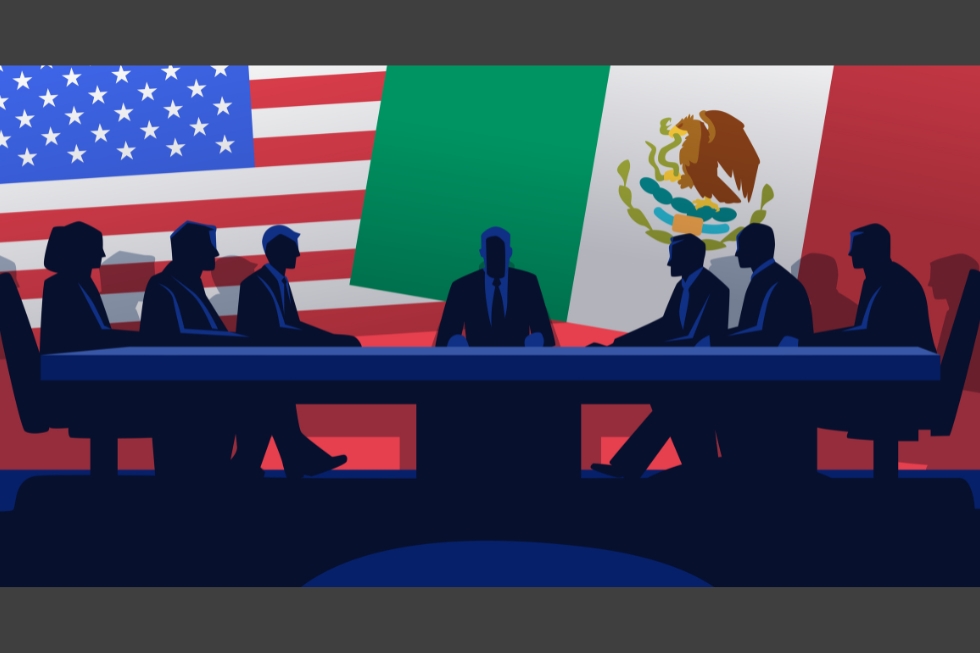




For the second time in less than a decade, the future of regional trade among the North American countries has become uncertain. On July 1, the Office of the United States Trade Representative (USTR), under the Trump administration, announced the country’s decision not to renew the US-Mexico-Canada agreement (USMCA). The announcement was likely anticipated by its Canadian and Mexican counterparts, who just one month prior had expressed their strong shared interest in renewing the trilateral agreement for a further 16 years — even if they acknowledged that the United States may put forward proposals in “areas where improvements may be warranted.”
In principle, Ambassador Jamieson Greer’s announcement means the agreement will remain in place until July 2036. In practice, the US will probably aim for the agreement to be reviewed every year, which will necessarily entail undermining the agreement altogether.
What should have been then a relatively uncontroversial renewal procedure (trade agreements never are) has now put the three countries in a very difficult and potentially regressive position. That is, a future without a free trade agreement (FTA) among the three countries with the world’s most intense intraregional trade relationship. The North American agreements, understood as the 1989 Canada–US Free Trade Agreement (CUSFTA), the 1994 North American Free Trade Agreement (NAFTA), which superseded it, and the 2018 USMCA, which only entered into force two years after being signed, have been the backbone of this intense intraregional trade relationship for almost four decades.
Collectively and incrementally, these agreements have provided greater (even if not full) certainty to the national and subnational governments of the three countries. They have also opened opportunities to businesses and investors in the region — namely, by providing more believable commitments from national governments that their investments in one another’s countries will not vanish overnight.
This is not the way of US President Donald Trump, however.
In the eyes of the current US administration, bullying its trade partners is an effective tactic to secure (further) economic, political and diplomatic concessions from them. The mere act of creating uncertainty on whether the US will renew the USMCA in its current form forces Canada and Mexico to sit back at the negotiating table. It also gives the Trump administration great leverage to push its agenda onto its neighbors and take the negotiations well beyond the topics of trade and investment. This potentially includes national security issues, which just over the last year have included the outlandish threats to annex Greenland for “global protection,” annex Canada and make it the “51st state,” and launch strikes against Mexico to target drug cartels.
A number of policymakers and policy analysts agree that the Trump administration’s erratic stance towards the USMCA is bad for business. As David Hebert, Senior Research Fellow at the American Institute for Economic Research, states:
USMCA’s greatest achievement was never a slate of tariff rates, exceptions and rules. It was the confidence that the rules would stay stable long enough for companies to make plans and act on them. A parts supplier in Michigan could sign a 10-year lease and order supplies because the terms governing what crossed the border were set.
But this attitude is only a reflection of Trump’s view of North America as a region. In his view, the US is entitled to use its preeminent position as the region’s largest importer and exporter, as well as its biggest market, as leverage against its geographic neighbors to secure gains of all kinds from them.
Such a distorted view of the region matters because the USMCA is not an “irrelevant” agreement with “no real advantage” to the US — as Trump claims. It structures one of the world’s most important trade and stable relationships in which the United States remains the dominant player alongside two other friendly trade partners, amidst a world that has been deliberately turned unpredictable and hostile to free trade — namely, by the Trump administration(s) themselves.
Moreover, it is true that there is currently no realistic alternative to the deeply integrated, regional trade dynamic that has been created between the North American countries. The US controls the largest market and enjoys the strongest bargaining position, and Canada and Mexico acquiesce to its periodic demands in exchange for continued access to it. But it is also true that a dramatic halt to the trade privileges (and benefits) created by the USMCA would impose costs on all three countries, including the US, and push its current partners to seek alternatives — first within the region, and soon after outside it.
Mexico’s current negotiating position
Considering these circumstances, Mexico should not pretend it can negotiate from a position of equality — it cannot. But this does not entail that it should accept every US demand. Its objectives should instead be narrow and realistic: preserve access to the US market to the greatest extent possible, defend sectors strategic to its own economy and society (something which it has not done before), and oppose trade arrangements that will damage its domestic economy and people without affording it long-lasting benefits. In effect, this implies remaining firm in defending its long-term socioeconomic interests while recognizing that the USMCA remains too important to abandon in the short term.
Hence, for Mexico (just as for Canada), the central question is not whether it will agree to sit at the negotiating table once more — but whether it should do so from the position which the US wants to impose on it. That is, to have Mexico and Canada seated in separate, new rounds of parallel bilateral negotiations (which have purportedly already started), and to have the trilateral negotiations abandoned de facto. Likewise, it should also oppose the agenda that the US wants to set for it, in which trade is linked to border and immigration control, as well as to combating drug trafficking — but does not touch upon the economic, social and cultural issues that are key to Mexico, namely agriculture.
To frame this adequately, it is necessary to remember that Mexico entered the NAFTA era from a comparatively weaker position, which meant the benefits of trade liberalization were distributed far less evenly than under the USMCA. Since 1994, the Mexican agricultural sector has been forced to compete with the US sector on uneven ground, leading many small farmers to struggle to survive. Namely, because they are unable to compete with the very heavily subsidized US agricultural sector, which enjoys the “farm commodity revenue supports” (i.e., subsidies) afforded to date by the US Farm Bill.
The result of this unfair competition was a shift in Mexico toward export-oriented production of high-value agricultural products ( avocados, berries and tropical fruits), greater dependence on imports of food staples crucial to Mexicans (corn), and persistent and growing food insecurity for the country.
In 2024 alone, Mexico’s agricultural product exports, of which high-value crops make up the greatest share, accounted for around 70% of US imports. This export-led model has come at the expense of the country’s traditionally diverse agricultural production and reduced the cultivation of staple grains for domestic consumption — chief amongst them corn.
Despite being one of Mexico’s most important historical and culturally significant crops, corn became increasingly uncompetitive in export markets. As a result, the area devoted to its cultivation has declined by 22% since the implementation of NAFTA, falling from more than 9 million hectares in 1994 to just over 7 million in 2019. While, for the most part, Mexico enjoyed corn self-sufficiency until the late 1980s, since the 1990s demand has exceeded supply (tied directly to population growth), leading Mexico to import ever-greater quantities of the staple crop from the US.
And the case of corn goes well beyond agroeconomics. The dispute between the US and Mexico over genetically engineered and genetically modified corn also shows how agricultural issues remain politically sensitive and legally contested within the USMCA framework. In 2023, the Mexican government issued a decree banning the use of genetically engineered corn in the production of dough and tortillas. Mexico argued that the use of genetically modified organisms (GMOs) in food-grade corn, which is commonly consumed in the US, could harm human health and food security in Mexico and threaten the country’s 60 varieties of native corn. The enactment of this decree triggered a trade controversy with the US, which in turn resulted in a settlement panel ruling in favor of the US — finding that the decree had violated the provisions of the USMCA.
France offers a useful precedent. In the second half of the 20th century, it invoked the “exception culturelle” as a foundational trade and public policy doctrine to justify state intervention in support of its film and audiovisual industries. It argued that culture should not be treated as just another commodity in the marketplace. More recently, this principle has been extended into an agricultural exception, allowing France to shield key products, such as grapes, from aspects of FTAs in the name of food sovereignty.
Mexico could adopt a similar approach to safeguard staple crops such as maize, which are central to the country’s diet, identity and cultural heritage. Any such strategy, however, must be consistent with existing trade commitments and rest on robust legal grounds, rather than arguments that cannot be substantiated and are likely to fail in future disputes.
The Mexican government undermined its own case to protect native maize by relying primarily on a sanitary argument, which the dispute panel rejected as lacking scientific backing, rather than grounding its defense in cultural heritage — just as France did. It goes without saying that the US was interested in such a ruling, as “Mexico ranks consistently a top market for US corn exports.” A fact that Mexico has failed to leverage in the negotiations.
To remain competitive in the North American market, dominated by heavily subsidized US producers, prices for Mexican agricultural products have been kept artificially low for over four decades — often below the actual cost of production, i.e., dumping. This practice has left many Mexican farmers, particularly smallholders with limited land and little bargaining power, struggling to make profits that can cover their production costs and enable them to sustain (let alone expand) their businesses.
The consequences of this misguided trade policy and the implied acquiescence of the Mexican government towards it can be seen in the sector’s sluggish growth. The Mexican agricultural output increased by only an average of 1.6% per year between 1991 and 2005 and 1.9% per year between 2005 and 2019, well below overall GDP growth, which averaged 3%–4% over the same period. Mexico’s agricultural exports expanded significantly after NAFTA came into force. But imports grew at a comparable pace. The country became increasingly dependent on US agricultural products, with roughly three-quarters of its agricultural imports originating from its northern neighbor.
The sector also experienced profound social change. The number of people employed in agriculture fell from just under 8 million in 1995 to around 6.5 million in 2020, as many left farming altogether in search of better-paid work elsewhere in Mexico or abroad. In 2024 alone, despite employing 12% of Mexico’s workforce, agribusiness accounted for only about 3.5% of the country’s GDP. The migration of labor out of the agricultural sector substantially neutralized the employment expansion in the export-manufacturing industry that followed the implementation of NAFTA — given that “agriculture is [not commonly] a leading candidate to improve employment outcomes and raise wage growth.”
Meanwhile, the drive for competitiveness accelerated the concentration of production and distribution in the hands of a small number of resource-rich and politically well-connected firms, such as Grupo Bimbo and Gruma. Paradoxically, those firms have now become global players in their own right, acquiring US legacy-brand companies in the food sector, showing that the trade game can be played both ways.
Uncertainty cannot sustain free trade, but neither can mercantilism
Over the past 30 years of North American free trade, Mexico has significantly increased its economic, political, and social dependence on the United States. Its export-oriented economy depends heavily on access to its northern neighbor’s market, and such dependence weakens its bargaining position vis-à-vis the United States. But it does not fully undermine it. Mexico is badly positioned for the post-North American mercantilist trade era, but it is not worse off than it was in 1994 — at least in terms of trade diplomacy.
Mexico’s economy has become too tightly linked to that of the US to make withdrawal from USMCA a credible (or even feasible) policy. Any renegotiation of the most recent North American FTA will inevitably be shaped by bullying from the current US administration, using its economic weight, leaving Mexico with little room to negotiate and secure meaningful gains, particularly for its agricultural sector. But even in this scenario, Mexico can pursue better terms than those currently in place.
The greatest factor at play is the creation of uncertainty. Businesses cannot make investment plans based on rules that are subject to permanent renegotiation. The suspension of the USMCA, or even worse, the full withdrawal from it, may create short-term bargaining power for Washington, DC. But it will also weaken the confidence of US businesses in the long-term stability of the US domestic economy if and when tariffs are enacted again (or increased), and export markets for US products are lost or severely undermined. Namely, when considering that nearly one-third of all US-manufactured goods originate in Canada and Mexico.
A withdrawal would have a knock-on effect on the heavily export-dependent US industries, including the agricultural and automotive sectors — in which Mexico and Canada are major consumers. And that does not even consider the loss of jobs that a US withdrawal from USMCA would entail, taking into account that, per the US Chamber of Commerce’s estimates, North American trade supports 13 million jobs — just in the US. It also doesn’t account for the rise in consumer prices that ending USMCA would engender.
This staunch willingness to (un)fix what is not (fully) broken is characteristic of Trump. In a world in which policymakers are already dealing with frictions created by diminishing access to natural resources, competition with other global economic players (namely China, the European Union and the disjointed-but-still-significant BRICS), as well as expanding conflicts in the Middle East, the latest Trump Administration is willing to jeopardize the present and future of North American economic integration.
In this landscape, Mexico is badly positioned for a post-North American trade era, but not irremediably powerless to fight back. Just last year, US–Mexico bilateral trade amounted to $873 billion. Comparatively, US trade with China reached $419 billion. Mexico’s economy is deeply integrated with that of the US. But the opposite also holds true. If the US wants to play the mercantilist card in the trade game, this might not be the best time to do so.
If Mexico were to make more concessions to appease the Trump administration in the next rounds of USMCA negotiations, the agreement would result in further social deterioration from the continued dismantling of strategic sectors of Mexico’s economy. Instead, the best strategy for Mexico is to use its comparatively better negotiating position in USMCA than the one it had in NAFTA. Some analysts suggest that it might be best to wait out the end of Trump’s administration in 2029, hoping for a less radicalized US administration which affords opportunities for creating a more balanced and fairer trade agreement. But the interim period would also be characterized by a high degree of uncertainty, which Mexico cannot afford.
If there is a lesson from the last three decades, it is that Mexico must negotiate carefully. Mexico was indeed the weakest partner in NAFTA. But, in USMCA, this does not hold (entirely) true. Since the 1990s, Mexico has also entered into nearly 15 FTAs with over 50 other countries worldwide. Meanwhile, the last US administration has managed to earn the animosity of its other trade partners throughout the world, including Canada, by reimplementing tariffs, disrupting other regions’ supply chains (e.g., blockading an already blockaded waterway) and sliding into the condition of an unreliable partner. In the current global environment, any serious push to withdraw from the existing North American trade dynamic is politically and economically implausible for Mexico. But so it is for the US.
[Kaitlyn Diana edited this piece.]
The views expressed in this article are the author’s own and do not necessarily reflect Fair Observer’s editorial policy.
Trump’s Canada and Mexico Tariffs Are a Magnificent Own Goal
Donald Trump raised tariffs on imports from Canada and Mexico to protect US industries and curb illegal immigration. These tariffs...


Support Fair Observer
We rely on your support for our independence, diversity and quality.
For more than 10 years, Fair Observer has been free, fair and independent. No billionaire owns us, no advertisers control us. We are a reader-supported nonprofit. Unlike many other publications, we keep our content free for readers regardless of where they live or whether they can afford to pay. We have no paywalls and no ads.
In the post-truth era of fake news, echo chambers and filter bubbles, we publish a plurality of perspectives from around the world. Anyone can publish with us, but everyone goes through a rigorous editorial process. So, you get fact-checked, well-reasoned content instead of noise.
We publish 3,000+ voices from 90+ countries. We also conduct education and training programs
on subjects ranging from digital media and journalism to writing and critical thinking. This
doesn’t come cheap. Servers, editors, trainers and web developers cost
money.
Please consider supporting us on a regular basis as a recurring donor or a
sustaining member.
Will you support FO’s journalism?
We rely on your support for our independence, diversity and quality.





Comment