


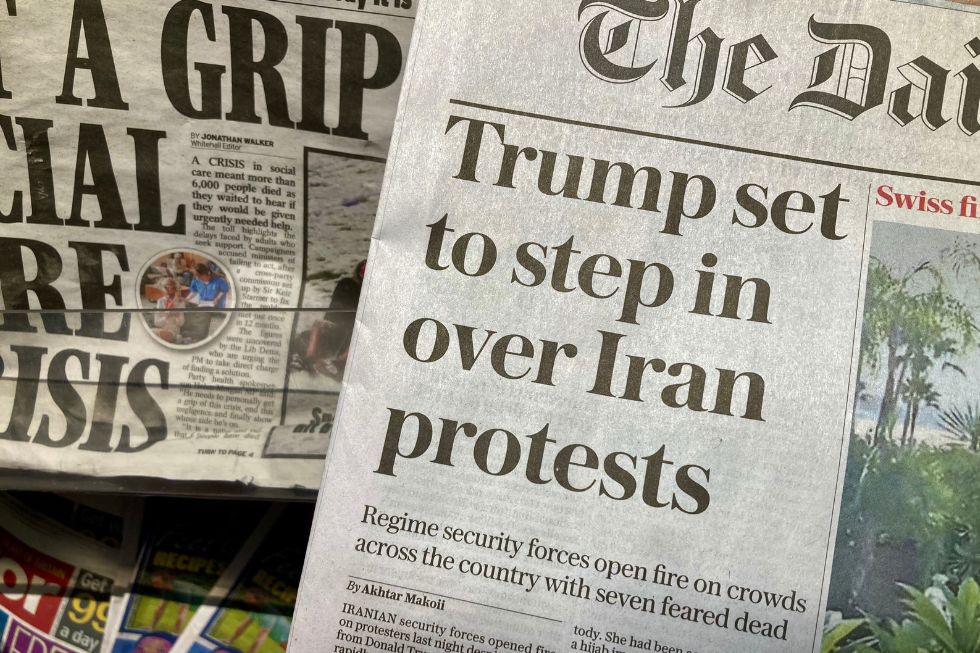



US President Donald Trump, who is nothing if not direct, had threatened to intervene on behalf of demonstrators calling for the removal of Iran’s ruling theocratic regime. But by mid-week, he decided to hold off. The ostensible reason for his turnabout was the apparent decline in protest activity and the government’s failure to follow through with executions of protesters. The real reason, however, may have been US military advisers’ report that the US lacked adequate military assets in the region, i.e., an aircraft carrier battle group and associated attack aircraft, to deal Tehran a meaningful blow. Despite the postponement/cancellation, no one should dismiss Trump’s previous threat as mere characteristic Trumpian bluster. Recall that Mr. Trump voiced similar threats about attacking Venezuela in the run-up to America’s actual military intervention in early January, seizing Venezuelan dictator Nicolás Maduro and his wife and whisking them off to New York to stand trial on federal drug and other charges.
Iranians’ economic misery
The demonstrations ignited in the final days of December, sparked by rapidly declining economic conditions in the Islamic Republic. Life there is plagued by shortages not only of goods and other life essentials but also heat, power, fuel and water. In the latter case, Iranian President Masoud Pezeshkian has even talked about evacuating portions of Tehran to alleviate the pressure on the limited supply. In short, however, there is no solution at present to the country’s declining water sources.
Monthly inflation is averaging more than 40%. The rial’s value has plummeted in recent months, especially following the reimposition of UN Security Council sanctions on Iran last October for failing to comply with international nuclear requirements, including International Atomic Energy Agency (IAEA) inspections of Iranian nuclear research and production sites. Today, the rial ranks as the world’s weakest currency, at 1.4 million rials per US dollar.
Inflation and the rial’s plunge conspired to drive already high prices into the stratosphere. Life was already becoming almost impossible for consumers. But the tens of thousands of small- to medium-sized business owners known as bizzarris, who make everyday life possible for the broad swath of the public, began closing their shops and taking to the streets. They cannot purchase products to sell, and their customers cannot afford what they offer. It wasn’t long before the rest of the country followed the merchants into the streets. And in increasing numbers and frequency. This hasn’t happened since the 1979 revolution.
Government resorts to familiar gameplan: more repression
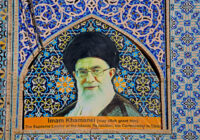
But it’s no longer just the economy that drives these protests. Iranians also want political change and aren’t afraid to proclaim it loudly. That includes direct criticism of Supreme Leader Ayatollah Ali Khamenei and his ruling theocratic clique. Initially, the government tried sympathizing with Iranians and the trials of everyday life in the country, including the water and power shortages and the state of the economy. Iranians wanted none of it and continued their demonstrations in ever greater numbers, reaching as high as thousands in the streets of some of the largest cities. Having failed at offering sympathy and palliatives, the government resorted to predictable form, brutal repression by the Islamic Revolutionary Guard Corps (IRGC) and its paramilitary forces, the Basij, the ubiquitous enforcers of the regime.
There have been beatings, live fire directed at demonstrators and mass arrests. The government also shut down the nation’s internet system. Deaths numbered in the thousands, and arrests in the tens of thousands. Executions, including hangings, had been expected earlier in the week. Hospitals reported bodies piling up in morgues and injured people backed up in waiting rooms awaiting medical attention. Yet, the demonstrators persisted.
Iranian commentators able to communicate with the outside world reported that these demonstrations now rank as the nation’s biggest and most serious since the 1979 revolution, exceeding the major demonstrations of 2009 (aka the “Green Revolution”), 2017 and 2022 (aka “Woman, Life, Freedom”) after the security forces’ brutal murder of Mahsa Amini.
The government’s latest campaign of ferocious repression may have ultimately succeeded in tamping down the demonstrations. Increasingly violent repression has worked in the past. It’s the only tool the government now has. However, no amount of repression will change the motives of the protesters. The economy will worsen, water shortages will continue, sanctions will remain or even increase, and public dissent will grow. And the government will have no answer, except ever more brutal suppression.
Enter Donald Trump
Shortly after the demonstrations erupted, Trump warned the Iranian government not to use force against the demonstrators. The government fired back, warning the US and Israel to keep out and threatening to respond to external interference with massive attacks on US and Israeli targets throughout the region. The US had withdrawn some personnel from its Al Udeid Air Base in Qatar; Israel had shut down Ben Gurion Airport. It’s worth noting that the government made similar threats in the lead-up to the June bombings by Israel and the US of its nuclear sites; Iran’s actual response was muted. The country’s defenses suffered enormous damage from those attacks. While not defenseless, they’re less able to respond today than they were last June.
But the real question is not whether the US is able to intervene on behalf of demonstrators, but rather, should it? Iran isn’t Venezuela, where the US enjoyed the advantages of proximity and relatively easy access to the capital and its president. A special forces operation to grab Khamenei, who has no outstanding US arrest warrants, would be infinitely more complicated from thousands of miles away. And would removing the Supreme Leader, who reports suggest may now be mostly an aging and ill figurehead spending most of his time in seclusion, actually make a difference? After all, it’s the IRGC who executes his orders and makes all the security recommendations to him on a day-to-day basis. It’s logical to assume that in his absence, the IRGC leadership, which stands to lose the most in the event of a government collapse, would step into the breach.
And even if US actions triggered even greater mass uprisings and an eventual government fall, then what? The demonstrators have no apparent organization, unifying ideological message — other than regime removal — and no visible leadership. There are reasons for that. The regime’s security forces have been very effective at removing, e.g., detaining, imprisoning and executing, anyone appearing to criticize, much less threaten, it. The shelf life of a vocal regime opponent inside Iran is measured in hours, if not minutes.
One name that’s recently risen to attention is Crown Prince Reza Pahlavi, son of the late Shah, who’s been living in the US in exile since the revolution. Pahlavi has taken to the airwaves and social media to offer his solutions to the current crisis, including, unsurprisingly, ridding the nation of the current regime. In an insightful interview last October at the Council of Foreign Relations, Pahlavi embraced largely American values in calling for democracy, secular governance with respect and tolerance for all religious faiths and ethnicities — Iran has more than a dozen — and reestablishing political, economic and cultural ties with all nations, especially the US and the West.
But the man-who-would-be-Shah dodged questions about his own role, presenting himself as an initial unifying figure. Given the current vacuum inside the country, that may not be such a far-fetched idea. Some unifying figure is needed. Former Supreme Leader Ayatollah Ruhollah Khomeini was a central figure in the 1979 revolution, despite residing outside the country for some 14 years. Khomeini had no political plan for the country, other than wanting a dominant role for the ulema, i.e., the clerical class. That would only come following the invasion of the country by Iraq under Saddam Hussein shortly after the revolution and the ensuing bloody eight-year war between the two countries.
However, it’s unclear and frankly unlikely that Pahlavi has a large following inside the country. The generation that knew and perhaps supported his father is long gone. Members of the former Shah’s government and military are either dead or aging abroad. And while few Iranians today know the brutality of the Shah’s regime, those who do understand that it pales in comparison to the sheer unrelenting viciousness of the current regime. So, Pahlavi may be a useful unifying figure for this phase, but it’s difficult to see him organizing a new government. He has a pleasant enough message for the country, but no organization to carry it out should the opportunity arise.
This begs the question: What might it mean for the government to fall? It seems certain that the IRGC will fight to the bitter end, regardless of the cost in lives and destruction to the country. A genuine collapse would require substantial defections by senior government officials and parliament members, resignations by military officers and most importantly, defections within the ranks of the IRGC. We have seen none of that so far. Opponents within the regime almost certainly exist. But matters have not yet reached the point where they are prepared to step up.
All this is important in the light of Trump’s threat. If the ultimate objective is regime change, then change to what? In 1979, it took an external invasion, wave after wave of arrests and executions of suspected dissidents, opponents and former members of the Shah’s government and military, and myriad groups fighting for power and influence before the Islamic Republic as we know it today emerged.
What can the US do?
In light of all of this, there appears to be little that the US can do to effectively protect protesters, short of a major and most improbable invasion. 2026 is not 1953, when US and British intervention forever altered the course of Iranian history by ousting the elected prime minister and restoring the shah to the throne.
Nevertheless, the American president should be commended for making it clear where America stands in the Iranians’ struggle to break the shackles of an extreme dictatorship. Moreover, there may be actions in which the Americans and others could actually be helpful when protests reignite, which they inevitably will. For example, countries could offer more secure and available ways for dissidents to communicate with one another in view of the government’s closure of most public communication networks, including the internet. More Starlink terminals might be an answer. There is also America’s vaunted cyber warfare capability to undermine the regime’s own ability to communicate within itself. If the US is contemplating kinetic military action, then it may consider targeting command and control facilities, bases housing IRGC and Basij forces used to suppress public demonstrations, and even key leaders within the regime.
America’s options in Iran are limited but potentially (and debatably) helpful. However, it should be clear that if the US or any other country inserts itself into this movement, it will forever bear some measure of responsibility for the results. After all, where Iran is today is the result, in part, of US actions in 1953.
[Kaitlyn Diana edited this piece.]
The views expressed in this article are the author’s own and do not necessarily reflect Fair Observer’s editorial policy.
Iran’s Protest Moment: Four Stakeholders, One Coherent Vision
Iran’s protests stem from deep economic hardship and a clash between societal change and an entrenched regime. Four groups —...
Why Is Iran Declaring War on Multiple Countries When It’s at War With Itself?
Iran’s recent declaration of war against the US, Israel and the EU signals a strategic effort to project strength amid...
Why Iran’s Collapse Requires Decisive American and Israeli Intervention
Iran has entered a terminal phase of systemic failure following the 12-Day War and the economic collapse of early 2026....
Support Fair Observer
We rely on your support for our independence, diversity and quality.
For more than 10 years, Fair Observer has been free, fair and independent. No billionaire owns us, no advertisers control us. We are a reader-supported nonprofit. Unlike many other publications, we keep our content free for readers regardless of where they live or whether they can afford to pay. We have no paywalls and no ads.
In the post-truth era of fake news, echo chambers and filter bubbles, we publish a plurality of perspectives from around the world. Anyone can publish with us, but everyone goes through a rigorous editorial process. So, you get fact-checked, well-reasoned content instead of noise.
We publish 3,000+ voices from 90+ countries. We also conduct education and training programs
on subjects ranging from digital media and journalism to writing and critical thinking. This
doesn’t come cheap. Servers, editors, trainers and web developers cost
money.
Please consider supporting us on a regular basis as a recurring donor or a
sustaining member.
Will you support FO’s journalism?
We rely on your support for our independence, diversity and quality.
FO° Exclusive: What Will the Middle East Look Like if Iran’s Islamic Regime Falls?
In this episode of FO° Exclusive, Fair Observer Founder Atul Singh and retired CIA Officer Glenn Carle explore post-October 7...

The Exploitation of the African American Struggle and Iranian Nationalism
Iranian leaders use the examples of Martin Luther King Jr. and Rosa Parks to argue that they stand for justice...





Comment