





In August 2017, marchers carrying torches through Charlottesville, Virginia, chanted “Jews will not replace us,” built on the conviction that a hidden hand was engineering demographic change to erase white America. Three years later, Britain’s national equalities watchdog concluded that the Labour Party — for a century the standard-bearer of the British left — had broken the law in its handling of antisemitism complaints. This was the culmination of leadership elected on a promise to take on “the elite” that proved chronically unable to recognize the same prejudice metastasizing inside its own movement.
Different centuries’ worth of ideological baggage, different countries, apparently nothing in common but the calendar. Yet in both cases, a movement organized around returning power to ordinary people from a corrupt few arrived, sooner or later, at the Jews.
A persistent obsession
The examples reach well beyond those two. In Paris in February 2019, Yellow Vest protesters hurled “dirty Zionist” at the philosopher Alain Finkielkraut, and an Ifop poll found nearly half of the movement’s supporters believed in a worldwide “Zionist plot.” In Venezuela, then-President Hugo Chávez blamed “minorities, descendants of those who crucified Christ” for grabbing the world’s wealth, pairing the oldest charge against Jews with the oldest myth about Jewish money. During Occupy Wall Street in 2011, a protest against the banks produced signs against Jewish bankers. The Anti-Defamation League (ADL) said such views did not represent the movement, but they appeared all the same. Different continents, different decades, different politics and the same villain.
This happens in too many unrelated places to be coincidence, and treating each instance as an isolated scandal — explicable by the specific pathologies of one party, one country, one leader — is exactly how the larger pattern keeps getting missed. It would be more useful, and more honest, to ask why populism in particular keeps finding its way here, on the left as readily as on the right.
The problem with populism
The answer has less to do with the specific content of left-wing or right-wing politics than with the shape of populism itself: a style of politics that requires a hidden, unified, all-explaining enemy to make sense of its own repeated failure to achieve the “general will” it claims to represent — and that inherits, whether its adherents intend it or not, the West’s oldest and most fully developed template for exactly that kind of enemy.
The place to start is with what populism actually is, since the word gets used loosely enough to describe almost anything with an anti-establishment flavor. Political scientists who study the phenomenon closely, most influentially the Dutch scholar Cas Mudde, define it more precisely: Populism is a “thin ideology” that divides society into two homogeneous, morally opposed camps — “the pure people” against “the corrupt elite” — and insists that politics should simply express the people’s general will, unmediated by the institutions built to slow it down.
Two features of that definition matter more than they first appear to. The first is “thin.” Unlike socialism or conservatism, populism has no substantive program of its own; it functions as a grammar rather than a vocabulary, and has to borrow content from whatever host ideology it attaches to in order to say anything concrete about taxes, borders or courts. That is why an identical structure can animate a nationalist rally in one country and a social-justice march in another: The underlying logic holds even when the politics wearing it point in opposite directions.
Italy’s anti-establishment Five Star Movement governed in 2018 with the far-right League, then in 2019 with the center-left Democrats, the party it had spent years denouncing. Greece’s radical-left Syriza took power in 2015 in coalition with the nationalist Independent Greeks. The two parties held different ideologies, and what bound them was opposition to the bailout. In Argentina, the neoliberal Menem and the redistributionist Kirchner both ran as Peronists, a form of populism unique to the South American country. The enemy stayed fixed, and the policies changed with the host.
The second feature is “corrupt elite.” Populism does not simply criticize specific policies or officeholders the way ordinary opposition politics does. It requires a class of enemies defined by their essential corruption and their opposition to the people as such: a group whose power is out of proportion to its numbers, whose loyalties run elsewhere.
This group’s influence works through channels ordinary citizens cannot easily see — finance, media, courts, universities, international bodies. That is a very specific explanatory shape. And Western political culture has, for the better part of a millennium, kept one archetype on hand that fits it uncannily well.
Antisemitism in action
Antisemitic conspiracy theory did not originate as a response to any real distribution of power. It is, in the end, a theory of hidden causation, holding that history’s disappointments are not the product of impersonal forces, bad luck or one’s own side’s mistakes, but of a secretive, unified group manipulating events from behind the scenes.
The historian Richard Hofstadter, writing about a very different American movement in 1964, called this general mode of thought the “paranoid style” — politics conducted as the uncovering of a vast, malicious conspiracy that explains why the virtuous majority keeps losing. Hofstadter was not writing specifically about antisemitism; he was more interested in how the same style recurs across very different targets — Freemasons, Catholics, international bankers — because the style, not the target, is the constant.
Antisemitism supplies that style’s most complete and durable target. For centuries, Jews were cast, often simultaneously and with no apparent concern for the contradiction, as the hidden force behind both rapacious capitalism and subversive revolution — cosmopolitan finance and rootless Bolshevism at once.
When 19th-century German socialists found colleagues trying to redirect working-class anger at Jewish bankers rather than at capitalism as a system, the retort that stuck was: “Antisemitism is the socialism of fools”. It is a critique of real power redirected at a fake, ethnically defined stand-in, because the fake enemy is easier to picture, easier to hate and does not require confronting the actual system.
That is precisely the shortcut populism is prone to reach for. A movement that has promised its followers a return of power to “the people,” and then fails to deliver it — because governing is hard, because institutions resist, because the world is complicated — faces an uncomfortable question: Why hasn’t the general will prevailed?
Antisemitic conspiracy theory offers the most fully worked-out answer Western culture has on file: Because a hidden elite, coherent across finance and media and government in a way no real elite ever manages to be, is thwarting it. Nobody has to invent the theory from scratch. It is sitting in the political culture’s attic, tested and pre-loaded, requiring only that someone reach for it.
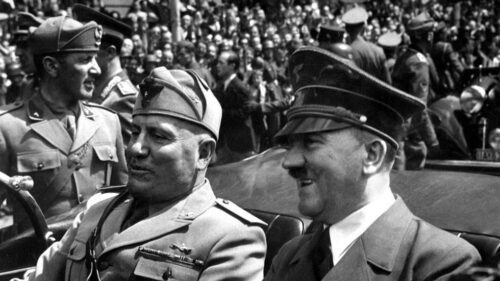
On the populist right, that reaching has an obvious 20th-century precedent — fascism was, among other things, antisemitic populism carried to its most murderous conclusion — and a set of contemporary echoes that make clear the impulse did not go extinct with it.
The Great Replacement theory and its violent conclusion
Consider the “Great Replacement,” the theory that Western elites are engineering the demographic replacement of native populations through mass immigration. Its modern coinage belongs to the French writer Renaud Camus, and ironically in its original formulation, it was a theory about Muslim immigration into France, not explicitly a theory about Jews.
But theories, once released, do not stay under their authors’ control. American white nationalists fused Camus’s framework almost immediately with the older belief that Jews orchestrate immigration specifically to dilute white political power, producing the version chanted at Charlottesville. A year later, it was cited by the gunman who murdered eleven worshipers at Pittsburgh’s Tree of Life synagogue, who had fixated on a Jewish refugee-resettlement charity he believed was bringing in “invaders.”
The distinction is worth preserving: it shows the antisemitic version of the theory was not an inevitable feature of anti-immigration politics but a specific, additional move — evidence that the “elite” slot in the populist framework stays open until someone decides to fill it with Jews, at which point the older, more complete conspiracy template takes over.
Hungary supplies a case study in how that filling-in can become official government strategy rather than fringe pathology. Since 2013, Prime Minister Viktor Orbán’s Fidesz party ran recurring national campaigns against George Soros, the Hungarian-born Jewish financier, portraying him on government-funded billboards as a smiling, scheming figure secretly directing migration policy against Hungary’s interests. The Human Rights Watch and Hungary’s own Jewish community organizations said this imagery echoed 1930s antisemitic propaganda, and was repeatedly defaced with slurs the government declined to disown.
The template proved durable enough to be recycled: In 2026, the same billboard format and composition reappeared to a new face, Ukraine’s President Volodymyr Zelensky, another Jewish target for the same puppet-master framing. Only the name had changed.
Germany’s Alternative for Germany (AfD) party illustrates the same current running beneath a party that otherwise presents itself as a conventional conservative alternative. Björn Höcke, the leader of its regional branch in Thuringia and one of the party’s most influential figures, has called Berlin’s Holocaust memorial a “monument of shame” and been convicted twice for using a banned Nazi slogan at party rallies; Germany’s domestic intelligence service classifies his state branch as confirmed right-wing extremist.
But the populist right’s relationship to antisemitism is genuinely more contested than a simple continuity story suggests, and a fair account has to hold both halves at once. France’s National Rally supplies the clearest counter-current: Its founder, Jean-Marie Le Pen, was expelled from the party he built after decades of remarks minimizing the Holocaust, in a rupture engineered by his own daughter. In November 2023, weeks after the Hamas attacks, she and her party’s officials joined a Paris march against antisemitism.
Whether that “de-demonization,” as French commentators call it, reflects genuine conviction or electoral calculation is a live and legitimate argument. What is not in dispute is that it happened, that it was resisted by parts of the party’s old guard, and that it shows the populist right is not monolithic on this question. Antisemitism is a persistent temptation for these movements, not a fixed identity.
A progressive antisemitism
The populist left’s version of the same temptation is less widely understood, partly because it wears the vocabulary of anti-imperialism and social justice rather than blood-and-soil nationalism, and partly because its most prominent recent case involved a party that most observers, on every side, already had strong priors about.
Britain’s Labour Party spent the second half of the 2010s under Jeremy Corbyn, a career backbencher whose politics were organized around exactly the populist grammar described above: a corrupt establishment — bankers, arms dealers, a complicit media — arrayed against ordinary people it had betrayed.
In 2019, after years of complaints, the Equality and Human Rights Commission (EHRC) opened a formal investigation into how the party handled antisemitism claims. Its 2020 report found Labour had committed unlawful harassment and discrimination, and concluded that Corbyn’s leadership had failed to do enough to prevent antisemitism and could, at worst, be seen to have tolerated it. Corbyn was suspended from his own party for disputing the findings.
Though it is worth being precise about what the report did and did not conclude: investigators explicitly said they had not found Corbyn personally responsible for unlawful antisemitic conduct. The EHRC documented a failure that was institutional and cultural rather than a matter of one man’s personal bigotry, which is, if anything, the more unsettling finding: An entire movement organized around opposing “the elite” spent years unable to recognize where its own rhetoric had gone.
The mechanism connecting anti-elite politics to antisemitism on the left runs through a different door than it does on the right, but it tends to lead to a similar room. Legitimate criticism of the Israeli government’s policies is not antisemitism, and treating it as such does real damage to honest debate — a point even many defenders of stricter definitions concede.
But there is a documented pattern, distinct from ordinary policy criticism, in which “Zionist” becomes shorthand for a cohesive, secretive, disproportionately powerful group manipulating governments and media from the shadows: the same explanatory shape antisemitism has always supplied, relabeled for a different political vocabulary.
Where ordinary criticism crosses into that pattern is genuinely, and often bitterly, disputed. The International Holocaust Remembrance Alliance’s working definition of antisemitism was written partly to draw that line, listing examples its authors consider antisemitic regardless of the speaker’s politics, such as holding Jews collectively responsible for the actions of the Israeli state. Critics, including Kenneth Stern, the definition’s lead drafter, argue it has been applied broadly enough to chill ordinary political speech and protest, particularly on university campuses. Both claims are advanced in good faith by serious people, and this essay is not the place to adjudicate between them.
In the wake of the war
What is not seriously disputed is the scale of what has happened since October 2023: Recorded antisemitic incidents in the United States reached the highest level in the 46-year history of the ADL’s tracking, breaking annual records for four consecutive years, with a majority of 2024’s incidents for the first time involving Israel- or Zionism-related content.
Some meaningful share of that total reflects exactly the conflation described above — rhetoric that slides from criticizing a government’s wartime conduct into older tropes about collective Jewish power and loyalty. Some other share reflects legitimate, occasionally furious but non-antisemitic protest being swept into the same count, a measurement problem serious researchers on all sides of the argument acknowledge. Untangling the two requires exactly the case-by-case scrutiny that both blanket accusation and blanket dismissal are designed to avoid.
It is worth adding, in fairness to the populist left, that this is a tendency rather than a law. Bernie Sanders — himself Jewish, and arguably the most successful left-populist figure in recent American politics — built an anti-elite coalition around Wall Street and billionaires without producing anything resembling Labour’s institutional crisis. Populism creates the vulnerability; it does not guarantee the outcome.
Balancing the scales, or removing them from our eyes
The temptation, on surveying all of this, is to keep score: to tally the right’s Soros billboards against the left’s Zionist conspiracy theorizing and declare a winner in the contest for history’s most antisemitic politics. That instinct is understandable and almost entirely unproductive. Treating antisemitism as a scandal that belongs exclusively to one’s political opponents does two things at once, both of them bad: It lets one’s own side’s version of the pattern go unexamined, and it turns a genuine and recurring hatred into one more move in an argument people were already having for other reasons.
The more useful diagnosis is structural rather than partisan. Political theorists who study populism, Jan-Werner Müller prominent among them, have argued that its defining feature is a claim to exclusive moral representation: Populists do not simply say they represent a majority, but that they, and only they, represent “the real people” — which makes any obstacle to their success illegitimate by definition, rather than merely mistaken.
A politics built on that premise needs its obstacles to be not just wrong but corrupt, and not just corrupt but coordinated, because an incoherent ordinary muddle of institutional friction, competing interests and bad luck is a far less satisfying explanation for repeated failure than a hidden hand. Antisemitic conspiracy theory is simply the most fully developed hidden hand Western political culture has on offer, tested across centuries and countries, requiring no one to invent it fresh. Whenever a populist movement — left or right, however sincere its underlying grievances — reaches for that particular story, it is waiting for them.
This is why the pattern keeps recurring in movements that agree on almost nothing else. It is not that the political right is secretly fascist, or that the political left is secretly Bolshevik in its antisemitism — charges that are as lazy as they are, in most individual cases, false. The truth is that both are vulnerable to the same structural temptation whenever anti-elite politics curdles into the belief that ordinary institutional failure must actually be sabotage, and no other conspiracy theory in Western history arrives so fully stocked with plausible-sounding evidence, ready villains and centuries of narrative infrastructure.
None of this should be read as a claim that populism is simply antisemitism by another name, which would be false and unfair to the millions of people who vote for anti-establishment parties out of ordinary economic grievance with no interest whatsoever in ethnic scapegoating.
Populism is compatible with plenty of other targets for its corrupt-elite slot — the International Monetary Fund (IMF), foreign multinationals, an entrenched domestic oligarchy — and much of Latin America’s populist tradition, for instance, has built its anti-elite politics around figures with no meaningful local Jewish population to blame in the first place. Correlation is not destiny.
The structure creates a vulnerability, not a certainty, and treating every anti-establishment movement as antisemitism-in-waiting is its own kind of intellectual laziness, one that conveniently delegitimizes ordinary economic and political grievances by association.
It is also fair to note, as critics of this whole line of argument sometimes do, that emphasizing populism’s structural susceptibility to antisemitism can itself become a rhetorical weapon: a way of tarring anti-establishment politics in general with history’s ugliest brush, deployed selectively depending on which anti-establishment movement the deployer already dislikes.
That criticism lands hardest exactly when the structural argument is applied asymmetrically — readily invoked against one’s political opponents, quietly shelved when the same mechanism turns up closer to home. The honest use of this framework cuts in both directions, or it is not honest at all.
Bitter rivals with common hatreds
Charlottesville’s marchers and Corbyn’s Labour Party would not recognize each other as allies, and would be furious at the suggestion. That is, in a way, the point. Neither movement needed the other’s ideology, or the other’s history, or the other’s grievances, to arrive at the same villain, because the villain was never really the point.
What mattered was the shape of the explanation: a hidden, coherent, all-powerful “them” standing between “the people” and the future they were promised. Antisemitism has supplied Western political culture with the most complete version of that explanation for longer than any currently existing nation-state has been in business, and it will remain available to any movement, of any ideological flavor, that needs an answer for why the general will keeps losing.
Taking it seriously means giving up the comfort of assuming it is always the other side’s problem. It means being as willing to call a Soros billboard antisemitic as a “globalist banker” meme, and as willing to name a chant that slides into old tropes about Jewish power as a demographic conspiracy theory that does the same.
The alternative — treating antisemitism as a useful stick for beating one’s political enemies rather than a pattern worth understanding on its own terms — is not opposition to it at all. It is simply the socialism of fools, one more time, with new people holding the stick.
[Casey Herrmann edited this piece]
The views expressed in this article are the author’s own and do not necessarily reflect Fair Observer’s editorial policy.
For JD Vance, Blaming Israel Is Easier Than Admitting Iran Won
US Vice President JD Vance’s recent interview with podcaster Joe Rogan shifted blame for the faltering US-brokered Iran deal onto...

The Great Betrayal: Why the Western Left Ignores Iranian Victims
The modern progressive movement has sacrificed its core values of liberty and secularism to form a strategic partnership with theocratic...

The Returning Nightmare: Europe’s Far Right and the Fading of Democratic Memory
The resurgence of far-right movements throughout Europe is a result of several converging issues: a decline in historical awareness, unchecked...
Support Fair Observer
We rely on your support for our independence, diversity and quality.
For more than 10 years, Fair Observer has been free, fair and independent. No billionaire owns us, no advertisers control us. We are a reader-supported nonprofit. Unlike many other publications, we keep our content free for readers regardless of where they live or whether they can afford to pay. We have no paywalls and no ads.
In the post-truth era of fake news, echo chambers and filter bubbles, we publish a plurality of perspectives from around the world. Anyone can publish with us, but everyone goes through a rigorous editorial process. So, you get fact-checked, well-reasoned content instead of noise.
We publish 3,000+ voices from 90+ countries. We also conduct education and training programs
on subjects ranging from digital media and journalism to writing and critical thinking. This
doesn’t come cheap. Servers, editors, trainers and web developers cost
money.
Please consider supporting us on a regular basis as a recurring donor or a
sustaining member.
Will you support FO’s journalism?
We rely on your support for our independence, diversity and quality.




Comment