


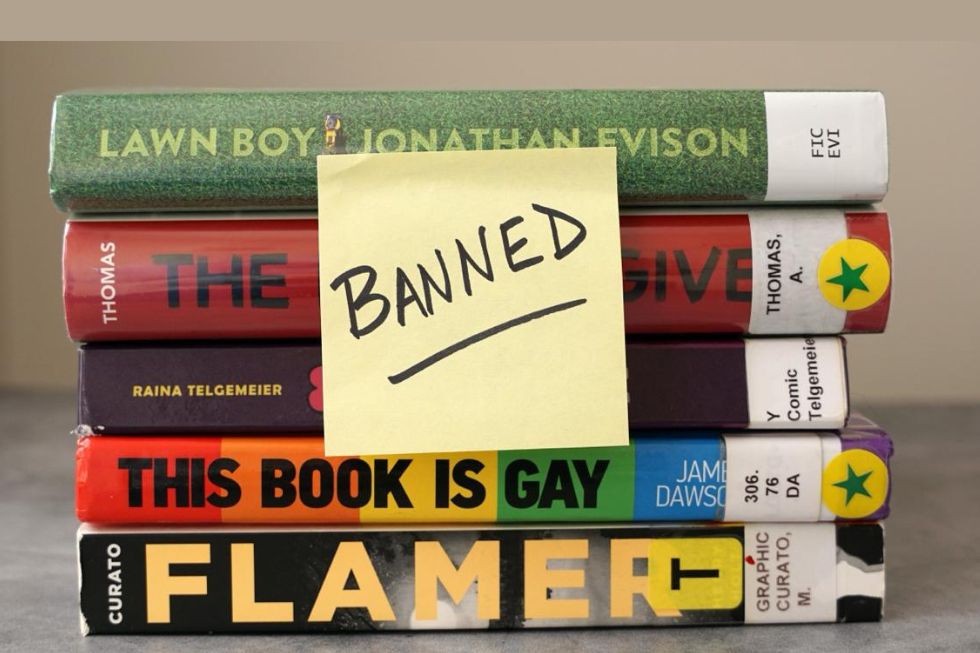


In June 2024, South Carolina Superintendent of Education Ellen Weaver introduced a new regulation regarding the availability of books in schools. Local educators and school boards shall now determine if materials are “Age or Developmentally Appropriate,” with additional language stating that instructional material is not “Age or Developmentally Appropriate” for any age group of children if it includes descriptions or visual depictions of “sexual conduct” as defined by state law (the description of which is too long to fit in this article).
The Department of Education’s new law gains inspiration from groups like Moms for Liberty, which advocates for more parental rights in education, and backlash against books that teach children about topics such as Critical Race Theory or lesbian, gay, bisexual, transgender or queer (LGBTQIA+) issues.
The push for censorship and its contradictions
Senator John Kennedy of Louisiana hilariously illustrated such books available to students in some parts of the country when he read sexually explicit excerpts from the controversial books All Boys Aren’t Blue and Gender Queer in a Senate Judiciary Committee hearing in 2023. Watching the video will make you cringe. It is shocking to see a United States Senator read a passage about sexual conduct in a formal setting, and it is alarming that these books are available to children.
While instituting a rule that would make such books unavailable to children is understandable given its appropriateness, the policy will likely have unintended negative consequences for the future of education in South Carolina, like government censorship often does, and we should oppose it.
The law is ironically contradictory in the name of discretion for appropriateness. It states that local educators and boards shall determine whether the material is age- and development-appropriate, but then the rule removes this autonomy by including the element of “sexual conduct” and limits local policymakers’ discretion.
Books containing descriptions or depictions of sexual conduct are now illicit because it is inappropriate, yet schools will still teach sexual education. It does not make sense to have classroom instruction on a topic while banning certain books that depict it. Parents already get to decide if their child can take sexual education classes, so the new rule is actually more detrimental to parental rights.
Weaver touts this law as a victory for parental rights, but these rights cannot be won with a blanket censorship law. Instead, we have parental rights for those who support this state policy rather than local jurisdiction, so each parent can better ensure their concerns are heard and their children’s education more closely aligns with their values.
However, parents will likely see drastic changes in their children’s education due to a lack of local jurisdiction and flexibility. South Carolina’s new rule explicitly means that books such as The Canterbury Tales, 1984, Romeo and Juliet and Brave New World, just to name a few, could be unavailable to any student regardless of age. These books did not draw red flags when I read some of them as a student in Union County Schools.
Lessons from other states
Assuming that the regulation is not a violation of the First Amendment (an argument often made by proponents of the law), primary concerns lie in its vague descriptions. Obviously, graphic depictions of sexual conduct should not be available to children in elementary school, but the law is too broad.
When I was in high school, just over four years ago, no one would have been taken seriously if they had asked for Romeo and Juliet to be banned because books like that were never a problem. We should protect classic pieces of literature and acknowledge their importance in education. However, as the saying goes, “The road to hell is often paved with good intentions.”
One may argue that the law will not lead to these consequences and that I am being alarmist. They would be wrong, as there are many examples throughout the country of barring certain books from school libraries that would draw the ire of the average person.
In 2023, the Davis School District in Utah removed the King James version of the Bible from elementary and middle school libraries due to “vulgarity or violence.” The parent who initially called for the Bible’s banning noted that the Bible contains instances of prostitution, incest and rape. In 2020, the Burbank Unified School District in California banned books, notably To Kill a Mockingbird, after parents complained of the book’s racism.
The case for local freedom
The moral of this story is that regardless of culture, Utah or California, Republican or Democrat, Christian or Atheist, once you give others the power to regulate your privileges and rights, it will almost certainly be used against you at some point. This story is especially true given that government officials are terrible at drafting meaningful laws. When it comes to government educational reforms, you should be careful what you wish for.
While the intent to protect children is commendable, the broad and vague nature of the regulations could lead to the banning of critical literary works. It is crucial to find a balance that protects children without stifling their educational growth and exposure to classic literature.
Local districts should be able to have autonomy with these policies, and local committees with diverse opinions should work. Local committees allow you to choose how your tax dollars are spent and how your child is educated. Freedom works, and you will find that liberty is the best path to progress.
[Kaitlyn Diana edited this piece.]
The views expressed in this article are the author’s own and do not necessarily reflect Fair Observer’s editorial policy.
Adults Are Now Pushing Teens Out of Teen Literature
Young Adult (YA) novels have long been an escape for readers aged 12 to 18. Recently, however, adult readers have...

Introducing MAGA’s War on the Truth — and Libraries
Public libraries are just about the only public institution that does not hurt anyone. Not only do they provide a...

Support Fair Observer
We rely on your support for our independence, diversity and quality.
For more than 10 years, Fair Observer has been free, fair and independent. No billionaire owns us, no advertisers control us. We are a reader-supported nonprofit. Unlike many other publications, we keep our content free for readers regardless of where they live or whether they can afford to pay. We have no paywalls and no ads.
In the post-truth era of fake news, echo chambers and filter bubbles, we publish a plurality of perspectives from around the world. Anyone can publish with us, but everyone goes through a rigorous editorial process. So, you get fact-checked, well-reasoned content instead of noise.
We publish 3,000+ voices from 90+ countries. We also conduct education and training programs
on subjects ranging from digital media and journalism to writing and critical thinking. This
doesn’t come cheap. Servers, editors, trainers and web developers cost
money.
Please consider supporting us on a regular basis as a recurring donor or a
sustaining member.
Will you support FO’s journalism?
We rely on your support for our independence, diversity and quality.





Comment