






Rumors of the resignation of Sudan’s Defense Minister Hassan Dawood Kabron, appointed in June, started as a whisper. His absence during a meeting of the Security and Defense Council, which he leads, fueled the rumors. It’s not confirmed whether Dawood has indeed stepped aside, but if he has, the impact may be bigger than what his modest public profile would suggest.
Dawood and the Sudanese Armed Forces
Dawood derived his importance within the Sudanese Armed Forces (SAF) not because of personal ambition or political charisma, but because he was one of the few senior figures not strongly connected with Sudan’s Islamist networks. These networks are closely connected to the era of former President Omar al-Bashir, who was pushed aside after the 2019 uprising, but they now have renewed influence as the war against the RSF intensifies. Their return has reshaped the SAF from within, particularly at the strategic and ideological levels.
There have long been two broad tendencies inside the Sudanese military. One consists of institutionalist officers, those who view the army as a national institution that must remain professional, structured and relatively detached from ideological politics.
The other consists of officers and allied Islamist militia leaders whose loyalties trace back to the al-Bashir era — remnants of the former ruling party, the National Congress Party (NCP), which is affiliated with Sudan’s Muslim Brotherhood. These elements of the country’s Islamist movement believe the war offers an opportunity to reclaim a long-lost influence. As the conflict has evolved, this latter group has become increasingly assertive.
Potential shift in military power dynamics
Dawood’s possible departure could mark a significant shift in this internal power struggle. Institutionalists may lose another senior figure able to counter Islamist hardliners’ ambitions, ultimately giving more leverage to those fighting for the prolongation of the war. Prominent figures like Ahmed Haroun, Ali Ahmed Karti and Malik Agar — the Vice President of the Transitional Sovereignty Council — remain highly influential behind the scenes.
Their initial rejection of the Quad initiative on September 12 came as little surprise, especially after the Joint Quad statement warned against the growth of influence by Islamist extremist groups and Muslim Brotherhood-affiliated leaders.
This internal shift would not only result in changes within Sudan but also across the wider region. Given that the war has become deeply entangled in the strategies of neighboring countries and Gulf powers, every actor has started pushing for its preferred outcomes. Members of the Quad have been leading diplomatic efforts for ceasefires, humanitarian relief and peace frameworks. However, the concerns among Quad members also extend to stability along the Red Sea, the future of political Islam and the balance of influence in the region.
In this regard, a more Islamist-dominated SAF leadership could make the Quad’s work considerably more difficult. Hardline officers are generally wary of outside mediation and often reject compromises that would dilute their influence. The trend could indeed be that, with Dawood having stepped aside and the hardliners consolidating their control, the SAF would drift toward being less open to the peace proposals US President Donald Trump is shaping. This places members of the Quad in a very difficult position, balancing the desire for a stable Sudan with deep mistrust of Islamist political currents.
Regional implications and diplomatic challenges
A strengthened Islamist presence inside the SAF might entrench fears that Sudan is moving in the wrong direction, given its long-term regional priorities. At the same time, members of the Quad cannot easily distance themselves from the SAF and allow others like Iran, Qatar or Turkiye to expand their influence and physical presence through Port Sudan.
Both Egypt and the US are actively engaged in mediation efforts and could also face similar challenges. Cairo does support a strong Sudanese army and appears to provide military support, but not one fractured by ideology. Washington has reengaged diplomatically, but an SAF leadership driven increasingly by ideological actors will be harder to influence through traditional pressure or negotiation.
For Sudan, a confirmed resignation by Dawood would further plunge Sudan into uncertainty at an already precarious moment. The war has become the world’s worst humanitarian crisis, and every shift within military leadership affects the prospects for a ceasefire. A strengthened Islamist influence inside the SAF might make the conflict even more intractable, further reduce the chances of compromise and heighten the suffering of civilians caught in the fighting.
In a conflict of shifting front lines and fluid political alliances, the resignation of one minister may seem a minor event. Yet sometimes the most significant changes do not occur on the battlefield but in the quieter realignments inside the institutions that hold, or fail to hold, a country together. Dawood’s absence, if true, might be one of those moments.
[Kaitlyn Diana edited this piece.]
The views expressed in this article are the author’s own and do not necessarily reflect Fair Observer’s editorial policy.
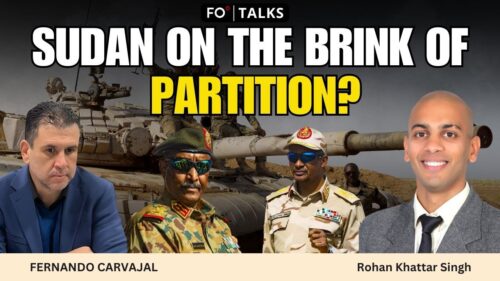
FO° Talks: Sudan’s Civil War Explained — RSF vs SAF, Darfur Crisis and Red Sea Geopolitics
In this episode of FO° Talks, Rohan Khattar Singh and Fernando Carvajal examine how Sudan’s civil war grew into a...
The World Must Act to Save Darfur’s Innocents From Further Massacre
Sudan’s crisis deepens as the Rapid Support Forces (RSF) battle the Sudanese Armed Forces (SAF) for dominance across Darfur. The...
The Sudan War: Why It Cannot Be Resolved
The Sudanese Armed Forces (SAF) and the Rapid Support Forces (RSF) are fighting for power amid deep ethnic and regional...
Support Fair Observer
We rely on your support for our independence, diversity and quality.
For more than 10 years, Fair Observer has been free, fair and independent. No billionaire owns us, no advertisers control us. We are a reader-supported nonprofit. Unlike many other publications, we keep our content free for readers regardless of where they live or whether they can afford to pay. We have no paywalls and no ads.
In the post-truth era of fake news, echo chambers and filter bubbles, we publish a plurality of perspectives from around the world. Anyone can publish with us, but everyone goes through a rigorous editorial process. So, you get fact-checked, well-reasoned content instead of noise.
We publish 3,000+ voices from 90+ countries. We also conduct education and training programs
on subjects ranging from digital media and journalism to writing and critical thinking. This
doesn’t come cheap. Servers, editors, trainers and web developers cost
money.
Please consider supporting us on a regular basis as a recurring donor or a
sustaining member.
Will you support FO’s journalism?
We rely on your support for our independence, diversity and quality.





Comment