


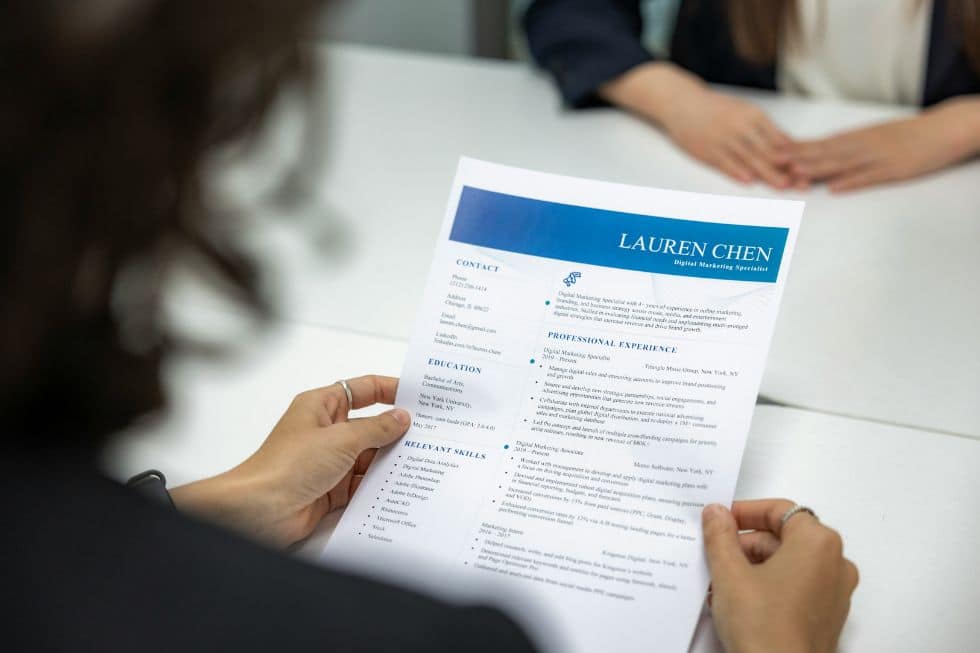



The power of generative AI has rapidly reached a level where anyone can fake it and make it in almost any field. With just a few text prompts, AI can produce a chart-topping song or write hundreds of lines of code faster than any human. And when it comes to job search, AI means it’s easier than ever to produce an impressive resume that ticks all the right boxes.
But does the increasing influence of AI in the job search process pose risks for the future of hiring? How do candidates stand out in an increasingly homogenous candidate pool, and how can recruiters differentiate between the genuine article and an AI-enhanced applicant? Let’s take a look at the future of hiring in the age of AI.
How much influence does AI have over the hiring process?
Research suggests candidates are increasingly looking to AI tools to improve their job applications and place them in the conversation when it comes to hiring decisions. In Jobseeker’s recent survey of US employees, 40% said they’d used AI tools in their recent job application activities. This could turn out to be a conservative estimate, with research from Career Group Companies suggesting around two-thirds (65%) of candidates now use AI to assist their applications.
On the flip side, recruiters themselves are increasingly leaning on tech to assist with and automate their recruitment activities. Research into this subject found that as many as 98% of Fortune 500 companies used Applicant Tracking Systems (ATS) to assist with their hiring workload. One of the most common uses of ATS in the hiring process is initial resume screening, and with many ATS suites now powered by AI, selection decisions are becoming more influenced by the technology.
Does this mean, then, that we’re moving towards an age where AI takes the lead from both sides of the recruitment process — in the preparation of job applications, and in the decision to hire? To gain a greater understanding of how influential AI has become in the recruitment sector, let’s take a more detailed look at both sides of the process.
How are candidates using AI?
AI tools are now available to assist with every stage of the job application process. Machine learning can increase the efficiency of application workflows and improve the efficacy of various aspects of the application itself.
Jobseeker’s research indicates 33% of those who’ve deployed AI in their job search used it to assist with resume writing. A further 23% have used it for help writing a cover letter. More than one in five (21%) used AI apps and assistants to prepare for a job interview. This means the majority of candidates use AI to improve the quality of the application itself. A further 16% and 7% respectively used AI to increase efficiency in job searching, or for completing other tasks.
How are recruiters using AI?
According to Boston Consulting Group (BCG), there are three key areas companies are using AI to enhance their recruitment processes:
— Creating job descriptions or other recruitment-related content, including marketing emails or candidate assessments.
— Automating administrative tasks such as interview scheduling.
— Screening candidates, matching their credentials to job descriptions.
BCG says that 70% of companies experimenting with AI are doing so within their human resources (HR) functions. Of those, 70% are using AI to automate administrative tasks, while 54% are using the technology for candidate screening.
Attitudes towards AI hiring are softening on both sides
AI was initially greeted with suspicion in the recruitment sector. However, as with many other areas of AI adoption, the growing ubiquity of AI has inevitably led to a softening of attitudes.
Candidates themselves appear convinced of the benefits of using AI to enhance their applications. Jobseeker’s research shows that more than 90% of candidates who’ve used AI in their job search rate it as helpful (scoring AI tools 4 or 5 out of 5 for “helpfulness”). Around four in five (74%) of those surveyed don’t think using AI in a job application is unfair, with only 16% asserting that AI gives candidates an unfair advantage.
When it comes to HR professionals, those who gatekeep recruitment decisions are equally softening in their attitudes towards AI usage in job applications. For example, only 13% of Jobseeker’s HR-based respondents would immediately disqualify a candidate for using AI in a cover letter. A minority of HR professionals are less likely to consider a candidate who uses AI in their application (41%), while even fewer (34%) say they would more closely scrutinize an application found to be AI-generated.
All this seems a far cry from initial fears over the growing influence of AI. In the past, candidates might have balked at the idea of AI-generated resumes giving candidates an unfair advantage, or HR professionals might have feared AI tools would render their hiring teams redundant. However, there now appears to be a growing acceptance that the technology has its uses at both ends of the process.
What role does the candidate play in the age of AI hiring?
The creeping influence of AI in the hiring process raises questions about what role the candidate themselves will play in the future of the recruitment process. Is it still the case that the best-qualified candidate, who presents their credentials in the best way, is most likely to get the job?
The attitudes of employees certainly point towards a growing feeling that traditional skills, techniques and know-how might soon not be enough to get you to the top of the candidate pool. Your application could get buried under an avalanche of enhanced application content unless you’re willing to embrace AI and learn how to exploit the power of the tools available.
Indeed, Jobseeker’s research shows that two-thirds of employees feel pressured to add AI skills to their repertoire lest they get left behind. This is especially concerning for younger employees, with 70% of 18 to 27-year-olds and 73% of 28 to 43-year-olds feeling the need to strengthen their AI skills.
Can you game the recruitment system using AI?
So, are employees right to be concerned about adding AI skills to their repertoire? Does using AI in your job application make a job offer more likely? There is, in fact, some evidence that yes, you can game the recruitment system with AI and give yourself a better chance of success.
Research conducted at the Massachusetts Institute of Technology (MIT) Sloan School of Management indicates that using AI in your resume leads to an 8% increase in the likelihood of being hired. It also makes you 8.4% more likely to receive higher wages than candidates with non-AI resumes.
Does automation mean the traditional resume is on its way out?
With evidence emerging that AI usage leads to better job application outcomes, question marks exist over the traditional job application process. Once AI is deemed an essential part of the resume-writing process, will resumes become homogenized to the point of becoming redundant?
Is the process of writing a resume, and it being assessed by hiring teams, all now just one pointless, performative dance? And if AI is generating so much of the application and playing such a prominent role in selection decisions, will we see the whole process become replaced by something far more efficient and direct?
Hiring practices could go one of two ways
If the art of preparing a compelling, persuasive resume becomes less of a factor in determining who gets a job, it’s conceivable to see a future where resumes are phased out altogether. LinkedIn and online job board profiles already provide platforms for candidates to showcase their work experience, skills and career achievements. One response to the influence of AI in generating and enhancing resumes could be to bypass the process altogether, with recruiters simply using existing sources of information to assess candidate credentials.
An alternative future could see a return to more traditional recruitment methods, where networking and face-to-face connections once again become the driving force of hiring decisions. Experts are already recommending that job seekers don’t rely too heavily on online job applications, instead using job listings as a springboard to identify potential employers and develop relationships. Reaching out directly to potential hiring managers or leveraging previous colleagues or alumni for referrals can create a far more powerful and impactful connection than a resume ever could.
The traditional resume holds strong for now
AI may be disrupting the recruitment process and showing the potential for a very different future for hiring practices, but for now, the traditional resume holds strong. Analysis from CVwizard shows that among Gen Z, almost 4 in 10 employees still feel a resume provides the best showcase of their skills and talents.
The majority of younger workers continue to rely on a combination of a resume and a cover letter in their job search. AI clearly has the potential to change the way we apply for jobs and the way employers make hiring decisions. However, for now, it appears that learning to integrate AI into traditional ways of applying for jobs gives you the best chance of success.
[Patrick Bodovitz edited this article.]
The views expressed in this article are the author’s own and do not necessarily reflect Fair Observer’s editorial policy.
Why 95% of Enterprise AI Projects Fail: The Pattern We’re Not Breaking — Part 1
According to the Massachusetts Institute of Technology (MIT), 95% of AI projects fail to deliver measurable returns. Our Intrinsicana/Fair Observer...

The AI Efficiency Trap: When Productivity Tools Create Perpetual Pressure
Workplace AI once promised to handle routine chores, freeing workers to accomplish higher-level tasks. But we’ve found that the AI...

The Impact of Automation on Corporate Decision-Making
Research co-authored by Wharton’s Pinar Yildirim shows how automation reshapes organizational power dynamics by centralizing decision-making and reducing mid-level managers'...
Support Fair Observer
We rely on your support for our independence, diversity and quality.
For more than 10 years, Fair Observer has been free, fair and independent. No billionaire owns us, no advertisers control us. We are a reader-supported nonprofit. Unlike many other publications, we keep our content free for readers regardless of where they live or whether they can afford to pay. We have no paywalls and no ads.
In the post-truth era of fake news, echo chambers and filter bubbles, we publish a plurality of perspectives from around the world. Anyone can publish with us, but everyone goes through a rigorous editorial process. So, you get fact-checked, well-reasoned content instead of noise.
We publish 3,000+ voices from 90+ countries. We also conduct education and training programs
on subjects ranging from digital media and journalism to writing and critical thinking. This
doesn’t come cheap. Servers, editors, trainers and web developers cost
money.
Please consider supporting us on a regular basis as a recurring donor or a
sustaining member.
Will you support FO’s journalism?
We rely on your support for our independence, diversity and quality.





Comment