






The 31st United Nations Climate Change Conference (COP31) is currently taking place in Antalya, Türkiye, from November 9–20. Governments meeting under the UN climate framework will continue the lengthy discussion on how to advance global climate action and implement existing commitments, amid ever-growing climate disasters and the breaking of planetary limits.
The summit comes as the United States faces a widening divide between federal climate policy and state-level efforts to reduce emissions. At the same time, the rapid expansion of artificial intelligence and cloud computing is driving up electricity demand, raising questions about how the country can meet its energy needs while staying on track with climate goals.
Over the past decade, US greenhouse gas emissions averaged 6.59 billion metric tons of carbon dioxide (CO2) equivalent annually from 2017 to 2019, during President Donald Trump’s first term, before falling to 5.98 billion tons in 2020, according to the Environmental Protection Agency (EPA). The drop coincided with COVID-19’s effects on travel and economic activity. Under President Joe Biden, annual gross emissions were about 6.2–6.4 billion tons, peaking in 2022 before declining to 5.91 billion in 2024.
Since Trump returned to office, the federal government has used executive and legislative actions to hinder the energy transition and promote fossil fuel production and use. A preliminary estimate shows emissions rose 2.4% in 2025. The EPA’s 2025 inventory is not expected until 2027, reflecting the administration’s disregard for climate-policy disclosure. The EPA also revoked the Endangerment Finding, the legal basis for regulating greenhouse gases, and eliminated federal minimum emissions standards for power plants and automobiles.
A widening gap between Washington and the states
Both international and domestic action under the second Trump administration has shifted sharply, as the US federal government stepped back from the Paris Agreement and other federal commitments to renewable energy policies and financing. The move reversed Biden’s re-entry and echoed Trump’s decision during his first term.
The federal retreat has left states and cities to shoulder more of the climate-policy burden. The US Climate Alliance — a bipartisan coalition of 24 governors formed in response to the first withdrawal in 2017 — has become a prominent vehicle for state-level action. As federal protections are rolled back, state governments are advancing climate policies, often linking emissions cuts to lower energy bills, greater reliability and job creation.
The US Climate Alliance reports that its member states have reduced net greenhouse gas emissions by 24% below 2005 levels while growing their combined GDP by 34%. Illinois, for example, enacted a law to expand battery storage, helping stabilize electricity prices and support a cleaner grid. Massachusetts has announced plans to procure additional clean energy and storage, while New Jersey has expanded community solar, offering bill discounts to participating low-income households. In Washington, a new state authority will help plan and finance transmission infrastructure, and Virginia is advancing measures to expand solar, storage and virtual power plants.
States are also targeting emissions from transportation, buildings and industry. Texas is expanding its electric vehicle fast-charging network, while California and New York are considering rules to curb truck pollution linked to large warehouses. Maryland and Washington are weighing transportation plans that would account for greenhouse gas emissions and promote alternatives to highway expansion. In buildings, Maine has expanded heat-pump use to reduce reliance on heating oil, and Virginia is piloting programs to help households make energy-saving upgrades. Pennsylvania is directing grants toward industrial decarbonization, while Washington, California and other states are supporting cleaner manufacturing.
Many of these measures remain proposals or are still being implemented, but together they show how states are pursuing emissions reductions alongside economic and public-health benefits.
States seek a role at COP31
The federal government’s retreat and the technology sector’s rapid growth are shaping the US presence at COP31 in Antalya, Türkiye. The federal government has a limited role, focusing on monitoring discussions that affect US commercial interests rather than joining international climate-finance commitments.
Democratic members of Congress participate separately, along with state officials, positioning themselves through the US Climate Alliance, highlighting state and local climate action, and engaging with international partners; however, they cannot vote on behalf of the United States or sign treaties for the federal government.
The states’ alliance teams its efforts with America Is All In — the largest US subnational climate coalition — which unites states, cities, businesses and institutions representing 63% of the population and 74% of the country’s GDP.
Overall, according to Climate Action Tracker projections, US emissions could be about 14% lower by 2030 under pro-climate federal policies similar to those Biden considered in his last year in office. Among the top contributors to US emissions are the booming data center installations.
AI’s growing footprint: energy, water, copper and concrete
The rapid expansion of data centers for AI and cloud computing is making future energy and water use hard to predict. One concern is already clear: Facilities can be built faster than the power plants and transmission networks needed to serve them. Some have extended coal-plant operations or relied more on natural gas, while renewable projects face permitting and grid delays. It is a big issue. The Lawrence Berkeley National Laboratory projects that data centers could account for 11.8% of US electricity consumption by 2030.
Northern Virginia, one of the world’s largest data-center hubs, is already straining its power infrastructure. In response, states are considering or adopting a range of measures. New York has paused new data center projects pending environmental reviews; Texas has temporarily frozen new grid permits; and Colorado and Minnesota are requiring companies to secure new clean-energy supplies and limit drinking-water use for cooling. Georgia, Virginia and South Carolina have also changed electricity-rate rules to prevent households from bearing the cost of infrastructure built for major technology companies. Some of these measures include surcharges of up to 15% for technology firms.
Beyond energy issues, the expansion also carries a high cost. Data centers consume hundreds of thousands of tons of copper, which is becoming increasingly difficult to extract: the amount found in a ton of mined rock has fallen from about 50 kilograms to less than 10, and new mines can take more than two decades to become productive. The result could be a widening gap between demand and supply, along with greater environmental damage from mining.
Construction adds another burden, particularly through the concrete used to build these facilities. Solutions include AI-assisted concrete design, which could cut emissions by up to 40%, and companies developing lower-carbon or carbon-free cement. These advances are promising, but they do not address the central concern: Environmental impacts are already growing, while many remedies are still being tested.
Big Tech turns to nuclear power
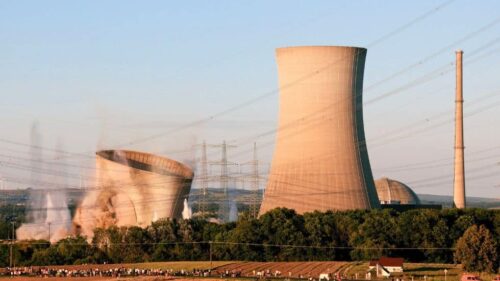
Technology companies are seeking reliable, low-carbon electricity to meet the rising demand. Google has partnered with Kairos Power to support small modular reactors, with commercial deployment expected starting in 2030. Meta aims to secure up to 6.6 gigawatts of reliable, carbon-free power by 2035 through companies such as TerraPower and Oklo, and has supported efforts to keep Illinois’s Clinton nuclear plant open. Amazon acquired infrastructure tied to Pennsylvania’s Susquehanna nuclear plant to power its data centers. Microsoft backed a 20-year deal to restart Three Mile Island to supply its data centers. Nuclear power could ease supply shortages, but raises safety concerns.
Nuclear plants can be operated under stringent safety standards, but no reactor is risk-free. The key question is whether each new or remodeled plant meets its specific safety review, inspection, and operating requirements. The answer requires determining whether a permit or environmental finding constitutes approval to operate. Regulators must confirm that each plant is fit to operate despite pressure from a Big Tech company with a signed contract to buy its energy. Nuclear power avoids the air pollution and carbon emissions associated with fossil-fuel generation, but accident risks, radioactive waste, security, aging equipment and emergency preparedness still require oversight.
Water use becomes a central concern
African and Latin American countries, including Uruguay and Chile, are urging limits on using drinking water to cool AI infrastructure amid drought and water competition. The United Nations warns that, by 2030, global data centers could use as much water as the annual basic needs of 1.3 billion people in sub-Saharan Africa. It also cites a World Economic Forum estimate that a quarter of data centers already operate in areas under severe water stress.
Proposals would restrict aquifer and drinking-water use for evaporative cooling, favoring closed-loop air cooling or treated wastewater. Underwater data centers, inspired by Microsoft experiments, use seawater to cool servers and wind power for electricity. The source claims they can cut freshwater use by over 90% and energy use by more than 20%, but they account for little global data center energy use.
New and sustainable technologies are exciting, but AI (and cryptocurrency mining) follow a familiar Anthropocene pattern: Impacts arrive first, followed by efforts to contain them. The question is whether solutions can be deployed at the speed and scale required, or whether they will again come too late. Regulations, at the state, national or global level, always come after the damage.
Proposals to regulate data centers
Proposals to regulate data centers
Data centers are becoming part of international climate discussions; however, at a slower pace given their environmental impact. Proposals include energy-efficiency standards based on power usage effectiveness (PUE) and restrictions on using drinking water for evaporative cooling in water-scarce regions.
The emissions challenge is already substantial. A Harvard study of 403 large US data centers estimated that their electricity use produced 25.7 million metric tons of CO2 between May 2024 and April 2025, with more than half of their electricity coming from fossil fuels. The estimate relies on available data and modeling, underscoring a central problem: Companies’ limited disclosure makes it difficult to measure the sector’s footprint consistently. After all, there is no clear access to sustainability indicators for Big Tech’s fast-growing operations.
Other proposals would require companies to recycle servers, semiconductors and rare metals, reducing e-waste from frequently replaced equipment. Some policymakers have proposed carbon-pricing or cross-border measures that could affect high-emission digital services, but no such measure for data centers has been established as a COP31 negotiating proposal. Regulation may need to keep pace with the industry’s rapid growth.
The climate agenda at COP31 is late to the data centers issue. We are far from answering key questions, such as whether international rules will be cross-border and enforceable under US state and local laws, or remain voluntary. Voluntary targets risk weak annual reviews that encourage better practices without requiring emissions cuts. As UN Executive Secretary for Climate Change, Simon Stiell, put it, “Claims about future emissions savings cannot excuse rising pollution now.” Credibility will depend on transparency, measurable reductions and, eventually, enforceable rules.
COP31’s best outcome
As the US climate debate is increasingly defined by a split between federal policy and state action, State governments are pushing ahead with clean-energy initiatives, but rising fossil-fuel production and the electricity needs of AI data centers are putting those gains under pressure. As international discussions turn to the energy and water demands of digital infrastructure, the challenge will be to align technological growth with climate targets and local resource limits.
The best outcome at COP31 would be practical safeguards for data centers, including clearer reporting of energy and water use, stronger efficiency standards and cleaner power for new facilities. Governments could also protect households from unfair grid costs and communities from water shortages. By aligning technological growth with climate goals, COP31 can encourage progress through cooperation among national and local governments, businesses and international partners.
COP31 cannot bridge Washington-state divides, but it can set shared expectations for technological growth to advance a cleaner, more reliable, equitable energy transition.
[Kaitlyn Diana edited this piece.]
The views expressed in this article are the author’s own and do not necessarily reflect Fair Observer’s editorial policy.
Gangs and Climate Change, Born in the USA, Drive Migration and Autocracy in Central America
We can thank US meddling for Latin America’s many crises. US deportation of gang members to countries like El Salvador,...

Undoing the Endangerment Finding: Science, Policy and the Fight Over US Climate Authority
US President Donald Trump’s repeal of the endangerment finding undermines decades of climate science linking greenhouse gas emissions to severe...
COP30 in Belém: Joint Effort, Tensions and a Path to the End of Fossil Fuels
The 30th UN Climate Change Conference (COP30) in Belém brought governments, Indigenous peoples and civil society to the Amazon to...

Is Nuclear Energy the Path to a Sustainable Future?
The debate over nuclear power’s role in addressing the energy crisis pits climate goals against economic, political and public trust...
Support Fair Observer
We rely on your support for our independence, diversity and quality.
For more than 10 years, Fair Observer has been free, fair and independent. No billionaire owns us, no advertisers control us. We are a reader-supported nonprofit. Unlike many other publications, we keep our content free for readers regardless of where they live or whether they can afford to pay. We have no paywalls and no ads.
In the post-truth era of fake news, echo chambers and filter bubbles, we publish a plurality of perspectives from around the world. Anyone can publish with us, but everyone goes through a rigorous editorial process. So, you get fact-checked, well-reasoned content instead of noise.
We publish 3,000+ voices from 90+ countries. We also conduct education and training programs
on subjects ranging from digital media and journalism to writing and critical thinking. This
doesn’t come cheap. Servers, editors, trainers and web developers cost
money.
Please consider supporting us on a regular basis as a recurring donor or a
sustaining member.
Will you support FO’s journalism?
We rely on your support for our independence, diversity and quality.




Comment