




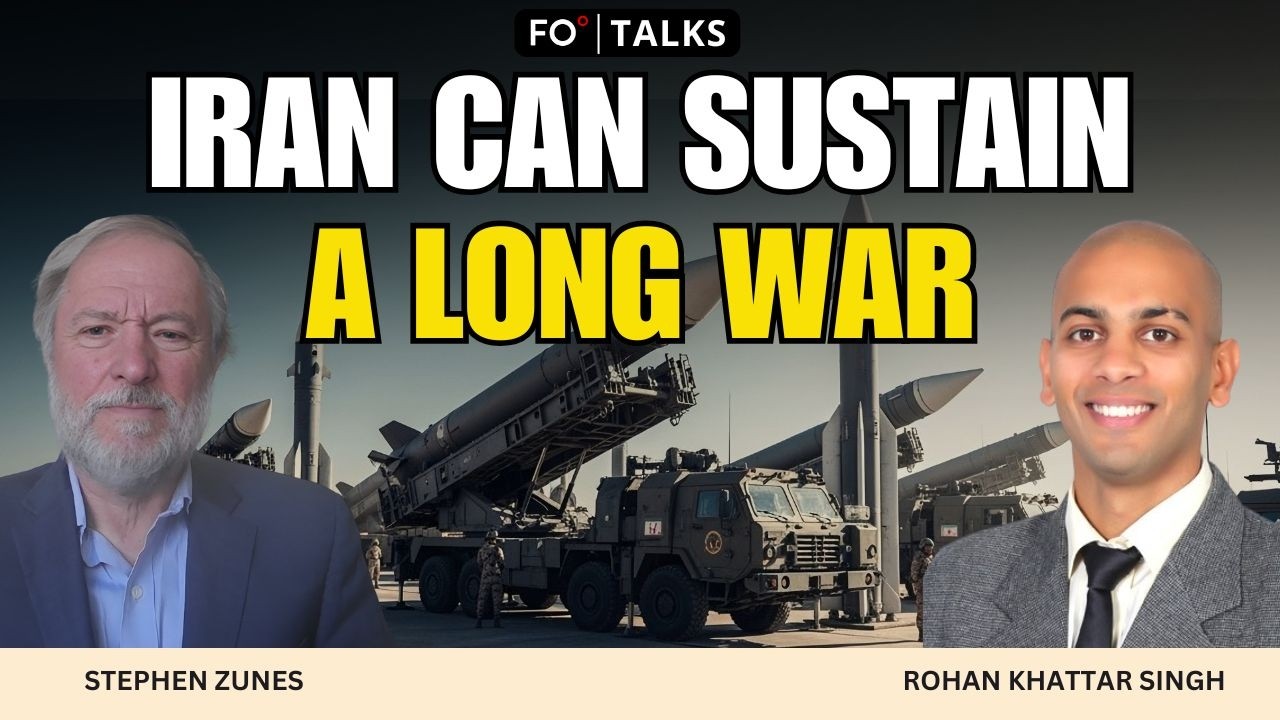
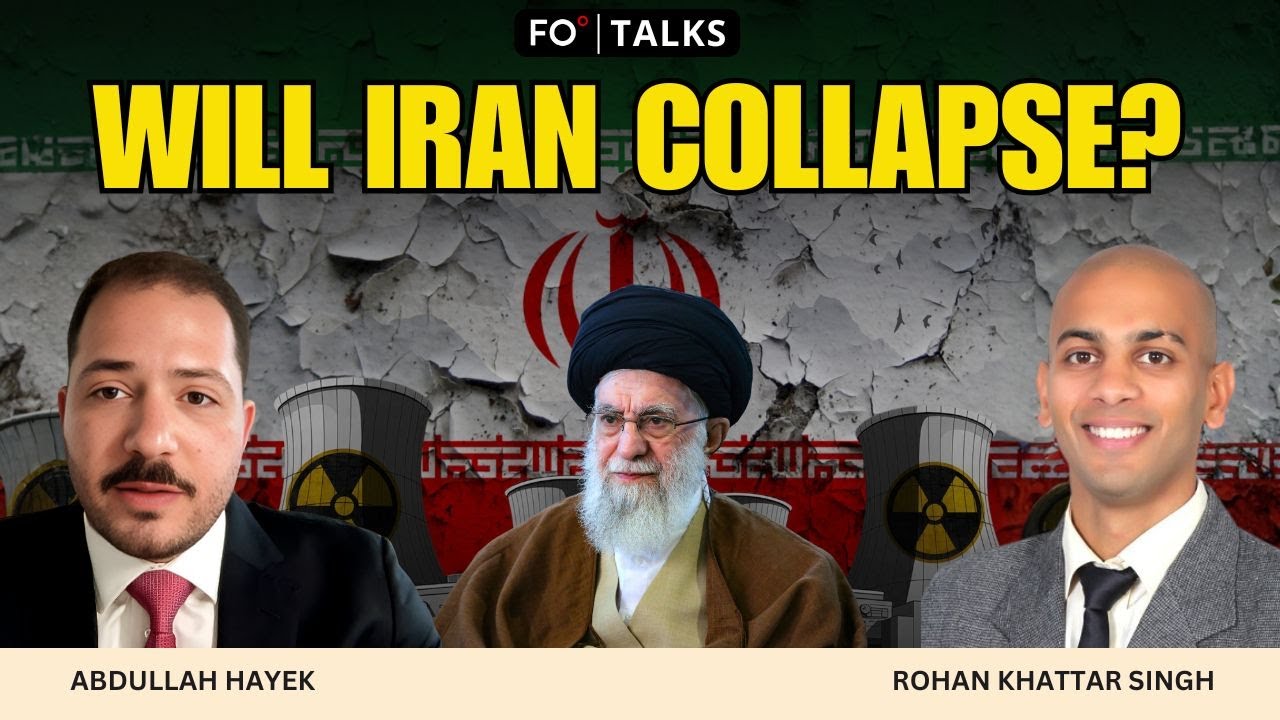
Fair Observer’s Video Producer Rohan Khattar Singh speaks with Stephen Zunes, professor of politics and director of Middle Eastern Studies at the University of San Francisco, as the United States and Iran enter a direct military conflict. Washington expected Operation Epic Fury, its February 28 joint attack with Israel, to destabilize the Islamic Republic and possibly trigger regime collapse. Instead, following the death of Iranian Supreme Leader Ayatollah Ali Khamenei, Iran has responded with missile and drone strikes against US bases and allied targets across the Gulf.
Khattar Singh and Zunes examine why the Trump administration may have misjudged Iran’s internal structure and resilience. Their discussion explores Iran’s military capabilities, the regional consequences of the war and the possibility that the conflict could settle into a prolonged war of attrition with global economic repercussions.
The limits of decapitation strategy
The conflict began with what the US described as precision strikes targeting Iranian leadership and military infrastructure. Some in Washington expected Khamenei’s death to create a power vacuum that might weaken or even collapse the regime.
Zunes argues that this expectation misunderstood how the Iranian political system actually works. Iran is not governed by a single leader whose removal would dismantle the state. Instead, the system functions through overlapping institutions that collectively sustain the regime.
“It’s not a matter of one-man rule where you could get rid of the bad guy and then things can open up,” Zunes says. He describes Iran as an oligarchic structure in which clerical authorities, state institutions and military organizations share power.
Perhaps the most important pillar of that system is the Islamic Revolutionary Guard Corps (IRGC). Over decades, the IRGC has expanded its authority far beyond military functions, controlling major sectors of the economy and embedding itself throughout Iranian political life. Even after the loss of senior commanders in US strikes, Zunes notes that the organization’s leadership network “runs pretty deep,” making regime collapse unlikely.
Geography and the limits of war
A large-scale ground invasion of Iran remains improbable. Unlike Iraq, where US forces advanced rapidly across open terrain in 2003, Iran presents formidable geographic obstacles.
Iran is roughly three times larger than Iraq in both area and population and is dominated by mountainous terrain. This geography alone makes conventional invasion extremely difficult.
“Iran is a very mountainous country,” Zunes explains. It is not a place where mechanized forces could simply “roll your tanks through.”
As a result, the conflict is likely to remain an air and missile war rather than a conventional invasion. Both sides are increasingly striking infrastructure and urban areas as the initial strategy of targeted attacks fails to achieve decisive results.
Retaliation and regional risk
Iran’s response has expanded the battlefield across the wider Middle East. Missile and drone attacks have struck US bases as well as facilities in allied states including Israel and the United Arab Emirates (UAE).
Zunes finds Iran’s targeting choices noteworthy. Although the UAE hosts relatively limited US military infrastructure compared with countries like Qatar or Bahrain, Iranian forces have launched multiple strikes against it.
He suggests that the UAE may represent something symbolic in Iranian calculations. “The UAE symbolizes some of the worst excesses of an Arab Islamic state, and its ties to global capitalism and the United States,” he says.
At the same time, many Arab governments have avoided joining the US-Israeli strike campaign. Despite possessing advanced Western weapons systems and large military budgets, states such as Saudi Arabia and the UAE have kept their distance from direct participation outside of their own defense.
According to Zunes, regional leaders recognize that their populations are deeply uncomfortable with the sight of thousands of Muslims being killed by a US-led coalition. Public opinion and fears of domestic unrest are therefore constraining their involvement.
A war of attrition
As the fighting continues, both sides appear increasingly locked in a struggle of endurance rather than quick victory. Iran has sustained significant losses, including the destruction of naval assets and repeated attacks on missile infrastructure. Yet the country continues to launch retaliatory strikes.
Zunes believes Washington underestimated Iran’s ability to sustain this type of conflict. “The United States grossly underestimated Iran’s military capabilities and its ability to continue firing missiles even after significant losses,” he argues.
Simultaneously, American forces face their own constraints. Missile defense systems are under pressure, particularly in protecting regional allies from Iranian ballistic missiles and drones. Both sides may therefore be hoping the other will exhaust key resources first.
In such situations, conflicts often end in what analysts call a “hurting stalemate” — when neither side achieves its objectives and the costs become unsustainable.
Economic shock and political fallout
Beyond the battlefield, the war is already affecting the global economy. Roughly 20% of the world’s oil supply ships through the Strait of Hormuz, which has become a central pressure point in the conflict. Iranian strikes on regional energy infrastructure and the threat to maritime traffic have already pushed energy prices higher.
Zunes warns that prolonged disruption could ripple across the global economy. Oil is not only essential for transportation but also for fertilizer, plastics and countless industrial processes. Rising energy costs could therefore contribute to inflation and economic slowdown worldwide.
Domestically, the war also carries political consequences for the US. Polling cited during the conversation suggests unusually strong public opposition to the conflict. Zunes notes how even controversial wars, like the 2003 invasion of Iraq, had majority support once they got underway. US citizens tended to rally around the flag and “support our troops,” only to decline as more American casualties mounted, the goals remained elusive and it became clear there was no end in sight. This is the first time there has been such strong opposition at the outset.
For Zunes, the larger problem is strategic rather than political. He argues that neither side can realistically achieve a decisive victory and that the war risks producing massive human and economic costs without a clear outcome.
In his view, this conflict resembles a natural disaster more than a traditional military campaign. Once unleashed, it may simply continue until both sides are exhausted.
[Lee Thompson-Kolar edited this piece.]
The views expressed in this article/video are the author’s own and do not necessarily reflect Fair Observer’s editorial policy.

































Comment