


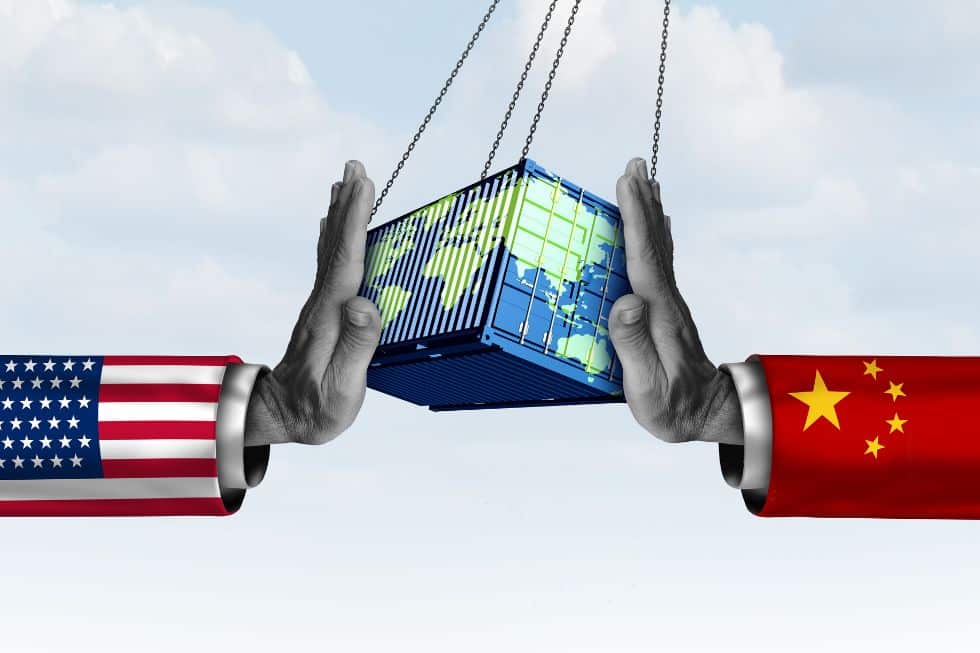



The US is in the grips of a trade war, battling against a resurgent Asian economic power. This Asian economy’s undervalued currency, formidable manufacturing capacity and unfair trade practices are driving its trade surplus with America to unconscionable levels. Moreover, this Asian power is moving up the manufacturing value chain, producing automobiles and electronics that rival those made in America. To support economic growth at home, this Asian economy is “dumping” its goods at artificially low prices across world markets. In response to these dynamics, the US is pursuing a raft of protectionist policies to address the growing competitive threat.
This scenario reads like a summary of the current US-China trade war, but it is actually a recounting of the 1980s US-Japan trade war. The uncanny similarities between the two trade wars reveal that little has changed in America’s strategy for addressing economic competition. With Japanese per capita GDP growing at an average rate of 7.1% between 1945 and 1956, Japan’s rapid post-World War II (WWII) growth and recovery led many Westerners to assume that it would one day overtake America as the world’s largest economy.
In a 1989 collection of essays on international finance, economics professors John Charles Pool and Stephen C. Stamos, Jr. claim that “new economic power blocs seem certain to assume world economic leadership early in the next century. Of these, Japan provides the most dramatic example.”
Although such predictions never fully materialized, America took the Japanese threat seriously. During the Reagan administration, a number of agreements were made with Japan to soften the impact of Japanese imports on the American economy; the most important being voluntary export restraints that placed quotas on imports of Japanese automobiles, steel, and machinery, the Plaza Accord — which strengthened the yen relative to the dollar to make Japanese imports artificially more expensive — and a semiconductor agreement that imposed a price floor on Japanese semiconductors sold in America and partially opened up the Japanese domestic semiconductor market to foreign companies.
The high-stakes sequel: unilateralism and the break from the Japan model
Given China’s emergence as an economic superpower in the early 2000s, it has supplanted Japan in observers’ minds as the most palpable threat to American world economic leadership, and predictions of when China might take America’s place as the largest economy in the world have become commonplace. The US’s response to the Chinese economic threat is largely identical to its response to Japan in the 1980s — a rising trade deficit with a fast-growing foreign power stokes protectionist sentiment at home and yields policies targeted at slowing that power’s growth both in the US and globally.
Unlike Japan though, China’s unwillingness to cooperate with American attempts to curb exports has resulted in more unilateral efforts by the US to achieve a balanced trade relationship with China, namely through tariffs, initially on certain products (steel, electric vehicles, etc) and then on all Chinese exports (US President Donald Trump’s “Liberation Day tariffs”), as well as through outright export bans of certain products on national security grounds.
An additional aspect of the US-China trade war absent from the Japan case is China’s reciprocal tariffs on American imports and other retaliatory trade actions, which have impacted American soybean exports, for example, and China’s rare earth licensing regime that limits rare earth exports to America, demonstrating China’s rare earth supply chain dominance.
Although the policies may differ in form, they are the same in substance and intent. In the US-Japan case, it was not protectionist policies that kept the American economy ahead of Japan’s, and such policies are not likely to have a decisive impact in the US-China case, either. Japan’s prolonged economic recession, driven by the unwinding of a real-estate bubble throughout the 1990s, is what prevented it from moving past America’s economy, and despite the recent bursting of a similar real-estate bubble in China, driving persistent deflation and dragging investment and consumption down, the economy continues to grow due to strong exports to the rest of the world.
The cost of contention: why fighting for number one may not be worth the price
American tariffs on Chinese products have simply rerouted Chinese manufacturing through third-party countries and integrated Chinese supply chains more deeply with other parts of the world. Notwithstanding a similar years-long recession that irreversibly stunts Chinese economic growth, American trade policy’s current stance on China will only provide a brief reprieve to Chinese competition for certain sectors of the American economy, which makes them and the broader economy ultimately less competitive in the long run.
On the contrary, if the US’s objective is to fend off the Chinese challenge for the title of the world’s largest economy, it must imitate what Japan and China did to become such formidable economic competitors in the first place — namely embrace supply-side economics and focus on the growth of production and exports not through tariffs or quotas on other countries, but through fiscal policy aimed at subsidizing and stimulating manufacturing output and exports.
Whether such a plan is in America’s best interests, though, is unclear given the trajectory of the American economy away from such activities, the competitive advantage and inertia in such activities already accrued in China and other emerging markets over the last few decades, and the staggering amounts of debt that such a plan would likely require.
If the US could learn to live with being only the second largest economy in the world behind China, the country would benefit from no longer needing to look over its shoulder and would instead be free to focus its efforts on ultimately more meaningful indicators of economic success, like striking an appropriate balance between the supply- and demand-side, resolving the growing debt crisis, reducing economic inequality, and developing economic and supply chain resilience. After all, as a Japanese economic researcher put it during the height of the US-Japan trade war, “being number 2 is really quite pleasant.”
[Ainesh Dey edited this piece]
The views expressed in this article are the author’s own and do not necessarily reflect Fair Observer’s editorial policy.
Lines of Power: Resilience Defines the US and China’s Futures
US President Donald Trump’s latest attempt to balance confrontation and conciliation with Beijing reveals the evolution of US–China relations into...
FO° Exclusive: China’s Purges, Japan’s Far-Right and America’s Gamble: The New Asian Order
In this section of the October 2025 episode of FO° Exclusive, Atul Singh and Glenn Carle examine East Asia’s shifting...
In Trade Rivalry With the US, China Will Not Become Another Japan
China, which enjoys a hefty trade surplus vis-à-vis the US, is paying attention to history. Back in the 1980s, a...
Semiconductor Tech Is a New Battlefield in the US–China Rivalry
The growth of technology has brought with it an accelerating battle over some of its most potent products: semiconductors. The...

Support Fair Observer
We rely on your support for our independence, diversity and quality.
For more than 10 years, Fair Observer has been free, fair and independent. No billionaire owns us, no advertisers control us. We are a reader-supported nonprofit. Unlike many other publications, we keep our content free for readers regardless of where they live or whether they can afford to pay. We have no paywalls and no ads.
In the post-truth era of fake news, echo chambers and filter bubbles, we publish a plurality of perspectives from around the world. Anyone can publish with us, but everyone goes through a rigorous editorial process. So, you get fact-checked, well-reasoned content instead of noise.
We publish 3,000+ voices from 90+ countries. We also conduct education and training programs
on subjects ranging from digital media and journalism to writing and critical thinking. This
doesn’t come cheap. Servers, editors, trainers and web developers cost
money.
Please consider supporting us on a regular basis as a recurring donor or a
sustaining member.
Will you support FO’s journalism?
We rely on your support for our independence, diversity and quality.





Comment