



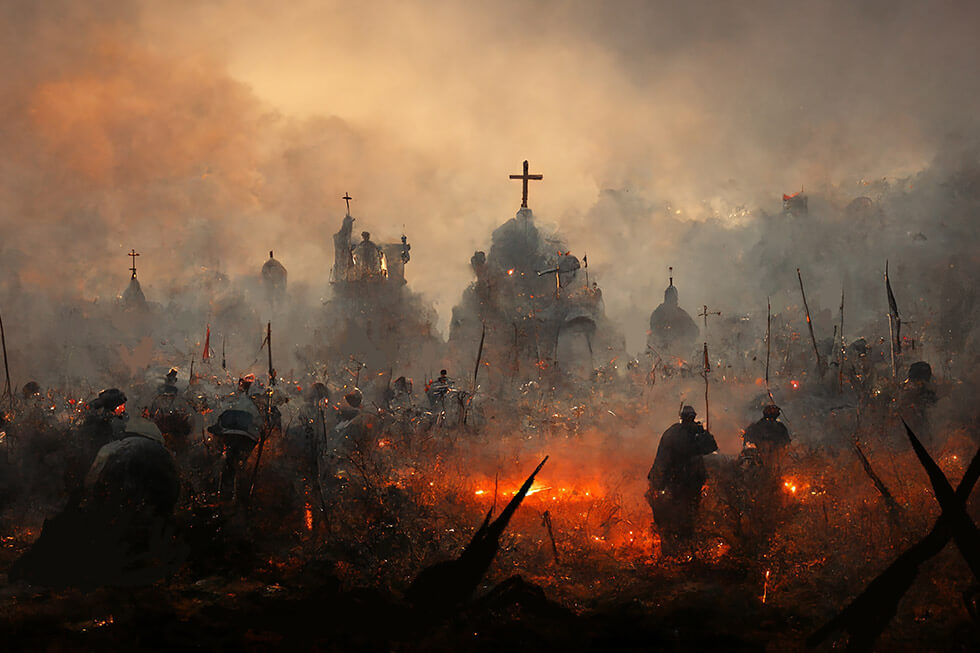



About a week after 9/11, US President George W. Bush declared, “This crusade, this war on terrorism, is going to take awhile. And American people must be patient.” It certainly did last a while. But no historian I’m aware of has proposed a specific date marking the end of Bush’s “war on terrorism,” which later became officially known as the “Global War on Terror” (GWOT). Because the concept itself, like the equally famous “Axis of evil” appeared so closely identified with one president’s specially creative psyche, we might somewhat mechanically assume that the GWOT ended in January 2009, when the daring war president was succeeded in the Oval Office by the first of two the 21st century’s self-proclaimed “peace presidents:” Barack Obama. The second, of course, was Donald Trump.
Looking into the records, a better proposal for the date of the GWOT may be February 12, 2012. That’s when, during Obama’s first term, Jake Sullivan, the State Department’s Director of Policy Planning, informed his boss, Secretary of State Hillary Clinton, that “Al-Qaeda is on our side in Syria.” A mere decade after Osama Bin Laden’s attack on New York’s World Trade Center and the Pentagon, Sullivan could affirm that the group guilty of traumatizing the entire country had now become a precious ally.
Even with Al Qaeda on our side, all was not well. Not only had ISIS emerged, Iran was deemed the world’s greatest sponsor of terror. Obama, the peace president, having “solved” the Libya question in 2011 by launching a war and removing a dictator, Muammar Gaddafi, still had Iraq, Syria and Iran to deal with.
On July 14, 2015, the United States, Europe, China and Russia signed the Joint Comprehensive Plan of Action putting an end to the threat of Iran, one of the three partners of the Axis of Evil. We now know only too well how fleeting that moment of tranquillity was destined to become.
The following year, real estate tycoon and television entertainer Donald Trump was elected president of the US. He wasted no time tossing the “Iran deal” in the scrapheap of history’s “bad ideas.” As a peace through strength president, he wanted to prove that the spirit of the crusade was still alive. Even if there was no need for overtly warlike action, he could focus on details such as assassinating Qasem Soleimani, the Iranian commander who had been Washington’s most effective ally in its ongoing crusade against ISIS in Iraq and Syria.
By January 2021, when Democrat Joe Biden moved into the Oval Office to replace Trump, the outgoing but defiant commander-in-chief began his four-year campaign to convince Americans anew that because he was angelically committed to peace, he deserved a second term. He cited the truly exceptional fact that during his first term, in contrast with all recent presidents, he hadn’t initiated any new wars. That was true. Instead of starting a new war, he had been content simply enjoying the inertia of the forever wars in Afghanistan and Iraq that fellow Republican Bush had bequeathed him.
The lesson we can draw from the history of our century’s war on terror is simple. When it comes to US foreign policy, nothing appears to be unambiguously certain. War can be peace; peace can be war. “Fair is foul; foul is fair,” as Macbeth’s witches observantly taught us.
On February 28, we had a new demonstration. “No wars” Trump, for the second time during his second term, without warning, interrupted ongoing negotiations with the Iranians, this time to decapitate their leadership. This should not be seen (according to him) as an act of unprovoked aggression because he did it “to defend the American people by eliminating imminent threats from the Iranian regime, a vicious group of very hard, terrible people.” We can read that last phrase as an updated gloss on Bush’s “axis of evil.”
Religion finally trumps ideology
Americans and Europeans remember the wars of the 20th century as moments of great heroism that could on occasion be exceptionally brutal. World War I and World War II stood as the most memorable, but the Cold War achieved a nearly similar status. Those wars all held one thing in common: The victors justified them on ideological grounds, whether or not that was the true cause.
WWI began in ambiguous circumstances with the breakdown of formerly complicit relations among European colonial powers. When things got out of hand, US President Woodrow Wilson not only saved the day but inaugurated a great tradition by defining the stakes. He taught our enlightened populations that there’s something pernicious in the world opposed to our noble concept of democratic governance. It was all about defending ideals, not gaining an advantage. According to Wilson, the US and its allies had embarked on “making the world safe for democracy.”
From that point on, the justification of any new war came to be the need to defeat a designated group of “hard, terrible people,” as Trump describes the latest enemy. The Nazis, Viet Cong, the Taliban, Islamist terrorists. The name of the groups might change, but creating the perception of the enemy as a hard, terrible people opposed to Western style democracy became the basis for war propaganda. For Trump in the latest iteration, the collective enemy that deserves the horror of carpet bombing is the population living under a specific theocratic regime in ancient Persia.
Throughout most of the 20th century, the defense of the “true” tradition of Western civilization was formulated not as the fault of a people, but of an ideology. The enemies had names associated with political worldviews: fascists, communists, Nazis, radicals, anarchists and — why not? — even the more generally mild-mannered socialists (guilty not of being hard and terrible, but of being “collectivist,” a severe moral failing based on their supposed ignorance of hard economic reality).
In his 2000 presidential campaign, George W Bush lamented the fact that, after the collapse of the Soviet Union, there was no apparent ideological enemy to motivate us to warlike heroism.
“When I was coming up, it was a dangerous world, and you knew exactly who they were. It was Us v. Them, and it was clear who ‘Them’ was. Today, we are not so sure who the ‘They’ are, but we know they’re there.”
It didn’t take him long, once he was in office, to identify “Them” as an undefined population that could be summed up in a single word “terror,” against whom all decent, civilized people must commit to wage war. The new enemy happened to have a religious identity — Muslim — but Bush quickly reassured us that, even though it was a crusade, it wasn’t about theology. It was about uncivilized behavior conducted by people whose minds were contaminated by a misperception of reality. They “hate us for our freedoms” Bush explained. They simply happened to be Muslim and were deemed to have a taste for hoarding weapons of mass destruction (until we found out there were none). He took the trouble to make an important distinction: “The face of terror is not the true faith of Islam… Islam is peace. These terrorists don’t represent peace. They represent evil and war.”
See no evil, or see evil everywhere?
As noted above, the War on Terror ran out of ideological steam about the time we could no longer decide whether Al Qaeda was with us or against us. Biden, Sullivan’s new boss, following Trump’s loss of the 2020 election, redefined Bush’s “Them” as “the autocrats” vs. us, “the democrats.” That enabled him to leave the question of ideology and Islamist terror behind him and focus not on ideas but on real evil-doers, such as Russian President Vladimir Putin and Chinese President Xi Jinping. That correlated with a new way of seeing the world: a Hollywood way. It created the expectation that if you could take out the evil leader, you could eliminate evil itself.
What better indicator of that successful transition than the fact that it was under Biden that the Syrian question was finally resolved by taking out the clearly evil dictator Bashar al-Assad? And they accomplished this by supporting and celebrating a new president, Ahmed al-Charaa, a man who had distinguished himself as a heroic former leader of both Al Qaeda and ISIS.
So where do we go from here? Most people until this epic year of 2026 had acquired the habit of thinking that wars of religion are a thing of the distant past. By the time the 18th century rolled around, we were already used to wars between nation states instead of religious denominations. In the 20th century, wars could be safely conducted between ideological adversaries.
Now we are at a new turning point. Trump, the peace president, sees an interest in making war great again by returning to the earlier paradigm of wars of religion. He has done so by teaming up with Israel and mobilizing an army led by selected generals familiar with the prophecies of the New Testament’s hallucinatory Book of Revelation. And he has set his sights on taking down the apostate theocratic regime that since 1979 has controlled the territory of ancient Persia. Trump has offered the world (centered on the Strait of Hormuz) an authentic latter-day religious war, something Europeans and Westerners in general haven’t seen since the Treaty of Westphalia in 1648.
This time, it’s the real thing. A Jewish theocracy teams up with a powerful, officially secular nation that has nevertheless thought of itself since its very beginnings in 1620 as the New Jerusalem. They have pooled their resources to attack a rigorous Shiite Muslim theocracy. Things couldn’t be clearer, even on the US side, despite its e pluribus unum mantra. When things get rough and swords are drawn, the unum (one) triumphs over the pluribus (many).
Throughout his political career, the secular but nominally Roman Catholic Biden consistently declared himself a Zionist. During his presidency, he proved it by generously providing the wherewithal for Israel to wage its genocidal campaign designed to depopulate the Palestinian community. But Biden could only go so far. Unlike Trump, Sleepy Joe had lost the connection with the wide awake (but clearly not woke) people who really mattered: Christian Zionists.
That connection has now been reestablished with brio. Trump holds all the reins and knows how to pull in one direction or another, with no need for assistance except from Heaven itself (apparently embedded in his brain). No need to consult Congress or convoke the United Nations Security Council. Why even think of informing his NATO allies, who could potentially be directly concerned? Trump has the moral stature that has plugged him directly into what Americans like to call the Judeo-Christian tradition, a controversial and ahistorical concept if ever there was one, but always serviceable in times of conflict. He has magisterially plugged himself into that tradition by launching what historians are likely to call the first genuinely Judeo-Christian Zionist war.
In the spectacular, unprovoked assault called Operation Epic Fury, Trump’s recently rechristened Department of War under Head Warrior Pete Hegseth achieved its initial goal of Operation Epic Fury with exceptional prowess by simultaneously taking out Supreme Leader Ayatollah Ali Khamenei and 165 dangerous schoolgirls. An uncontested success certain to provoke jealousy among the weak-minded.
Some have mockingly referred to it as “Operation Epstein Fury.” They do so on two grounds. The US–Israel tandem, a kind of “coalition of the willing to conduct blackmail when needed to stabilize things” brings together people with bold ideas and few inhibitions, including Trump himself, who have at various times shared “good times” with pedophile Jeffrey Epstein himself. And a poll this week shows a majority of Americans entertain the idea that Trump launched the war to push the Epstein files out of the news headlines.
Of course, referring to the campaign as Operation Epstein Fury — which seems to me a pretty appropriate and effective joke — has been predictably qualified as antisemitic. The Washington Post published an article calling the joke an act of “conspiratorial rebranding.” The Post’s journalists clearly expect us to agree with the proposition advanced by the Anti-Defamation League that conspiratorial actions are evil and ipso facto the work of the devil.
Speaking of branding people, ideas or nations as evil, this Devil’s Advocate happened upon a Substack column with the title, “Iran as ‘the evil one,’” by former Herald Tribune journalist Patrick Lawrence. He reminds us of what most Americans should be thinking about in the weeks following the launch of a new US war: “Not for the first time, America does not know what it is doing or why it set out to do it.” A bit like Eve in the Garden of Eden, who didn’t realize what was going on but followed the advice of the evil serpent. We’ve seen the same scenario play out, with interesting variations, in Vietnam, Afghanistan, Iraq, Libya, Syria and elsewhere. The usual assessment has been that these lengthy and fruitless campaigns made perfect sense at the outset — evil must always be combated, it’s the nation’s moral duty — but over time they all turned out to be badly planned or their aftermath poorly executed.
This time, however, all will be well. The Christian Zionists are sure of that because everything lines up with what the Apostle John so clearly laid out in the Book of Revelation, announcing the Second Coming of Jesus. One US commander has been quoted as explaining to his troops that “President Trump has been anointed by Jesus to light the signal fire in Iran to cause Armageddon and mark his return to Earth.” The soldiers immediately consulted their manuals on lighting a signal fire.
A somewhat more level-headed man, William Butler Yeats, alas with no military training, had a different take on the Second Coming in a poem he published in 1919. The great Irish poet described the state of humanity in the leadup to the Second Coming:
“The best lack all conviction, while the worst Are full of passionate intensity.”
Living in our aging and some say declining Western world — specifically here in Europe — I tend to agree with Yeats. I see the first line as accurately describing our European leaders. The second line even more aptly portrays Trump, his intimates in the Oval Office and Hegseth’s War Department on the other side of the Atlantic.
*[The Devil’s Advocate pursues the tradition Fair Observer began in 2017 with the launch of our “Devil’s Dictionary.” It does so with a slight change of focus, moving from language itself — political and journalistic rhetoric — to the substantial issues in the news. Read more of the Fair Observer Devil’s Dictionary. The news we consume deserves to be seen from an outsider’s point of view. And who could be more outside official discourse than Old Nick himself?]
[Lee Thompson-Kolar edited this piece.]
The views expressed in this article are the author’s own and do not necessarily reflect Fair Observer’s editorial policy.
Europe, Iran and the New Face of American Power
Europe’s diplomatic influence on Iran has sharply declined since the US withdrew from the Joint Comprehensive Plan of Action and...
FO Talks: Iran War — Former Israeli Negotiator Josef Olmert Explains What Comes Next
In this episode of FO Talks, Atul Singh and Josef Olmert examine the escalating Iran war and the strategy behind...
For Historians, Was This a Pearl Harbor or a Suez Moment? Part 4
Given the gravity of events, are we permitted to laugh at the absurdity of US President Donald Trump’s rhetoric in...
Force Without Legitimacy: Bombing Iran Will Not Produce Regime Change
The US-Israeli strike campaign against Iran aims to topple the regime but overlooks the resilience of Iran’s authoritarian power structure,...
Iran and Israel: In Conclusion, There’s No Conclusion
When all wars are planned to be endless, nothing can be concluded, either by negotiation or by recognition of an...
Support Fair Observer
We rely on your support for our independence, diversity and quality.
For more than 10 years, Fair Observer has been free, fair and independent. No billionaire owns us, no advertisers control us. We are a reader-supported nonprofit. Unlike many other publications, we keep our content free for readers regardless of where they live or whether they can afford to pay. We have no paywalls and no ads.
In the post-truth era of fake news, echo chambers and filter bubbles, we publish a plurality of perspectives from around the world. Anyone can publish with us, but everyone goes through a rigorous editorial process. So, you get fact-checked, well-reasoned content instead of noise.
We publish 3,000+ voices from 90+ countries. We also conduct education and training programs
on subjects ranging from digital media and journalism to writing and critical thinking. This
doesn’t come cheap. Servers, editors, trainers and web developers cost
money.
Please consider supporting us on a regular basis as a recurring donor or a
sustaining member.
Will you support FO’s journalism?
We rely on your support for our independence, diversity and quality.





Comment