



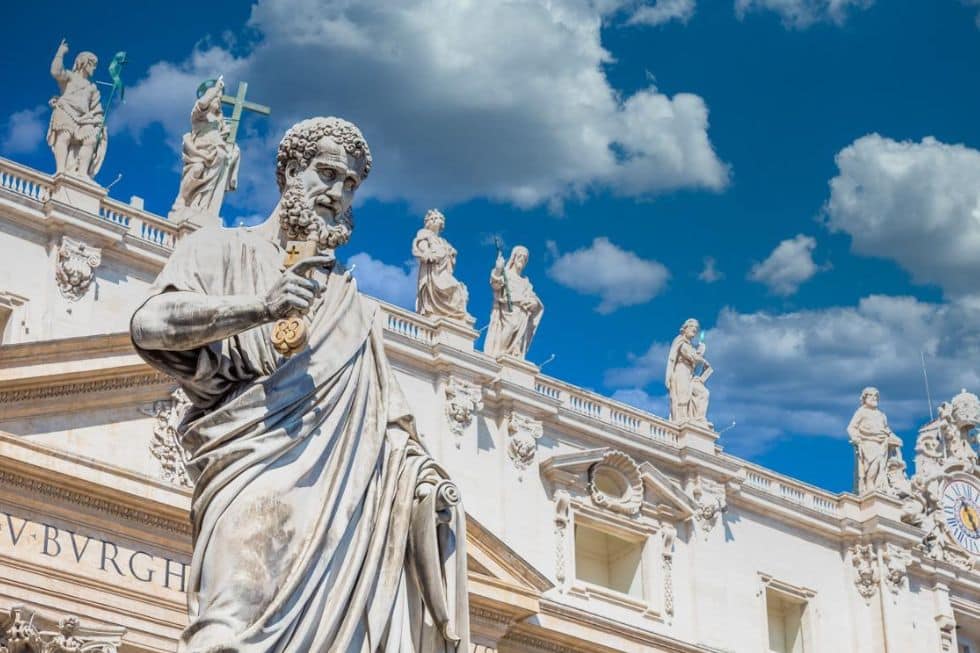



This Devil’s Advocate is worried. My professional activity requires the emergence of recognizable personalities who exhibit saintly behavior. Like a recruiter in a modern enterprise, my job is to weed out the weak candidates, note the flaws in their CV, and thereby permit the truly performing ones to become identified and vetted. The trend in emerging saints has been on a downward spiral for decades.
It used to be common, even while watching the evening news, to hear of someone in the public eye with a claim to angelic or saintly behavior. It didn’t have to be religious. There was a kind of civic culture that had taken over from the ecclesiastic order that had reigned in former times.
These secular saints might have entered the news cycle or our space of cultural consciousness through acts deemed to serve the local community, mankind in general, sickly children or just their own family. They might even be incarnated as cartoon characters, as different as “Popeye the Sailor Man,” a working-class hero, or global guardian Superman, aka reporter Clark Kent (also a working man). They embodied and defended shared ideals in the community. In the modesty of their daily lives, they put on a display of unquestioned though largely banal virtue.
In some sense, both the fictional and real heroes of the past — Helen Keller, Mahatma Gandhi, Martin Luther King Jr. — perpetuated an essentially religious tradition that still persisted in the late 20th century but has clearly been surpassed today.
Whereas most people are in some sense aware of the progressive secularization of Western nations, not everyone today, especially among the younger generations, realizes how quickly that transformation has occurred and how deep its effects have been. Those of us old enough to remember what should now be called “the former world order” should be able to understand that what we’re talking about is the wholesale remodelling of our shared value system.
A time for comparative historical ethics
Just think of the choices and even the everyday decisions people routinely made 50 years ago and compare them with today’s behavioral norms. There are acts we see today, in the age of US President Donald Trump, that people in a position of power half a century ago would have hesitated to engage in. We entertain ideas today that no one would have dared express in former times due to their fear of being perceived as too bold, pushy or unjustifiably audacious.
At the top of the list of formerly unperformable acts are ones such as overtly taking advantage of someone else’s weakness. Covert acts could pass muster, provided they took place within the framework of institutional norms. That might, for example, include overthrowing a democratically elected leader in a smaller country or working out deals to extract another population’s wealth.
Today, people in the same elite social category are more likely to feel ashamed of failing to be adequately assertive. They will be blamed for not doing “what’s natural.” We now understand that human nature includes not just the urge to grab, control and exploit whatever is “there for the taking,” it can and should include a complementary virtue: the capacity to act. We have finally overcome the Hamlet syndrome!
The idea of “what’s natural” has a long, complicated history in the West. Many acts we today consider “gross” were once considered natural. For centuries, Europeans deemed it natural to eat with one’s hands, as Indians do to this day. The same Westerners who thrive on handheld sandwiches feel disgust at the idea of seizing cooked food from a plate with their fingers. In his book The Psychopathology of Everyday Life (1901), Sigmund Freud expressed his indignation at discovering a staircase that had no spittoons.
Religiously derived ethics
Established religious morals and the “rule of law” have one thing in common: people spend an inordinate amount of time finding ways to contravene them, even while believing to variable degrees that they are the key to civilized life and social stability.
Apart from fanatical Puritans or dedicated students of Emmanuel Kant’s ethics, few people in the lands formerly known as Christendom have sought to align their behavior rigorously with Yahweh’s celebrated gift to Moses: the Ten Commandments. Until very recently, all educated heirs of the European tradition were keenly aware of the prominent place the Ten Commandments held in their culture. Obeyed or ignored, they served as a general reference for idealized social interaction. The Decalogue defined a kind of abstract ideal, or at the very least a vague set of guidelines concerning acceptable, which is to say normal social relations.
No one — not even the Catholic church — expected the Ten Commandments to rule an average citizen’s everyday behavior. Why, after all, install a confessional in churches and assign hours to the priests if people never have anything to confess? Catholic saints — those who withstand and survive the Devil’s Advocate’s inspection — emerge as an exclusive community of people who elevate themselves above the rest of humanity by respecting the spirit as well as the letter of the law. However committed they are to a virtuous life, they confess. One famous saint (Saint Augustine) published a book titled Confessions, a pillar of Western culture. Any self-respecting Devil’s Advocate would cast serious doubt on the canonization dossier of a proposed saint who never confessed.
Honored as much in the breach as in the observance, the Ten Commandments nevertheless have long constituted a kind of backdrop framing for our social order. Its famous locution, “Thou shalt not,” echoed across centuries, inducing an awareness of something that couldn’t be ignored even when not obeyed. It defined a specific area of moral agency in the human psyche that tested our ability to avoid succumbing to temptation. Not because temptation wasn’t worth occasionally succumbing to, but because it represented something everyone seemed to agree we’d rather not talk about in public. Moral decision-making is always fraught with ambiguity. It’s the uncertainty that keeps our awareness of the stakes alive.
Taking stock of the change
US culture, in particular, has practiced a 180° on that one. In our media, both mainstream and social, we now delight in narratives that recount how boldly succumbing to various temptations has become some people’s pathway to success. How many corporate conquerors today aren’t pleased and gleamingly proud to recount in private how cleverly they maneuvered to crush competition or found devious ways to circumvent unnecessary laws?
In a column last year, I cited the inspiring professional advice former Google CEO Eric Schmidt shared with an audience of young Silicon Valley engineers:
“Make me a copy of TikTok, steal all the users, steal all the music, put my preferences in it, produce this program in the next 30 seconds, release it, and in one hour, if it’s not viral, do something different along the same lines.”
He followed this up by explaining:
“If it took off, you’d hire a whole bunch of lawyers to clean up the mess. But if nobody uses your product, it doesn’t matter that you stole all the content.”
I doubt that even the boldest of entrepreneurs 50 or 60 years ago would have been tempted to think such a thing, but even if they had, they would never have expressed it. “Thou shalt not steal” meant not only that you probably wouldn’t get away with it, but that if you were mad enough to try it and succeed, you would almost certainly become a social pariah.
We live today in a different world, one that has elevated success, usually measured by wealth, to the top of our hierarchy of values. We no longer formulate values as necessary constraints. Instead of the negativity of “thou shalt not,” we now frame our values in a very positive way, presenting them as goals to pursue on the road to success rather than rules to respect or behaviors to work out interactively with others.
The Calvinists who played a major role in shaping Western culture between the 16th and 19th centuries saw success as an indicator of virtue. Even if excessive wealth and resounding success were achieved through manifestly unvirtuous means — genocide and slavery, for example — the emerging capitalist-colonial culture had devised ways of repressing thoughts about cause and effect. Even if there were the occasional moments of clarity, whether or not accompanied by pangs of guilt, one would never be vain enough to broadcast that knowledge the way Schmidt did.
Another example, this time from the political realm, highlights the radicality of the transformation. Trump’s Secretary of State Mike Pompeo, in April 2019, coolly vaunted to a group of students in Texas his own conversion (something of the opposite of Augustine’s) in these words:
“When I was a cadet, what’s the cadet motto at West Point? He will not lie, cheat or steal, or tolerate those who do. I was the CIA director; we lied, we cheated, we stole. It’s like we had entire training courses.”
Whether it’s commercial, financial or political, success turns out to be an extremely convenient “supreme value.” It functions as a common denominator, justifying extreme virtue as well as abject criminality. Saints can be successful at what they do, but so can sinners, and the latter often more efficiently. Success can be many things, ranging from a singer who sells multiple gold records to an entrepreneur who launches a new, innovative gadget that brings some form of unanticipated and often unnecessary convenience to our lives. But even more impressively, it can occur thanks to the skills of a genius who has mastered the art of building, managing and enforcing a predatory monopoly that guarantees its founders will become multibillionaires. That wealth then provides them with the clout required to influence every important political decision in any of our democracies. Success breeds success.
At this moment of history when the leaders of Christendom (i.e. Europe) are jumping through hoops as they seek literally — according to Belgian bankers and the nation’s prime minister — to steal hundreds of billions of dollars of Russian assets in the name of assisting a victim of aggression and prolonging a brutal war in which other people are dying, it’s definitely time to ponder how our scale of civilizational values has evolved in the recent past and continues to evolve towards an uncertain future.
*[The Devil’s Advocatepursues the tradition Fair Observer began in 2017 with the launch of our “Devil’s Dictionary.” It does so with a slight change of focus, moving from language itself – political and journalistic rhetoric – to the substantial issues in the news. Read more of The Fair Observer Devil’s Dictionary. The news we always consume deserves being seen from an outsider’s point of view. And who could be more outside official discourse than Old Nick himself?]
[Kaitlyn Diana edited this piece.]
The views expressed in this article are the author’s own and do not necessarily reflect Fair Observer’s editorial policy.
Martyrs, Money and the Manufacture of Political Holiness
Can a politician ever truly be a saint, or even appear as one? From Nelson Mandela’s aura of sanctity to...

How to Make a Religion out of Money: Economists, the Priests of Capitalism
Capitalism is one of the world’s most popular religions. Its adherents strive to store up savings just like Christian monks...

Soul-Searching for America’s Broken Ethics
What would it take for America to become a better version of itself?

Support Fair Observer
We rely on your support for our independence, diversity and quality.
For more than 10 years, Fair Observer has been free, fair and independent. No billionaire owns us, no advertisers control us. We are a reader-supported nonprofit. Unlike many other publications, we keep our content free for readers regardless of where they live or whether they can afford to pay. We have no paywalls and no ads.
In the post-truth era of fake news, echo chambers and filter bubbles, we publish a plurality of perspectives from around the world. Anyone can publish with us, but everyone goes through a rigorous editorial process. So, you get fact-checked, well-reasoned content instead of noise.
We publish 3,000+ voices from 90+ countries. We also conduct education and training programs
on subjects ranging from digital media and journalism to writing and critical thinking. This
doesn’t come cheap. Servers, editors, trainers and web developers cost
money.
Please consider supporting us on a regular basis as a recurring donor or a
sustaining member.
Will you support FO’s journalism?
We rely on your support for our independence, diversity and quality.





Comment