


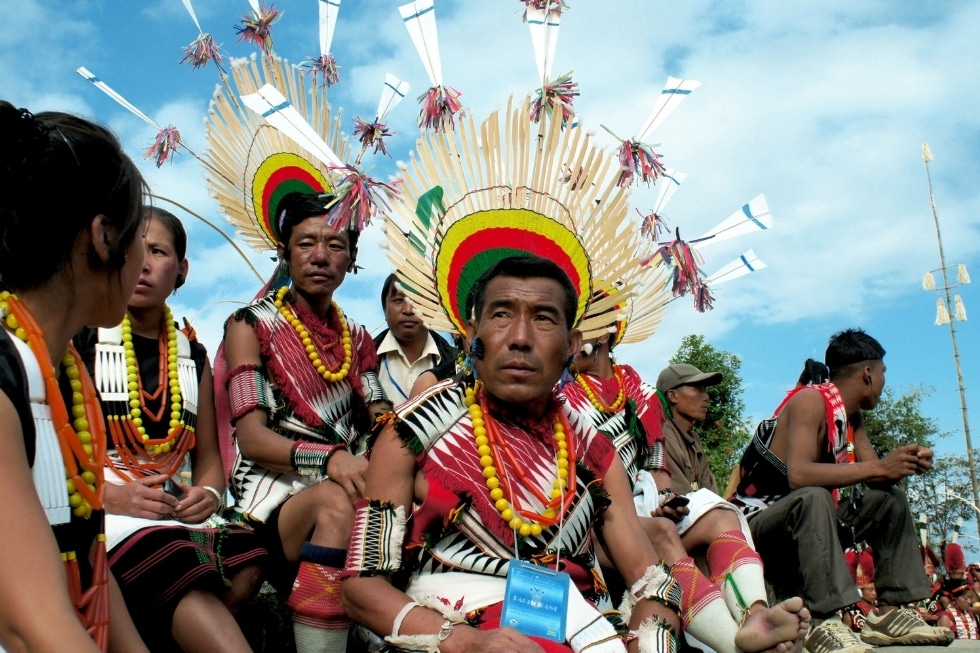


Tribeverse, a recently released Indian cultural-adventure reality show, raised a host of controversies. Marketed as a celebration of indigenous communities of the North-Eastern state of Nagaland, Tribeverse brought contestants to Nagaland to participate in challenges inspired by local culture and traditions. Debates arose when some of the most widely circulated clips featured contestants struggling to consume local food, visibly uncomfortable, or reacting with disgust, with some even calling the food “weird.”
Although framed as entertainment, these scenes did not sit well with Northeast Indian viewers. They felt less like cultural appreciation and more like a familiar experience of having their way of life treated as strange, exotic or even repulsive. Hence, the controversy surrounding Tribeverse is not simply about a reality television show. It is about a well-recognized pattern in India: celebrating diversity in principle while marginalizing certain cultures in practice.
The question, therefore, is not whether contestants are obligated to enjoy every dish they encounter. Everyone has foods they like and foods they dislike. The issue is why the discomfort of outsiders becomes the central story, while the culture itself becomes little more than a backdrop. The issue appears more glaring for a show originally intended to foster the inclusion of diverse indigenous identities and cultures.
A familiar hypocrisy
The show has been heavily criticized, most notably by Akishe L. Jakha, a film and media scholar from Nagaland. He explores how the show exploits Naga culture and exoticizes other Indigenous peoples. But what makes Tribeverse particularly of interest to me is the troubling hypocrisy it reveals. Indians are often quick to condemn racism abroad when Indian food is mocked. Yet in their own country, a show that treats Naga food as something disgusting, which contestants must endure as part of a challenge, gets approved.
As a North-East Indian living abroad, I have met many Indians from Europe, North America and elsewhere, who have grown up hearing their lunches described as “smelly,” “weird” or “disgusting.” Many recall being embarrassed to bring homemade food to school because they feared ridicule from classmates. Such experiences are rightly recognized as forms of prejudice. Food is deeply connected to identity, family and belonging. To mock someone’s food is often to mock the people themselves.
Yet similar attitudes frequently emerge within India. If it is unacceptable for outsiders to ridicule Indian food, why is it acceptable for Naga food to be treated as a test of endurance for television audiences? Why does disgust become entertainment when the target is an indigenous community within India’s own borders? These are the broader questions that Tribeverse speculates on.
Food as a marker of status
The answer lies in the fact that food in India has never been merely about taste. Food is also about status. Across the country, certain diets are often associated with ideas of purity, civility and respectability, while others are treated as inferior. Even apartments have often attempted to restrict the cooking or consumption of meat. “Vegetarian only” housing advertisements continue to appear in many cities, including large cities like Chennai.
Entire communities have historically faced discrimination because of what they eat. The hierarchy is rarely stated openly, but the message is clear: Some foods are seen as normal and cultured, while others are seen as backward or undesirable. These attitudes disproportionately affect communities whose diets differ from dominant social norms, including Dalits, Adivasis and many indigenous communities of Northeast India.
Growing up in mainland spaces within Assam
I experienced this dynamic firsthand growing up in Assam.
One of the schools I attended provided breakfast, lunch and evening snacks. Despite being located in Northeast India, the food served was overwhelmingly vegetarian and largely drawn from mainstream and mainland Indian cuisine. There was little recognition of the culinary traditions of the region in which the school itself was situated.
Thus, as a student, I often encountered negative reactions when I mentioned that pork was a staple food in my community. Some classmates and even teachers from mainland Indian backgrounds expressed disgust at the idea. I remember one teacher asking why my family did not cook the kind of foods they were accustomed to. The implication was subtle but unmistakable: Certain foods were normal, while others required explanation.
At the time, these moments seemed minor. Looking back, they reveal something larger about how cultural hierarchies are reproduced. In a way, schools become an entry point for the dichotomization of normative and derivative cultural patterns. Their primary function as educational hubs extends to a broader sociocultural practice of inclusion and exclusion. Hence, when institutions located in Northeast India fail to reflect Northeastern cultures, cuisines and traditions, they send an implicit message about whose identities matter and whose do not.
A different lesson, in France
Today, studying in France, I have found a contrast that often surprises me. I have shared meals with Muslim and Jewish friends who do not eat pork. When pork is served, they simply choose not to eat it. They do not move seats; they do not expect me to justify my food, nor do they react with disgust toward it.
The same is done by Hindus here when beef dishes are served. Respect does not require agreement. It requires co-existence. That lesson is not complicated. People do not need to eat the same food to share the same table.
What real inclusion looks like
This is why representation cannot be reduced to occasional celebrations of diversity or symbolic gestures. True inclusion requires treating different cultures as equally legitimate parts of the national community. That includes food. The apparent superiority of mainstream practices has to be consciously negated.
Children should grow up understanding that diversity is not limited to traditional clothing worn on cultural days or performances staged for special occasions. Diversity also exists in everyday life, in the languages people speak at home, the festivals they celebrate and the food they eat around their dinner tables.
Nobody’s food should be a punchline
The problem with Tribeverse is not that contestants disliked a particular dish. Rather, it is in the fact that it turned an entire culture into a spectacle of discomfort. In doing so, it reflected a broader reality that many indigenous communities in Northeast India know all too well: Being included in the nation often comes with the expectation that their cultures remain objects of curiosity rather than subjects worthy of equal respect.
The hypocrisy with which Indians react to their otherification has to be inculcated within. The nation cannot simultaneously condemn food shaming when directed at Indians abroad while normalizing it against their own indigenous communities at home. A genuinely diverse society is not one in which everyone eats the same food. It is one in which nobody’s food becomes a punchline.
[Ankita Dutta edited this piece]
The views expressed in this article are the author’s own and do not necessarily reflect Fair Observer’s editorial policy.
Wangchuk, Sharmila and a Tale of Two Hunger Strikes in India
Scientist and activist Sonam Wangchuk ended his 26-day hunger strike after Delhi Police forcibly hospitalized him. Days later, Education Minister...
Why Northeast India Remains Neglected and How to Fix It
When filmmaker Lakshmipriya Devi accepted a British Academy Film Award in London, she told the world that her home state...
Anjel Chakma’s Killing Exposes India’s Denial of Racism
The killing of Anjel Chakma, a young student from India’s Northeast, exposes the persistent denial of racism within Indian society...
Support Fair Observer
We rely on your support for our independence, diversity and quality.
For more than 10 years, Fair Observer has been free, fair and independent. No billionaire owns us, no advertisers control us. We are a reader-supported nonprofit. Unlike many other publications, we keep our content free for readers regardless of where they live or whether they can afford to pay. We have no paywalls and no ads.
In the post-truth era of fake news, echo chambers and filter bubbles, we publish a plurality of perspectives from around the world. Anyone can publish with us, but everyone goes through a rigorous editorial process. So, you get fact-checked, well-reasoned content instead of noise.
We publish 3,000+ voices from 90+ countries. We also conduct education and training programs
on subjects ranging from digital media and journalism to writing and critical thinking. This
doesn’t come cheap. Servers, editors, trainers and web developers cost
money.
Please consider supporting us on a regular basis as a recurring donor or a
sustaining member.
Will you support FO’s journalism?
We rely on your support for our independence, diversity and quality.





Comment