



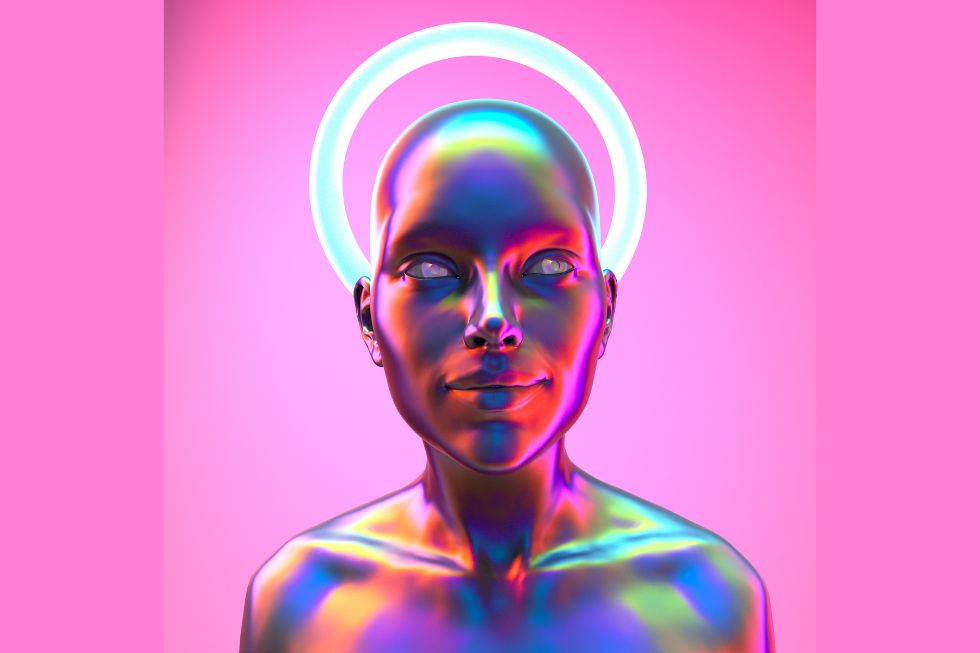


Our world needs a new definition of what it means to be a saint. The traditional Christian definition supplies only part of the meaning. We need to find ways of focusing on the true value of saints, who stand as moral exemplars and sources of inspiration for the rest of us, condemned to struggle with our own imperfections. We need to remind ourselves that in centuries past the impact of the lives of saints on the populations of Christian Europe had less to do with the idea of the saints’ devotion to the church than to their tangible connection with the sacred.
The church itself has become a marginal player in defining our civilization’s moral culture. It has been replaced by modern churches that celebrate new generations of sanctified personalities whom they hold up as examples to imitate. By “modern churches,” I’m referring essentially to the media. They have resolutely assumed the task of normalizing and spreading our civic and spiritual values in the form of what is meant to be taken as an original secular gospel. The ones they canonize tend to be celebrities who have achieved something exceptional in the material world and understand how to publicize their accomplishments. They have names like Elon Musk, Donald Trump, Michael Jordan, Steve Jobs, Warren Buffett, Mark Zuckerberg, Taylor Swift, Nelson Mandela, Oprah Winfrey and Muhammad Ali. Ali’s the only one with some kind of spiritual connection, which dated from his early days as a Black Muslim, but the media successfully airbrushed that side of his personality out of his image in the final decades of his life.
On the other side of the ledger we find people who have similarly reached the pinnacle of success but who no longer deserve our admiration. The excesses and moral lapses of these individuals have turned them into emblems of evil. The list includes names such as Bernie Madoff, Elizabeth Holmes, Sam Bankman Fried, Harvey Weinstein, Jim Jones and Robert Maxwell. And, of course, the most inglorious of them all, the one who continues to dominate the headlines: Jeffrey Epstein, worthily accompanied by Maxwell’s daughter, Ghislaine.
In the recent release of Epstein files, one document — a two-hour video interview conducted by Steve Bannon — stands out for what it allows the public to sense about the sexual predator’s personality. At the very end, Bannon clearly embarrassed Epstein when he impertinently asked him to confirm what many people believe about the man: the idea that the best friend of Andrew Mountbatten Windsor, Alan Dershowitz, Ehud Barack, Peter Thiel, Bill Gates, Bill Clinton, Donald Trump and, of course, Leslie Wexner was the devil himself. Epstein attempted to deflect a clear answer to Bannon’s question, but he leaves the impression that he himself may be wondering about the attribution.
This raises a question many people are asking and which the media has avoided addressing directly. In a world where so many people in positions of leadership and exercising great public responsibilities fail to recognize that they have been “supping with the devil” while forgetting to equip themselves with a long spoon, isn’t it time to focus on what distinguishes the devils from the saints? In other words, if there is a message for Silicon Valley, it should be this: We desperately need to invent a GPS capable of leading us to the address of some saints.
French novelist Marcel Proust highlighted the problem of identifying and recognizing saints in a world, such as Proust’s own, that was fascinated by the lives and fortunes of the elite.
Speaking of his family’s servant during his youth, the narrator tells us:
“…she [Françoise] possessed that saintly nobility of the sisters of charity who have suffered, who have lived for others, and who, in the very simple and yet impressive actions of their daily lives, show a grandeur that is not of this world, though they themselves are unaware of it.”
The world Proust wrote about literally called itself “the World” (le Monde) as if the privileged social circle of Faubourg Saint-Germain contained and summed up all human values worth talking about. Proust understood the logic of a culture that was fading, one that sought inspiration from the humble, and his series of novels documented the mentality and morals of a new “world” that would definitively replace the old one. It is a world that excelled in developing that special form of self-awareness we call narcissism. Should we be surprised today that our democracies almost invariably elect narcissists and that our media focus on the lives of those who have achieved celebrity?
Geolocating a new generation of saints
That GPS for sainthood may nevertheless finally be emerging. And it’s thanks to AI. In another column, I hope to find the opportunity to discuss a major phenomenon that no one seems to have noticed: the link between AI and narcissism. For today’s purposes I should simply like to highlight the fact that the hubris of AI labs may be the providential source for a new generation of saints.
The website Futurism recounts the personal drama of OpenAI’s economics researcher Tom Cunningham who claimed “that the economic research team was veering away from doing real research and instead acting like its employer’s propaganda arm.” That’s a strong claim considering AI labs present themselves as scientific laboratories. Propaganda, ever since the “father of public relations” Edward Bernays explained in detail, has been a concept shared by two privileged domains: politics and advertising. So how is it that an AI lab is not only stifling scientific research but dedicating itself to propaganda?
The same article cites other AI apostates: William Saunders, a former member of OpenAI’s now-defunct “Superalignment” team. He “quit after realizing it was ‘prioritizing getting out newer, shinier products’ over user safety. After departing last year, former safety researcher Steven Adler has repeatedly criticized OpenAI for its risky approach to AI development, highlighting how ChatGPT appeared to be driving its users into mental crises and delusional spirals. Wired noted that OpenAI’s former head of policy research Miles Brundage complained after leaving last year that it became ‘hard’ to publish research ‘on all the topics that are important to me.’”
Could this be a trend pointing towards a new form of saintly behavior? These are people who appear to be walking away from OpenAI. Gemini explained when I asked it that for “senior researchers like Saunders (who was on the Superalignment team) and Cunningham (who led economic research), total annual compensation likely sat between $800,000 and $2 million.”
Now that sounds like the grounds for calling it a noble sacrifice. But Gemini also explained that people with their profile “are often transitioning from being ‘corporate employees’ to ‘industry architects.’” In other words, it’s more like a graduation than a retirement to the desert to live in peaceful harmony with their principles and the spiritual forces that guided them to that decision. It may instead be that they see this move as an opportunity to join Silicon Valley’s version of Proust’s “Monde.”
But the latest case may be the first indicator that a new wave of vocations of sainthood may be emerging. Mrinak Sharma seems to be following a similar pattern but with a possible saintly twist. Like the others, Sharma describes the environment he has chosen to abandon. “Throughout my time here, I’ve repeatedly seen how hard it is to truly let our values govern our actions. I’ve seen this within myself, within the organization, where we constantly face pressures to set aside what matters most, and throughout the broader society too.”
This time it isn’t OpenAI but Anthropic, the AI provider that has been working on perfecting Claude’s soul, a spiritual endeavor if ever there was one. But Sharma doesn’t appear ready to follow the path Gemini described for his ilk. Instead, Business Insider’s article informs us: “Sharma said he plans to pursue work aligned with his integrity, explore a degree in poetry, and devote himself to courageous speech.”
And then we learn how a modern saint may frame things: “I lead the Safeguards Research Team at Anthropic. Before that, I obtained my PhD in Statistical Machine Learning from the University of Oxford. It is my sincerest wish that my work may be of the benefit of all. The work only matters if it comes from love.”
His commitment to love doesn’t, however, imply that he will be focusing on poetry and courageous speech alone. He reveals a certain affinity with those who have “graduated” when he invites other to join him in his quest, presumably with sufficient means to guarantee subsistence. “If you are interested in working with me,I am hiring motivated research scientists and engineers. You can apply to join my team here. I also mentor projects outside of Anthropic, for example, through MATS and through Anthropic Fellows.”
Does that sound like advertising (propaganda)? Perish the thought. Sharma tells us of the real meaning of the life that awaits him. “Other than research, I love Rainer Maria Rilke, who inspires a lot of my own poetry, including my collection, We Live and Die a Thousand Times. I cherish the beautiful qualities of the heart called the Brahma viharas, and love Rob Burbea’s teachings on Soulmaking. I co-organise the Bay Area Burbea Sangha and source keep an intentional living house in Berkeley. I am also a DJ and facilitate themed dances that look to develop wisdom and heartfulness, often at The Berkeley Alembic. If you think we might be friends, reach out!”
If you’re surprised by the variety of activities he promises in the context of his new vocation, think of the profoundly ascetic St. Francis of Assisi, who effectively founded the Franciscan order in the 13th century that had a major influence on the Catholic church’s culture and history. The order began in 1209 and included just St. Francis and 11 followers. Within a few decades, it grew into a global powerhouse.
Should we expect truth to emerge once again from Silicon Valley, but this time transformed by power? Is it a return to the marvelous 13th century that spawned even a royal saint (Louis IX of France)? Sharma even appears to be bringing some alchemists along for the ride at The Berkeley Alembic.
All these men are young, so if sainthood awaits them, there is the unfortunate requirement of having to pass the threshold of death, which is likely to be a long way off. But for the kind of transformation we’re looking at, it may well be worth the wait.
*[The Devil’s Advocate pursues the tradition Fair Observer began in 2017 with the launch of our “Devil’s Dictionary.” It does so with a slight change of focus, moving from language itself — political and journalistic rhetoric — to the substantial issues in the news. Read more of the Fair Observer Devil’s Dictionary. The news we consume deserves to be seen from an outsider’s point of view. And who could be more outside official discourse than Old Nick himself?]
[Lee Thompson-Kolar edited this piece.]
The views expressed in this article are the author’s own and do not necessarily reflect Fair Observer’s editorial policy.
Who Canonized the Western Canon — and Why Did We Kill It?
Some at Davos this week are wondering why deep anxieties about AI, power and leadership feel eerily familiar. Nineteenth-century writers,...
The Devil’s Advocate in a World Without Saints
Modern society has abandoned its search for saints, both religious and political. Since the Vatican eliminated the Devil’s Advocate role...
In the Marketplace for Saints, the Pickings are Slim
Today’s culture has replaced traditional virtue with success-worship. Where saints and civic heroes once embodied shared ideals, today’s leaders proudly...
A Saint (Charlie Kirk) and a Devil (Tony Blair) in the Headlines
Who today isn’t curious to learn about the diabolical processes at play around an assassination in Utah and a genocide...
Support Fair Observer
We rely on your support for our independence, diversity and quality.
For more than 10 years, Fair Observer has been free, fair and independent. No billionaire owns us, no advertisers control us. We are a reader-supported nonprofit. Unlike many other publications, we keep our content free for readers regardless of where they live or whether they can afford to pay. We have no paywalls and no ads.
In the post-truth era of fake news, echo chambers and filter bubbles, we publish a plurality of perspectives from around the world. Anyone can publish with us, but everyone goes through a rigorous editorial process. So, you get fact-checked, well-reasoned content instead of noise.
We publish 3,000+ voices from 90+ countries. We also conduct education and training programs
on subjects ranging from digital media and journalism to writing and critical thinking. This
doesn’t come cheap. Servers, editors, trainers and web developers cost
money.
Please consider supporting us on a regular basis as a recurring donor or a
sustaining member.
Will you support FO’s journalism?
We rely on your support for our independence, diversity and quality.





Comment