


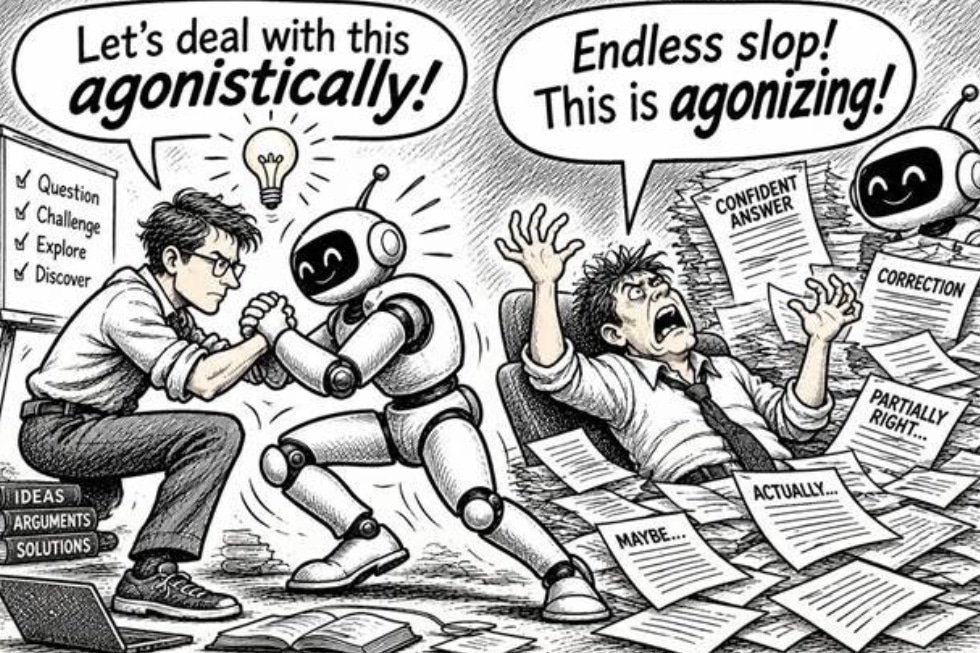



Despite recent bad press and an increasingly shaky economic outlook for AI, I’ve remained focused on what seems to me beyond doubt or serious criticism: the idea that working with an AI chatbot can be productive, profitable and enriching if done in the right way. Most reasonable people agree with that. Yet the central question remains surprisingly open: What, exactly, is the right way?
There’s been no lack of commentators reminding us that, whether for work or leisure, we tend to use AI the wrong way. And there happen to be several wrong ways. Perhaps the most common and laziest missteps is to ask direct factual questions and fall victim to hallucinations. Another is our inclination to anthropomorphize the interface, seeking emotional solace for loneliness. In terms of professional use, where the aim is increased productivity, blindly delegating tedious tasks risks creating cognitive dependency on an unaccountable subordinate.
Other examples of dysfunction exist. For example, the tendency to accept first-draft outputs without critical evaluation or iteration. This carries with it a possible contrary risk: a loss of focus and time wasted. This may also strip away the dynamic, exploratory nature of the conversation.
On the positive side, many of us have settled on a standard rule of thumb that I’ve repeatedly attempted to apply: treat the chatbot as a sparring partner, not an oracle. But that metaphor appears vague if you don’t know what kind of fight you’re preparing for. More to the point: Is it even a fight? I view the optimal method as an agonistic approach, where humans and AI engage in constructive struggle rather than combat.
Political theorist Samuel Chambers defines agonism in these terms:
“Agonism implies a deep respect and concern for the other; indeed, the Greek agon refers most directly to an athletic contest oriented not merely toward victory or defeat, but emphasizing the importance of the struggle itself—a struggle that cannot exist without the opponent.”
The dramatic outcome of last week’s US midterm elections led me to engage in a personal speculative exercise aiming at using agonistic logic to structure two important factors that take place in any effort at clarification or problem solving: perception and pattern recognition. The approach begins with exploratory intent and uses dialogue to construct an improved and more complete image of the issue addressed.
To illustrate the process, last Friday, I began with the following exploratory prompt that reflected some of the ideas I’ve seen circulating as the entire world seeks to make sense of US politics under President Donald Trump:
The 2026 US midterm elections took place three days ago. The shock was enormous and everyone is left wondering about what might happen next. Given the uncertainty surrounding so many issues and the even deeper confusion about how any of the problems we acknowledge can be addressed, guessing the future has never been more literally perilous. I use that adjective because among the credible scenarios are nuclear war, economic collapse and environmental catastrophe. What plays out will be a game of action and reaction, but there’s no way of determining who will be the first to initiate and what form the reaction — or rather chain of reactions — will take.
To simplify and focus only on decisions taken and orientations adopted inside the United States, what do you see as the most likely first move of President Donald Trump? Inebriated by victory, how do you see the Democrats rewriting their agenda and acting upon it?
I don’t expect that any scenario deserves more credit than another, but which ones seem coherent enough, in terms of political reasoning, to merit examining in detail?
I confess that my motivation in composing this text contained two dissimilar components. The first is my genuine curiosity and desire to get some idea of how people in the world are attempting to understand the forces at play that will define the future. I deliberately built into the prompt a level of complexity designed to challenge AI’s ability to respond.
The second was to test Claude’s ability to enter into the realm of what I’ll call “creative ambiguity,” a space in which gaps caused by incomplete information about facts, perception of facts and inference force our intelligence to take a step back and assess what cannot be known. My tentative conclusion: creative ambiguity is beyond Claude’s comfort zone.
Those interested in rhetorical strategy may have noticed that the prompt contained three separate questions at the end. This reflects the practice of what many television interviewers do, with a double objective: signify their own sense of the issue’s complexity and offer the interviewee a choice about which question to give priority to.
I certainly wasn’t expecting the response Claude gave me which appears in totality in the screen capture below, followed by my ensuing prompt.
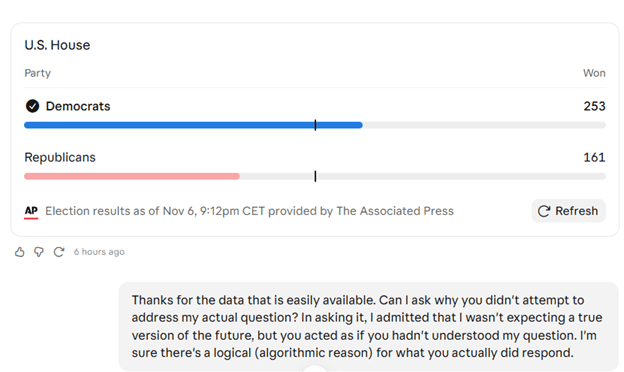
Claude’s response to this was even more surprising. Instead of addressing my request to explain why it had failed to respond to my original question, it avoided that question. Instead, it switched gears and offered a full response to the question it had previously evaded.
Here is a seriously abridged version of its lengthy response.
Where things stand. Multiple outlets report Democrats capturing both chambers, and CNN’s decision desk projected the flip of House and Senate. … I don’t know what Trump has said or done in the last three days, so what follows is structural reasoning, not reporting.
Trump’s first move
The useful question is where a president who has lost Congress can still act without it. The answer is the lame-duck window, which runs until the new Congress is seated in early January, and then the domains Congress barely constrains: personnel, foreign policy, trade, emergency powers, pardons, and impoundment…
I would rank the coherent first moves like this:
1. Purge and blame. A cabinet or agency shake-up combined with a narrative that the loss was caused by disloyal Republicans, bad candidates, or irregularities…
2. Executive maximalism in the lame-duck window. Appointments, rule-making, tariff actions, and emergency declarations done before oversight begins…
3. A foreign-policy gambit. This is the scenario closest to your list of perils. Foreign policy is where a weakened president faces the fewest institutional checks, and where a dramatic act can change the subject…
4. A transactional pivot. A deal with a Democratic House on something like cost of living…
The Democrats
I’d push back a little on “inebriated.” Their power is real but oddly shaped. Subpoenas, the purse, and Senate confirmations are meaningful. Legislation is not, because a veto stands behind everything…
1. Oversight as the main event. Investigations are cheap, popular with the base, and the only tools that bite immediately. This is the default.
2. The impeachment temptation. The base will demand it, and the House can do it. But conviction needs 67 votes, so it would be pure theater, and the 2019 precedent shows how it polarizes…
3. The affordability pivot. A narrow, populist cost-of-living agenda that gets passed in the House, fails in the Senate or at the veto, and becomes the 2028 platform…
4. Structural-reform maximalism. Court expansion, filibuster abolition, redistricting counter-escalation. This is the highest-variance path…
Underneath all of these is an intra-party struggle over leadership and ideology that victory postpones but doesn’t resolve.
Scenarios worth examining in detail
I’d pick three, because each isolates a different mechanism of escalation:
- Lame-duck executive maximalism meeting Democratic oversight in January.
- The fiscal standoff.
- The foreign-policy gambit with a Democratic Congress unable to restrain it.
Environmental catastrophe shows up differently. It’s less a scenario than a loser by default, since gridlock means executive rollbacks are the only policy that actually moves.
I continued the conversation with a new prompt that focused on an issue I was keen to explore, one that Claude hadn’t considered.
There are “sources” cited by people who have credible access to such anonymous sources that claim Trump is likely to resign, or is at least toying with the idea. One well-known commentator, James Carville, appears to believe in its likelihood and forecasts a date: the spring of 2027. What should we think of this and what new issues does such a scenario raise?
What the evidence is. Carville’s claim is well documented. He first set a deadline of March 17, 2027, then moved it to Easter, which falls on March 28. His stated reasons are frustration with midterm losses and boredom with being politically stymied, plus subpoenas and, in his telling, health deterioration. That is an inference from public behavior by a partisan with an incentive, not sourced reporting. I could not find any credible outlet reporting anonymous insiders who say Trump is considering resigning. The only sourced resignation reporting I found was about others. The Independent reported that Rubio and four or five other senior officials may leave after the midterms to pursue 2028 bids. If you’ve seen the anonymous-source claims, tell me where. I’d want to know whether they come from reporters with a track record or from the 2017 pattern, when unverifiable hearsay about a Trump resignation circulated and Snopes could not substantiate it.
How much weight to give it. I’d put it well under 10% by Easter. The structural reasons:
I’d treat the resignation forecast as a story that clarifies what each actor’s incentives are, not as a probable event. If you’re writing on it, the best angle may be how a prediction like this works as a market for attention: it’s unfalsifiable until the date, costless to repeat, and rewarded in the meantime.
Claude’s response, as usual, went into more reasoned detail, which I shall not reproduce here.
What this conversation reveals
As I argued above, I’m publishing this conversation to illustrate some of the features of agonistic dialogue.
To conclude, I’ll make three brief remarks, which I intend to develop in a follow-up article.
- Claude is perfectly capable of being just plain dumb, not knowing how to react or even think about what might be appropriate. The response to my first question is a flagrant case of infuriating cluelessness.
- Claude is capable of getting down to business, but only if pushed by the human interlocutor who understands agonistic logic.
- Claude has developed a patently artificial relationship with me that prevents the otherwise friendly chatbot from detecting or even being curious about my motivation. Because we often exchange about my work crafting articles, Claude assumes that my motivation is to milk the chatbot for data to put in an article and that its role is to provide information. Role switching is not its forte.
In short, Claude is not built for agonistic conversation and never really rises to the task. We can now speculate about whether a future version of Claude or any other LLM might not only develop an agonistic capability but also become sensitive to the clues that allow it to understand when the agonistic mode is appropriate.
The capacity to detect and adapt to shifts in conversational register is a topic I intend to explore in the near future. For the moment, I would say that it simply isn’t part of any LLM’s DNA. I tend to think that that layer of behavioral intelligence is beyond even the most sophisticated algorithmic logic. Take this as my contribution to the next spec for developers of superintelligence. Work on building register recognition and adaptive capacity if you really want us to believe in the future singularity.
Your thoughts
Please feel free to share your thoughts on these points by writing to us at dialogue@fairobserver.com. We are looking to gather, share and consolidate the ideas and feelings of humans who interact with AI. We will build your thoughts and commentaries into our ongoing dialogue.
[Artificial Intelligence has become a feature of everyone’s daily life. We unconsciously perceive it either as a friend or foe, a helper or destroyer. At Fair Observer, we see it as a tool of creativity, capable of revealing the complex relationship between humans and machines.]
[Lee Thompson-Kolar edited this piece.]
The views expressed in this article are the author’s own and do not necessarily reflect Fair Observer’s editorial policy.
Blue Wave, Green Tide: Politics in an Age of Liquidity
Election-night headlines reach for metaphors (waves, floods, flips) that dramatize change while hiding structure. Donald Trump is a symptom, not...

Going, Going, Gone! The President of Decline May Take the Planet Down with Him
US President Donald Trump has followed many American presidents by waging nigh-endless wars in the Middle East and Africa. Yet...
How to Stop Presidents, Like Trump, From Destroying America?
US President Donald Trump has initiated two unprovoked wars against Iran, one in June 2025 and another in February 2026....

Even Under Trump, AI Governance Is Here to Stay
While many worry that the Trump administration will loosen AI regulation, federal policy is just one part of AI governance....

The Party’s Over, But the Democrats Are Dying for a Last Drink
Unless he is impeached, Donald Trump will continue to define the essence of today’s Republican Party, but who will define...
Support Fair Observer
We rely on your support for our independence, diversity and quality.
For more than 10 years, Fair Observer has been free, fair and independent. No billionaire owns us, no advertisers control us. We are a reader-supported nonprofit. Unlike many other publications, we keep our content free for readers regardless of where they live or whether they can afford to pay. We have no paywalls and no ads.
In the post-truth era of fake news, echo chambers and filter bubbles, we publish a plurality of perspectives from around the world. Anyone can publish with us, but everyone goes through a rigorous editorial process. So, you get fact-checked, well-reasoned content instead of noise.
We publish 3,000+ voices from 90+ countries. We also conduct education and training programs
on subjects ranging from digital media and journalism to writing and critical thinking. This
doesn’t come cheap. Servers, editors, trainers and web developers cost
money.
Please consider supporting us on a regular basis as a recurring donor or a
sustaining member.
Will you support FO’s journalism?
We rely on your support for our independence, diversity and quality.




Comment