

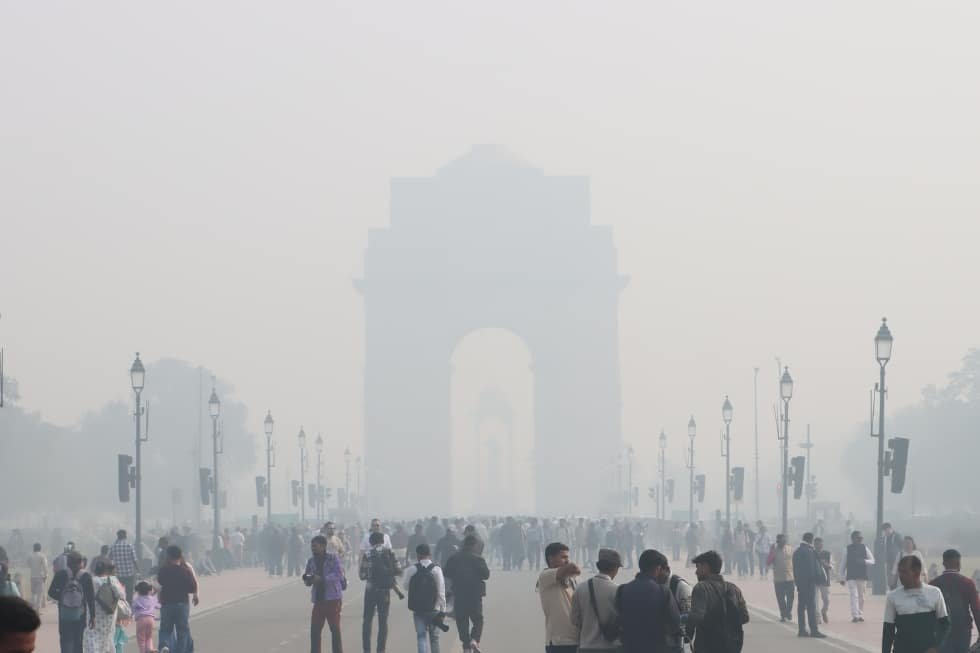



When I flew into Delhi in late October, the setting was strangely pleasant. First, it was raining; the city seemed to be experiencing the remnants of Cyclone Arnab, which had recently hit India’s east coast. And because of the rain, the air was relatively clean; the Air Quality Index (AQI) was hovering around 200. But — like when you climb into the ride cart at the Fun Fair — you know the happy, placid beginning is too good to last.
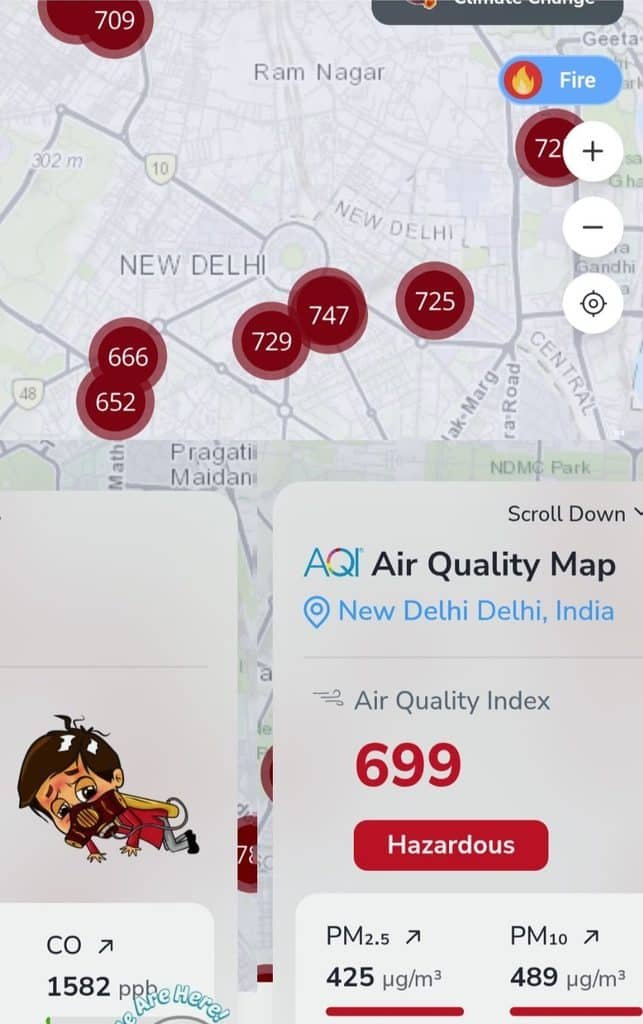
Sure enough, today, the ride began, and we entered the tunnel of doom; I woke up to an AQI of over 500. My phone labeled it as “hazardous.” The World Health Organization (WHO) considers a PM2.5 (particulate matter with a diameter of 2.5 micrometers or smaller) concentration above 15 µg/m³ (micrograms per cubic meter) as unsafe; the Delhi reading was 425 µg/m³. Our PM10 (particulate matter with a diameter of 10 micrometers or smaller) reading of 489 was more than ten times the WHO’s recommended level of 45 µg/m³.
Causes
This dramatic deterioration in air quality happens each year — usually beginning in late October and continuing to the end of January. Sandwiched between Autumn and Spring, this has become Delhi’s Air Pollution season.
There are two main contributing causes. The first is the emissions from Delhi’s roughly 8.7 million motor vehicles (a nearly 8% increase from the previous year), which are said to be the single largest contributor to its air pollution, accounting for over half of local PM2.5 emissions. The second contributor is farmers burning the crop residue off their fields after harvest and before replanting. Much of Delhi’s air pollution comes from stubble-burning in Punjab, as well as some from Haryana.
And of course, Diwali falls at this time of year. It’s a festival as important to Hindus as Christmas is to Christians or Eid al-Adha to Muslims. An integral part of Diwali is bursting firecrackers. Over the past decade, this practice has drastically reduced, largely due to widespread, intensive campaigns in schools. Beginning in 2025, the Supreme Court instituted a year-round ban on firecrackers. However, in light of Diwali coming this weekend, the court has now lifted the ban for two days and allowed the bursting of certified green crackers (low-polluting, quieter, eco-friendly fireworks). As a result, given this difficult-to-monitor loophole, vast quantities of non-green crackers are being discreetly made and sold.
While all these activities cause pollution, the yearly phenomenon of thermal inversion acts like a physical lid that traps pollutants close to the ground, preventing them from dispersing. The warm layer of air on top traps the cold polluted layer below and creates a “gas chamber” effect. And Delhi being landlocked and having very little wind allows this effect to persist for days or even months. One year, after Diwali, I returned from a 3-hour walking tour of Old Delhi to find the AQI showing 999; this was because the meter had only 3 digits.
Impact
Some analysts liken breathing Delhi’s air to smoking half a packet of cigarettes a day.
The health impact can be both immediate and long-term. One can experience immediate minor symptoms such as burning eyes and throat irritation. Children, seniors, and anyone with pre-existing asthma or heart conditions can have breathing difficulties and coughing. Prolonged exposure can cause a rise in blood pressure, chronic tension headaches, skin irritations, dry eyes and eye diseases. Longer term, air pollution can be a risk factor for major diseases — such as cardiovascular inflammation and attacks, strokes, chronic obstructive pulmonary disease, asthma and cancer — as well as worsen existing illnesses.
Recent studies estimate 10,000 premature deaths each year in Delhi alone due to air pollution.
Actions
Unfortunately, action is impossible against the thermal inversion that happens at this time each year in Delhi. But action against pollution sources like vehicles, fire crackers, and stubble-burning is possible.
In previous years, the Delhi government waited until air quality became really bad to take action. But this year, starting November 1, they implemented several pre-emptive measures: They’ve restricted the entry of certain vehicles (old vehicles or those that did not pass emission tests) into the city; they’ve stipulated reduced office attendance — with the Delhi government and private offices limiting physical attendance to 50%; they’ve increased parking charges; fuel will only be sold to vehicles with valid pollution certificates; and they’ve curbed dust-generating construction activities.
But they also need to hand out free masks to the millions traversing and living on the streets, and offer free acute health care for respiratory ailments, at least during pollution season. In the longer term, they need to vastly improve and expand mass transport and shift to e-vehicles.
The temporary lifting of the firecrackers ban for Diwali may be seen as culturally sensitive and momentarily festive — but it will be cruel health-wise. For the sake of the population at large, the government needs to take a hard and permanent stance on this activity.
Since 1981, stubble-burning has been illegal. Over the past decade, the central government has taken a multipronged, carrots-and-sticks (rewards and punishment) approach to reduce stubble burning and encourage more climate-friendly management of agricultural residue. They are offering farmers subsidies to buy machinery to remove stubble, access to rent such machines and a bio-decomposer to spray onto and eliminate stubble. The government is offering to buy stubble from farmers to generate compressed biogas (Bio-CNG) and biomass pellets. They are also monitoring farm fires via satellites and drones to catch and penalize violators.
But the fires continue and more needs to be done. Many smaller farmers still cannot afford to buy the relevant machinery or manage the narrow time window to rent equipment, and are forced to resort to stubble-burning — which they often do at night to minimize detection.
Prayers
Whether these measures will be sufficient remains to be seen. In the meantime, I’ll implement some measures of my own. Since, temperature-wise, this is the perfect time of year, I have been eating my meals outside on the patio; this is something I will no longer be doing. Instead of taking my daily walk outside, I’ll do my exercises within the house. I’ll keep all my doors and windows closed. Inside the house, I’ll run the air purifier in my study during the day and in my bedroom at night. When I go out, I’ll ensure the air purifier in my car is on. When I step out of the car, I’ll ensure my mask is on.
And for the millions of others in this city of over 30 million people, I’ll pray that they make it through yet another dangerous Air Pollution Season with minimal damage and come out alive at the other end of our tunnel of doom.
[Kaitlyn Diana edited this piece.]
The views expressed in this article are the author’s own and do not necessarily reflect Fair Observer’s editorial policy.
Air Quality Sensors Overestimate Industrial Pollution in the Gulf Coast
A five-month audit near the Louisiana Industrial Corridor finds that low-cost Air Quality Index (AQI) sensors exhibit a systematic bias...
We Can’t Ignore the Human Toll of Climate Change
In July 2023, the Earth hit its highest recorded temperature, highlighting the urgent impacts of climate change. Rising temperatures and...


Support Fair Observer
We rely on your support for our independence, diversity and quality.
For more than 10 years, Fair Observer has been free, fair and independent. No billionaire owns us, no advertisers control us. We are a reader-supported nonprofit. Unlike many other publications, we keep our content free for readers regardless of where they live or whether they can afford to pay. We have no paywalls and no ads.
In the post-truth era of fake news, echo chambers and filter bubbles, we publish a plurality of perspectives from around the world. Anyone can publish with us, but everyone goes through a rigorous editorial process. So, you get fact-checked, well-reasoned content instead of noise.
We publish 3,000+ voices from 90+ countries. We also conduct education and training programs
on subjects ranging from digital media and journalism to writing and critical thinking. This
doesn’t come cheap. Servers, editors, trainers and web developers cost
money.
Please consider supporting us on a regular basis as a recurring donor or a
sustaining member.
Will you support FO’s journalism?
We rely on your support for our independence, diversity and quality.




Comment